8_TSH Hearing Impairment and Hearing Aids
Learning Outcomes
At the end of this lecture, the learner will be able to:
Explain auditory localisation.
Describe measurement of hearing function, audiometry.
Define dB Hearing Level.
Differentiate between air-conduction & bone-conduction audiograms.
Distinguish between neural hearing-loss & conductive hearing-loss.
Discuss hearing aids.
Auditory Localisation
Definition - Auditory localisation is a fundamental ability that allows to perceive the spatial location of a sound source in the environment.
Localising sound requires the use of both monaural and binaural cues
Monaural - one ear, which primarily relies on the intensity and frequency of sound waves reaching that ear, helping to identify the direction of sounds when binaural cues are not available.
Binaural - two ears, allowing for the comparison of sound signals received by each ear to determine the direction of the sound source.
Interaural Time Differences (ITD)
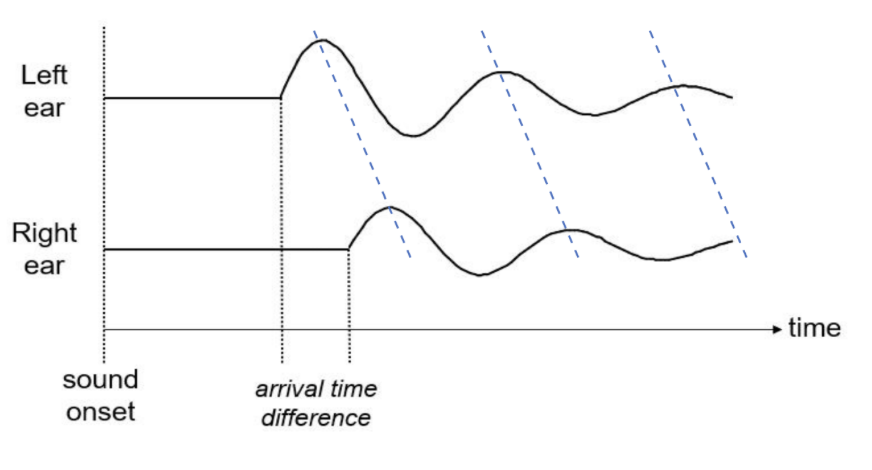
The slight difference in the time it takes for a sound to reach each ear, which is crucial for localising sounds that are directly in front or behind the listener. This mechanism allows the brain to interpret the direction of the sound based on which ear hears it first.
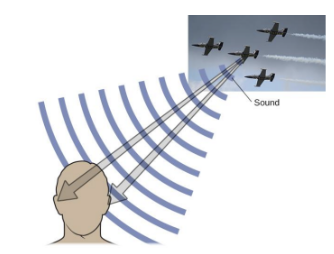
This photo illustrates the concept of ITD.
The sound waves are at different phases when they reach the two ears. as seen below
Interaural Level Differences (ILD)
Another method of sound localisation that depends on the positioning of the head to the origin of the sound wave.
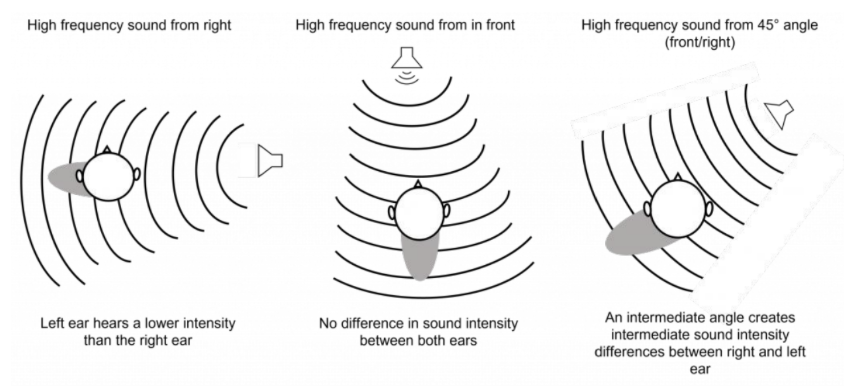
If the head is positioned directly in-front of the origin, both ears will hear the sound at approximately the same intensity.
Although, if one ear is turned towards the source of the sound, the ear closer to the sound will perceive it as louder due to the sound shadow created by the head, allowing the brain to determine the direction of the sound.
If the head is tilted or turned at various angles, the brain can further process differences in timing and intensity between the ears, refining its ability to pinpoint the sound source accurately.
Acoustic Shadow - When the head blocks some of the sound waves, resulting in a difference in intensity between the ears.
Frequency Dependence of Auditory Localisation
ITD and ILD effectiveness varies by frequency:
Below 1000 Hz: There is no ILD due to the small size of the head relative to sound wavelength and there is no acoustic shadow
Above 4000 Hz: ITD becomes ineffective as phase differences blur and become hard to differentiate
*Both ITD and ILD allow us to detect the direction in which the source of sound came from*
Pinna Direction Filtering
The direction in which the sound wave enters the pinna, from above or below for example, is important for the perception of sound localisation.
Depending on where the sound hits thee pinna, the sound amplifies differently within the auditor canal
Allows us to identify the elevation of the sound source
Audiometry
Definition - Measurement of the range and sensitivity of a person's sense of hearing.
Hearing function and hearing loss are both measured dBHL (decibel hearing level) using an audiometer, producing an audiogram.
Audiometer - A device used to evaluate hearing sensitivity by presenting sounds at various frequencies and intensities, allowing for the assessment of an individual's hearing capabilities.
Audiogram - A graphical representation of the results obtained from an audiometer, showing the softest sounds a person can hear at different frequencies, which helps in diagnosing the type and degree of hearing loss.
Audiometry Procedure
Patient wears headphones that are connected to the audiometer while a series of fixed frequencies are presented at varying intensities.
Step 1 - A pure tone signal is presented to the patient through the headphones, and the intensity is first at 0 but steadily increases unlit the patient hears sound at which they will raise their hand.
This determines the patients threshold of audibility, which is the lowest volume at which they can detect sound at each frequency tested.
Step 2 - The frequency is changed and the procedure is repeated until a wide range of frequencies have been covered.
This is because different frequencies have different levels of “phons”
Step 3 - All of the data is recorded on the audiogram
Audiogram
The audiogram visually represents the hearing thresholds of an individual across various frequencies, allowing audiologists to assess the degree and type of hearing impairment.
Y axis - Hearing level (dB) and it is upside down
X axis - Frequency (Hz)
-Sounds of the same dBHL are perceived as having the same loudness for a normal hearing person.
-The threshold of audibility is mapped to dBHL
-The louder the tone needed to be played to be heared
Audiogram symbols represent air conduction and hearing loss.
Audiogram Example
Shows the results of a patient with normal hearing and a patient with hearing loss.
Normal Hearing - The line on the graph is located within the normal range, typically between 0 to 20 dB, indicating that the individual can hear sounds at these levels without difficulty.
Hearing loss - The line on the graph is positioned below the normal range, indicating varying degrees of hearing impairment based on the specific dB levels recorded.
Hearing Impairment
Definition - Refers to the partial or total inability to hear sounds in one or both ears, which can affect communication and quality of life.
Causes of Hearing Impairment
Hearing loss may arise from conductive path issues (outer/middle ear) or sensorineural issues (inner ear/cochlea).
Conductive Hearing Loss
Conductive Hearing loss is the result of any obstruction in the outer or middle ear that prevents sound from being conducted to the inner ear, which can be caused by factors such as earwax buildup, fluid in the middle ear, or malformations of the ear structure.
Caused by disorders preventing sound transmission to the inner ear.
Symptoms include faint or distorted sound perception.
Testing Conductive hearing loss - uses the air conduction route, using over the ear headphones to deliver sounds at various frequencies and intensities to assess the patient's ability to hear.
Common Causes of Conductive Hearing Loss
Causes include:
Ear infections
Wax build-up
Foreign objects
Fluid in middle ear
Eardrum damage
Ossicle dislocation
Unusual growths or tumors
Bone Conduction
Definition - The ossicles are three small bones in the middle ear that help transmit sound vibrations from the eardrum to the inner ear; dislocation of these bones can lead to significant hearing loss.
Examples of Bone Conduction
A large portion of the sound produced by the larynx is transmitted to the cochlea via bone conduction.
This is why recordings of your voice sound different than your voice as you speak.
Bone conduction headphones vibrate the ossicles
This technology allows sound to bypass the outer and middle ear, directly stimulating the cochlea, making it a valuable option for individuals with hearing impairments. .
Sensorineural Hearing Loss
Testing:
Air conduction doesn’t work for this kind of hearing loss
The hearing loss is a result of problems along the conducive path in the ear
Small neural transducers are placed on the bone behind the ears (temporal) that transmit sounds directly to the cochlea, by-passing the outer and inner ear route.
Bone conduction audiograms are thus used to test neural hearing loss
Important Distinctions
Hearing loss can be either conducive or sensorineural.
The reason both tests are necessary is that they help differentiate the type of hearing loss, guiding appropriate treatment options.
Importance of both tests to identify the hearing loss source.
Audiogram Markers
Different symbols used for air conduction and bone conduction on audiograms.
Different marker symbols are used to depict air conduction (x,o) or bone conduction ([,] or <,>) on the audiogram.
Sensorineural Hearing Loss: Presbycusis
Aging process leads to presbycusis, most common cause of sensorineural hearing loss.
As we age, inner ear nerves and sensory cells gradually die.
Affects high frequencies more than low frequencies.
Other Causes of Sensorineural Hearing Loss
Causes include:
Injuries
Noise exposure
Viral infections
Ototoxic drugs
Meningitis, stroke, high fever
Acoustic tumors, heredity, diabetes
Notch Defect in 9-Year Old
“Notch” = over a narrow frequency range
A child with a Notch defect may experience difficulty in hearing certain frequencies, which can affect their speech perception and overall communication skills.
Mixed Hearing Loss
Occurs when hearing loss involves both conductive and sensorineural components.
Auditory Test Symbols
Circle for air conduction; triangle for bone conduction representation.
Conductive loss - O is in hearing loss range
Sensorineural loss - X and O gradually go down the graph; on top of each other.
Mixed loss - Both X and O are in the hearing loss range but they are not on top of each other
Hearing Aids
Definition - A hearing aid is a small electronic device that amplifies sound, designed to improve hearing for individuals with hearing loss. These devices can be customized to fit the specific needs of the user and are available in various styles and technologies.
Indications for Hearing Aids
Hearing aids are recommended for individuals who experience difficulty hearing in various environments, such as conversations, group settings, or while watching television.
Conversation is typically at 60 dB and in the 100-3000Hz range
Hearing aids needed when >55 dBHL loss is identified, primarily in the 100-3000 Hz range.
designing the hearing aids must be done with care because the threshold of pain for the patients are the same as the normal threshold (120-130dB)
The patients can reach the threshold faster
Digital electronics allow frequency responses to be tailored for the individual and their needs.
Hearing Aid Types
In-ear monitors & Over ear monitors
They both deliver sound via the ear canal, and act as an amplifyer
Surgical Implants
Surgical implants such as bone anchored hearing aids bypass the ear canal and middle ear.
Methods like bone anchored hearing aids and cochlear implants bypass damaged structures in the ear.
Cochlear implants also bypass the hair cells and directly stimulate the auditory nerve.
Personalisation of Hearing Aids
Digital technology allows for tailored frequency response to individual needs. Unlike analog hearing aids which are less specified to the patient.