The Director and the Producer – Comprehensive Study Notes
ROLES OVERVIEW
Two central leadership positions in any stage production:
Director
Creative head of the stage work.
Shapes the artistic, visual, and rhythmic life of the performance.
Producer / Manager
Business head of the enterprise.
Secures money, rights, personnel, space, publicity, and long-term solvency.
Additional key collaborators the director must coordinate with:
Playwright (if alive / available)
Designers (scenery, costumes, lights, sound, props, makeup, hair)
Dramaturg (where budget allows)
Stage manager and full backstage crews
THE TRADITIONAL DIRECTOR
Conventional (“text-based”) theatre begins with the written text / script.
Playwright (= dramatist) supplies the foundational expression of the human condition.
Traditional director’s first macro-decisions:
Select which script to stage.
Isolate the play’s spine (inner action / motivational through-line that drives every event).
Determine overall style (realism, expressionism, heightened theatricality, etc.).
Formulate a unifying directorial or production concept.
Training pathways:
Many rise from acting backgrounds (learning theatre organically from inside rehearsal hall).
Others study directing in universities / conservatories.
DIRECTOR & THE SCRIPT
In a licensed, published play:
Words treated as sacred; script cannot be changed without permission.
Playwright (or estate) earns royalties.
Unique feature of theatre: reverence for the dramatist’s exact language—especially for deceased authors.
In an unlicensed / public-domain script:
Text can be cut, reordered, or rewritten.
Classic authors (e.g.
Shakespeare) often subject to radical concepts—sometimes clarifying, sometimes detrimental.
THE DIRECTORIAL CONCEPT
Definition: A clear, overarching idea or metaphor that aligns every design and performance choice with the playwright’s story.
Functions:
Keeps designers and actors moving in the same direction.
Prevents contradictory elements that might pull spectators out of the narrative.
Variability:
Different plays → different concepts.
Same play → multiple valid concepts across separate productions.
Example: Lorraine Hansberry’s "A Raisin in the Sun"
Concept & Period (Realism, Chicago)
Goal: reproduce poverty-level South-Side apartment with absolute historic accuracy.
All stage elements (sets, clothes, props, music) restricted to .
Texture: worn, faded, but not dirty—reflects matriarch Lena’s pride.
Violations (e.g., contemporary rap music) would jar the audience out of the period truth.
Concept & Central Image (The Apartment = The Family)
Dingy, cramped flat embodies the Younger family’s own fatigue.
Mama’s plant = living metaphor.
Sickly indoors → potential to thrive in sunlight of new home.
Encapsulates play’s optimistic ending.
Concept & Purpose (Social Change)
Illuminate the ills of racism, segregation, and patriarchal limits.
Desired outcome: shift attitudes, inspire pursuit of equity.
EVOLUTION OF THE DIRECTOR
George II, Duke of Saxe-Meiningen ()
Widely credited as first to occupy the dedicated job title "director."
Championed unified ensemble acting and historically accurate crowd scenes.
Earlier eras: playwright-actors self-directed.
Aeschylus (Greek, )
William Shakespeare (English, )
Molière (French, )
THE DRAMATURG (LITERARY MANAGER)
Luxury position present mostly in larger or well-funded theatres.
Typical duties:
Scout promising new works & foster playwright development.
Curate significant plays from the past for revival.
Generate educational materials for teachers / audience outreach.
Write program essays; compile historical criticism.
Note: The referenced department lacks a staff dramaturg, so directors & faculty absorb these tasks.
AUTEUR & POSTMODERN DIRECTORS
Auteur approach:
Director assumes total authority over all production facets.
Script is raw material to reshape, even override playwright’s intent.
Postmodern hallmarks:
Deconstruction of text—questioning accepted meanings.
Rejection of linear storytelling; fragmented or collage structures.
Unfamiliar casting (cross-gender, multicultural, unexpected racial dynamics).
DIRECTOR & PRODUCTION ELEMENTS
Oversees physical production:
Costumes, makeup, hair
Scenery & properties (props)
Lighting
Sound design / music
Casting (auditions)
Match roles to performer personalities & physical traits.
Typecasting: Actor matches role’s observable characteristics (e.g., as a bodyguard).
Casting against type: Actor opposite expected image (e.g., Johnson as shy librarian) → often comic or satirical.
Rehearsals
Director & stage manager co-run room logistics.
Blocking: Designer of all movement and stage positions.
Acts as audience’s surrogate eye, refining stage pictures and actor focus.
Controls movement, pace, rhythm within scenes and across act structure; cultivates performers’ inner tempo.
Technical & Dress Rehearsals
Occur after weeks of scene work; integrate every technical department.
Tasks:
Establish cues for scenery, lights, and sound.
Choreograph precise scene shifts (what moves where, by whom, in what sequence).
Freeze lighting looks: color palettes, intensity, transition speed.
Set sound levels and timings; rehearse exact delivery of effects.
Dress rehearsal: first full run with actual costumes, makeup, hair under show lights; actors practice quick changes.
Outcome: holistic preview for entire team of the finished stage picture.
Preview Performances (Try-outs)
Public audiences admitted (often at reduced prices).
Final ingredient—the spectator—tests pacing, jokes, dramatic build.
Company gauges which beats land, which moments need recalibration.
DIRECTOR: POWER & RESPONSIBILITY
Charged with weaving texts, performances, and designs into a coherent whole that can:
Enlighten, move, amuse, entertain, or challenge.
Must simultaneously satisfy artists, producers, critics, and audiences.
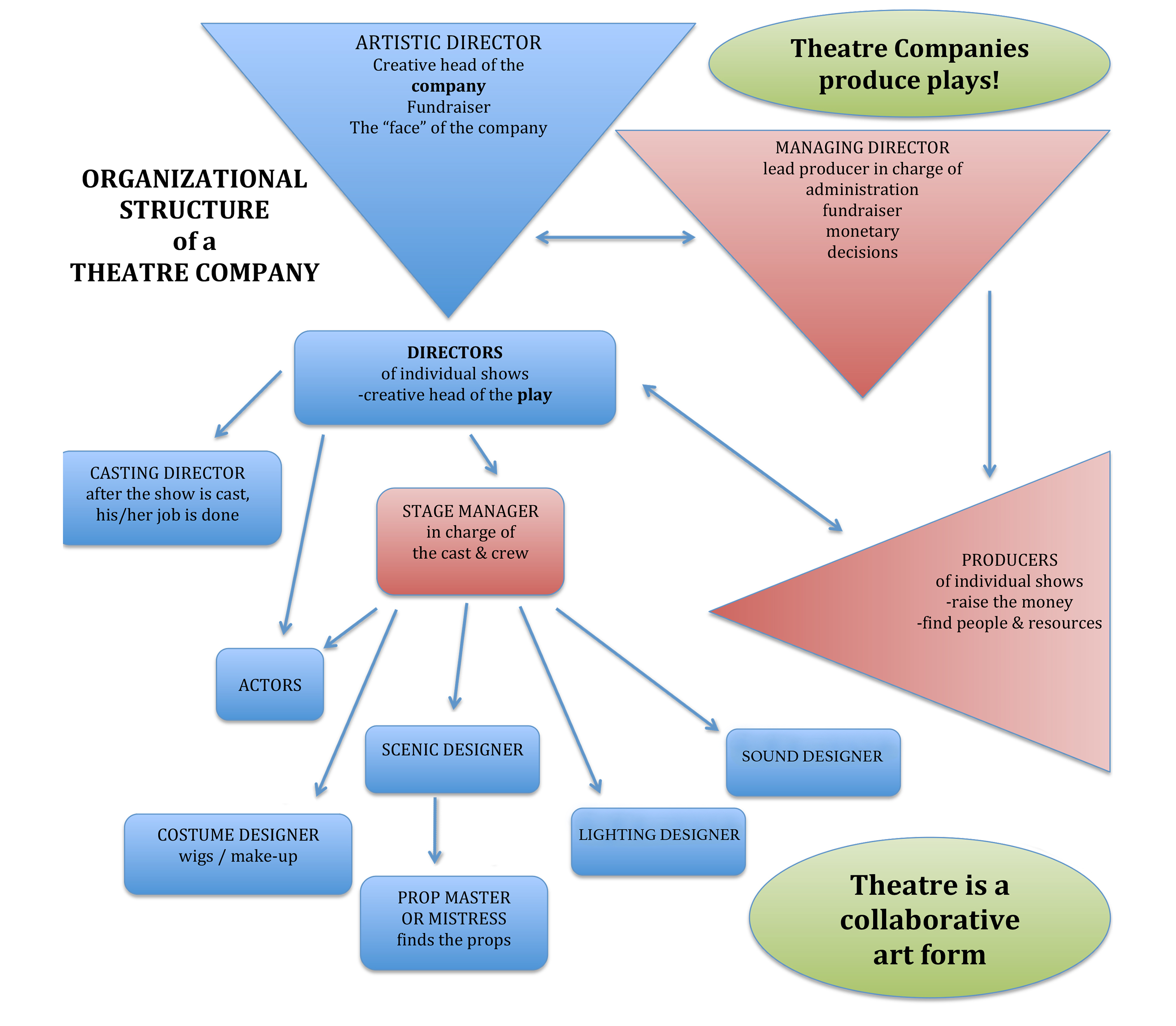
Works laterally with many departments (see chart reference):
Designers, dramaturgy, stage management, performers, publicity, etc.
THE PRODUCER (COMMERCIAL CONTEXT)
Financial & administrative nexus behind the scenes.
Core duties:
Raise capital.
Secure rights to scripts.
Negotiate with agents for playwright, director, and actors.
Hire all major creatives and crews.
Interface with unions.
Rent theatre venue.
Supervise box office, audience services, and facility operations.
Oversee marketing / advertising.
Manage budgets and weekly financial health.
Organizational charts place producer at the top, reflecting overarching jurisdiction.
THE PRODUCER (NON-COMMERCIAL / NON-PROFIT)
Often titled executive director or managing director.
Responsibilities tilt toward sustaining the institution:
Building maintenance.
Season-long budgeting.
Marketing & publicity.
"Front-of-house" services: ticketing, programs, ushers, concessions.
COMPLETING THE PICTURE – INTERDEPENDENCE
Playwrights craft the intellectual skeleton (words + ideas).
Designers paint the sensory environment (sights & sounds).
Performers inject breath and motion—the living flesh.
Directors synchronize all artistic limbs into a single organism.
Producers / Managers keep the organism financially nourished and publicly visible.
"A stage production succeeds only when every spoke of the wheel turns together—business and art in balanced rotation."