Mitochondria
Key Terms
Reduction: Addition of an electron (e⁻).
Oxidation: Removal of an electron (e⁻).
Outer Membrane - Barrier containing porins for the exchange on ions and small molecules
Cristea - Highly folded inner lipid bilayer membrane, with increased permeability to ions, site of the electron transport chain + ATP synthesis
Matrix - The inner fluid filled space, containing enzymes, mitochondrial DNA and ribosomes.
Cardiolipin - Increases inner membrane impermeability and stability.
Mitochondria Basics
First discovered in the 19th century.
Size
Cylinders
Diameter - 0.5 – 1 µm
Length - 7 µm
Nature
They can change shape
move around the cell
fuse together and separate again
Travel on microtubules
Abundance
Depends on the energy requirements of the cell
Average Cell - 200
Liver Cell - 1000,2000
Skeletal muscle - 4000
Adipocytes & Skin - few
Structure
Double membrane structure
Outer Membrane - Barrier containing porins for the exchange on ions and small molecules
Cristea - Highly folded inner lipid bilayer membrane, with increased permeability to ions, site of the electron transport chain + ATP synthesis
Contains Cardiolipin which further Increases inner membrane impermeability.
Matrix - The inner fluid filled space, containing enzymes, mitochondrial DNA and ribosomes.
Site of the Krebs Cycle
Enzymes that metabolize pyruvate and fatty acids to produce acetyl CoA.
Redox Reactions
OIL RIG
Reduction: Addition of an electron (e⁻).
Oxidation: Removal of an electron (e⁻).
HYDROGEN = ELECTRON +PROTON
H = e⁻ + H⁺
Key Redox Reactions
FAD + 2H → FADH₂
NAD⁺ + 2H → NADH + H⁺.
Be careful with proton involvement:
Protons (H⁺) neither reduce nor oxidize.
Glucose Metabolism
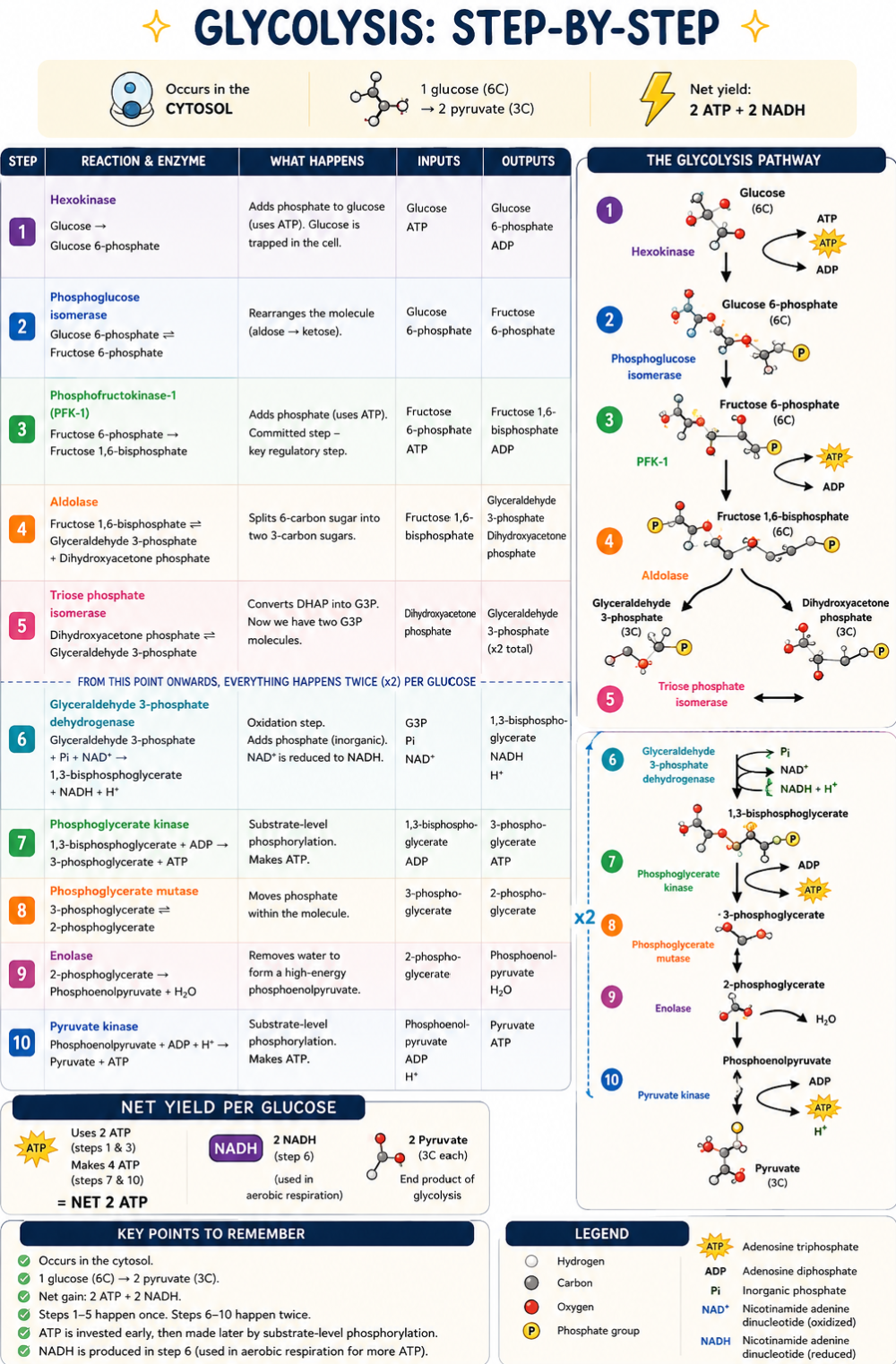
Glycolysis - This is the process of oxidising Glucose into Pyruvate.
Occurs in the cytosol
Net production under aerobic conditions.
2 ATP
2 Pyruvate
2 NADH
Start with glucose, from diets which we use to produce energy
Glycolysis - net production of 2 ATP, it is not very efficient
Citric Acid Cycle
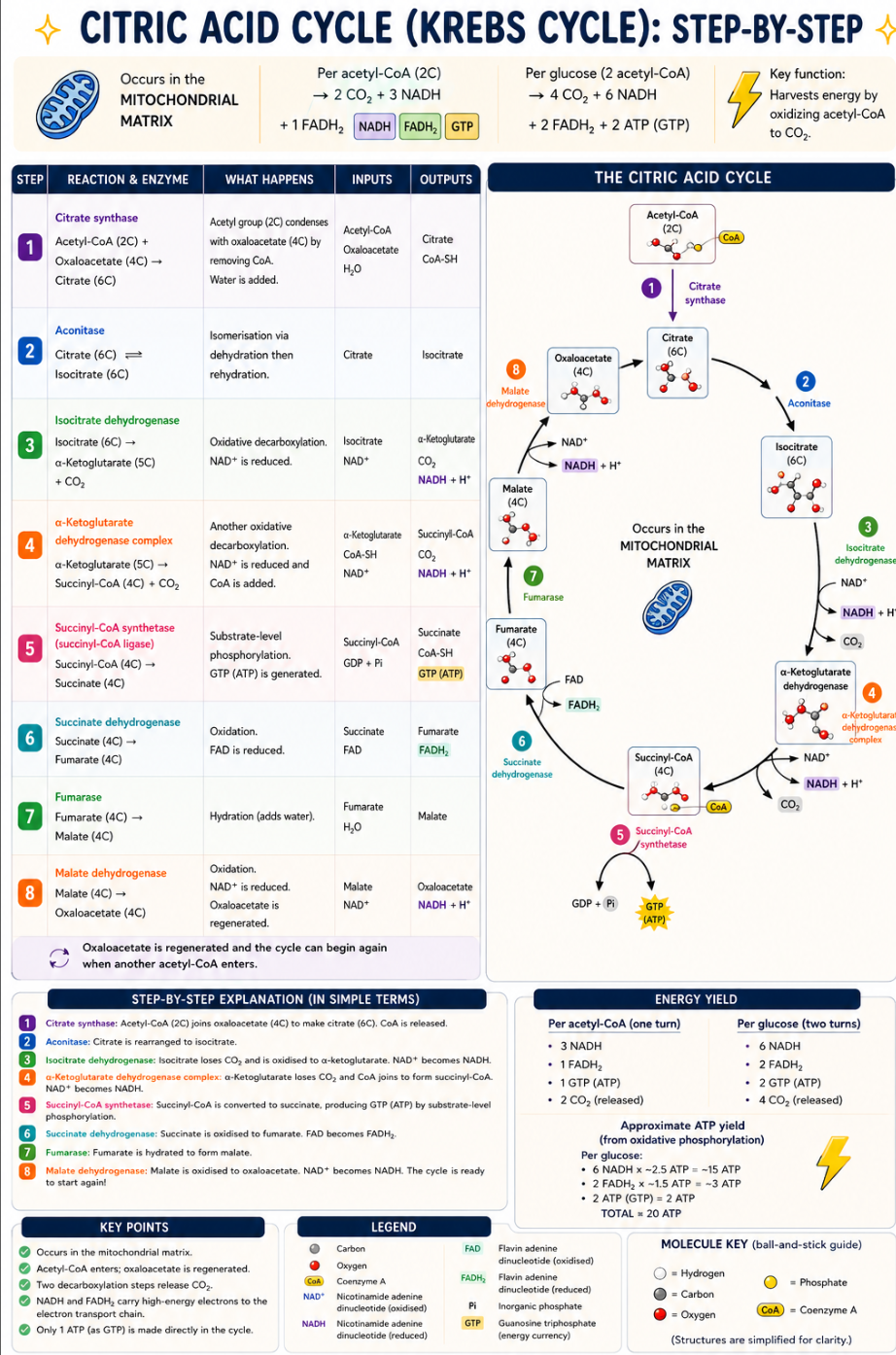
The citric acid cycle occurs in the mitochondrial matrix
Produces reduced electron carriers (e.g., NADH) for the electron transport chain.
Inputs come from food, which is broken down in digestion
these are then converted into NADH and FADH 2 these have a lot of energy in them from their electrons.
the energy from food is in the electron
this energy is then transferred into ATP.
Electron Transport Chain
Where it happens
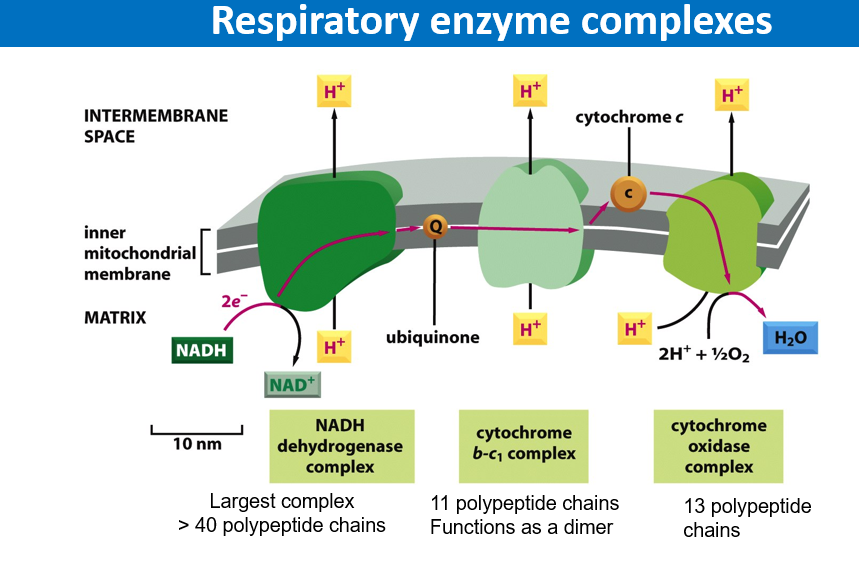
Inner mitochondrial membrane
Proteins are arranged in a line
What the ETC actually does
Take the energy from NADH & FADH₂ and convert it into ATP without wasting any.
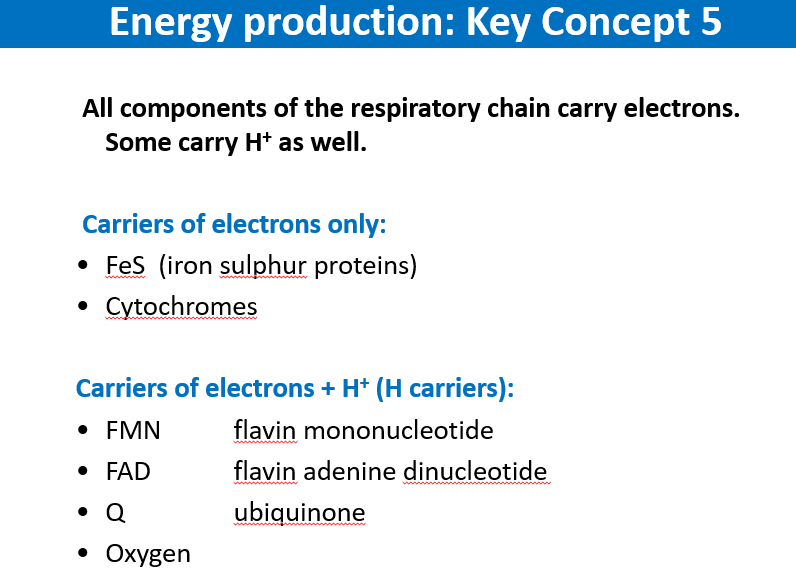
It does this by passing electrons through a series of proteins that perform redox reactions.
Complex I — NADH Dehydrogenase
Accepts electrons from NADH
Pumps H⁺ into intermembrane space
Passes electrons to CoQ (ubiquinone)
Complex II — Succinate Dehydrogenase
Accepts electrons from FADH₂
Does NOT pump H⁺
Also passes electrons to CoQ
Complex III — Cytochrome b‑c₁
Accepts electrons from CoQ (Ubiquinone)
Pumps H⁺
Passes electrons to cytochrome c
Complex IV — Cytochrome Oxidase
Accepts electrons from cytochrome c
Pumps H⁺
Transfers electrons to O₂ → forming H₂O
Oxygen is the final electron acceptor.
Without oxygen, the chain stops.
ATP Synthase
How it works:
ATP synthase utilizes the proton gradient created by the electron transport chain to synthesize ATP. The potential energy stored in the proton gradient is used to drive ATP synthesis.
Structure:
ATP synthase is a multi-subunit protein complex with a mass of over 500,000 Da responsible for catalyzing the formation of ATP from ADP and inorganic phosphate (Pi).
Efficiency
Overall Reaction:
Glucose + O₂ → CO₂ + H₂O + 686 kcal/mol.
The synthesis of ATP from ADP + Pi releases 7.3 kcal/mol.
ATP Output: In respiration, 1 glucose yields 38 ATP molecules.
Energy Calculation:
Energy from glucose = 38 × 7.3 kcal/mol = 277 kcal/mol.
Efficiency = 277 / 686 = 40%. (Remainder lost as heat.)
Mitochondrial uncoupling proteins (UCPs)
UCPs - transport proteins present in the inner mitochondrial membrane found in mammals and plants.
Function: They allow for energy from substrate oxidation to dissipate as heat rather than being captured as ATP.
Prioritization in Energy Usage
Priority:
Heat generation over energy conservation.
Mitochondrial membrane can be proton-leaky or non-leaky, affecting respiration and ATP production.
Types:
Uncoupled (reduced ATP synthesis) versus well-coupled systems (efficient ATP synthesis).
This mechanism is crucial in thermogenic cells like brown adipocytes, which help maintain body temperature.