Consonants and their phonetic phenomena
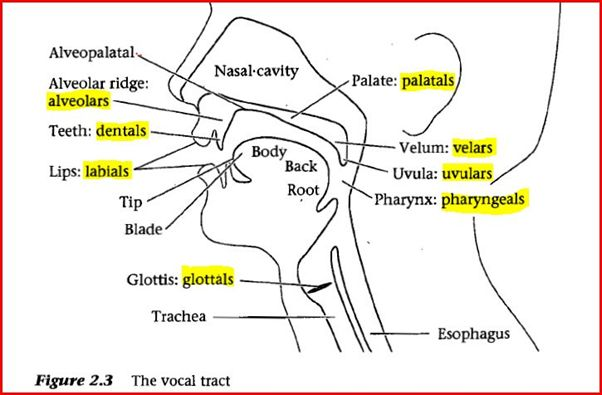
Speech organs
Speech chain
Production
- psycholinguistic - formulation of a concept in the brain
- articulatory - the message form our brain is sent to the speech organs
- acoustic - the sound of speech itself
Reception
- sound is received by the ear
- information is transmitted to the brain
- interpretation of the message in the brain
Types of consonants by features
Place of articulation
bilabial :: m, p, b, ^^Made with the two lips.^^
labiodental :: f, v ^^Lower lip and upper front teeth^^
dental :: θ, ð ^^Tongue tip or blade and upper front teeth.^^
alveolar :: n, t, d, s, z, l ^^Tongue tip or blade and the alveolar^^ ^^ridge^^
post-alveolar/palato-alveolar :: tʃ, dʒ, ʃ, ʒ, r ^^Tongue blade^^ ^^and the back of the alveolar ridge^^
palatal :: j ^^Front of the tongue and hard palate^^
velar :: ŋ, k, ɡ, w ^^Back of the tongue and soft palate^^
glottal :: h
Manner of articulation
obstruents :: there are obstructions between the speech organs, the sound is shorter, if you try to stretch the pronunciation, you will get different sound (dyyyyyyy)
sonorants :: the airflow is not obstructed by anything, the sound are longer and continuous - all vowels, nasals and approximants
plosive/stop :: p, b, t, d, k, ɡ ^^a complete closure of the speech organs with an explosive release of air^^
affricative :: tʃ, dʒ ^^first part of the sound is plosive, second part is fricative^^
nasal :: m, n, ŋ ^^soft palate lowers and allows air to go through the nose, otherwise there are closures in the mouth^^
fricative :: f, v, θ, ð, s, z, ʃ, ʒ, h ^^speech organs move so close that the outcoming air causes friction between them^^
approximant :: l, r, j, w ^^narrowing between speech organs, but not narrow enough to cause friction^^
phenomena
aspiration::
short puff of air after pronoucing:
- voiceless stops p, t, k
- at the beginning of words
- at the beginning of stressed syllables
no audible release/unreleased sound*::*
a plosive with no release burst:
- first stop of a cluster of plosives - apt, doctor, baptism
- if the first word ends with a stop and next word begins with a nasal sound or a stop
nasal plosion*::*
air pressure built up behind the stop closure is released through the nose by the lowering of the soft palate for the nasal consonant
- t, d + n
hidden, wooden, bitten
- most often in the -den, -ten ending
lateral plosion*::*
air pressure built up during the stop is released by lowering the sides of the tongue;
- t, d, + l
ladle, little, middle
tap*::*
the tongue makes a single tap against the alveolar ridge
- t, d, n when there is 2 of them
ladder, tanner, letted
flap*::*
- r-colored vowel in the stressed syllable
dirty, sorting
voicing
are voiced::
- voiced sounds at the end of words
- voiced sounds in consonant clusters
- voiced sound + s = z (at the ends of words)
- verbs with noun homonyms when they are verbs - use - /juz/
are not voiced::
- nouns with verb homonyms when they are nouns use - /jus/
- certain words with voiced sound + s basis, analysis
silent letters*::*
ŋg
- in words that are derivates
- comparative and superlative forms
- ends of words
- verbs with -ing