Business Organisations
“Association of two or more persons formed to make a profit”
A partnership arises when two or more people (can be individuals or companies) agree to go into business with a shared intention of making profit.
This definition is codified in Section 8 of the PLA 2019. It doesn’t require a formal written contract — a verbal agreement or even implied conduct can be enough to form a partnership.
Example: If two people start a baking business, pooling ingredients and profits, they can be in a legal partnership — even if nothing is written down.
Important: If there is no intention to make a profit (e.g. a hobby group or a charity), then it’s not a partnership in law.
🔹 “Deed of partnership usually governs internal matters”
A deed of partnership (or partnership agreement) is a legal document negotiated and signed by all partners. It governs:
Capital contributions (how much each partner puts in),
Profit/loss sharing ratios (does everyone get 50/50?),
Decision-making rules (do all partners need to agree?),
Exit/retirement procedures,
Conflict resolution.
Without a deed, default rules under PLA 2019 apply — which may not reflect what the partners intended.
Most lawyers strongly recommend having a deed to avoid future disputes.
🔹 “PLA 2019 provides default rules”
The Partnership Law Act 2019 provides standard rules that apply unless partners agree otherwise.
Some important default provisions include:
Equal profit sharing regardless of contribution (s 27),
All partners can participate in day-to-day business decisions (s 30),
Major decisions made by majority vote, unless they affect the nature of the business, which requires unanimous agreement (s 31).
A partner cannot be expelled by the others unless all agree this is allowed (s 32).
These rules can be overridden by a written agreement — so if no deed is in place, partners may be legally bound to unwanted terms.
🔹 “Can use a trading name, e.g. ‘Joe & Jane’s Café’”
A partnership may operate under a business/trading name that is different from the personal names of the partners.
In NZ, this name can be registered with Inland Revenue and the NZ Business Number (NZBN) system. You don’t need to register a partnership with the Companies Office (only companies).
Example: Even if the legal partners are Joe Brown and Jane Li, their café may trade as “Brew Haven”.
However, liability remains personal — if the café owes money, creditors can sue Joe and Jane personally.
Also, they may need to register for GST if revenue exceeds $60,000 annually.
🔹 “Partners share business risk; share management; share profits”
In a partnership:
All partners are jointly liable for business debts and obligations — even if only one partner entered into a contract. This is known as joint and several liability (s 14 PLA 2019).
All partners can bind the firm (i.e. enter contracts on behalf of the partnership).
They also share profits and losses — by default, equally (s 27).
This means that:
If one partner borrows money recklessly, the other partners may be legally liable.
If the business succeeds, profits are taxed individually (not at the partnership level).
This model works well for small businesses where the partners know and trust each other.
🔹 “Transfer of an interest dissolves partnership”
Under s 40 of the PLA 2019, the transfer (sale or assignment) of a partner’s interest to someone else automatically dissolves the partnership.
Why? Because partnerships are based on personal trust and consent — each partner must agree on who they are in business with.
Example: If Jane sells her share of “Joe & Jane’s Café” to her cousin without Joe’s consent, the partnership legally ends.
However, many modern partnership agreements include continuity clauses that allow the remaining partners to continue without dissolution, or to approve a new partner.
Dissolution doesn’t mean the business must stop — it may simply continue in a new legal form.
Sole Trader (Proprietor)
A sole trader is the simplest and most common form of business structure in New Zealand. It is often the first structure used by small businesses, freelancers, tradespeople, and startups.
1. One person
A sole trader is owned and operated by a single individual.
There are no partners, shareholders, or directors involved.
The owner makes all business decisions and receives all profits.
Example: A self-employed graphic designer or a plumber operating under their own name.
2. No governing legislation
Unlike companies (governed by the Companies Act 1993) or partnerships (under the Partnership Law Act 2019), there is no specific statute that governs sole traders.
Instead, sole traders are subject to general laws such as:
Contract law
Fair Trading Act 1986
Consumer Guarantees Act 1993
Taxation laws (e.g., Income Tax Act 2007, GST Act 1985)
Employment laws, if they hire staff
Business activities must still comply with health & safety, licensing, privacy, and industry regulations.
3. No internal governance rules
There are no formal governance structures like constitutions, boards, or partnership agreements.
The sole trader has complete control and makes decisions autonomously.
No requirement to record minutes, have meetings, or file detailed reports (unlike companies).
This makes it simple and low-cost to operate.
4. Can use a trading name (e.g., ‘Meg’s Café’)
The sole trader can operate under their own name (e.g., “Meg Taylor”) or a trading/business name (e.g., “Meg’s Café”).
A trading name does not create a separate legal identity — Meg is still personally responsible for debts and contracts.
The trading name should be:
Unique (to avoid confusion or legal claims),
Not infringing on registered trademarks (checked via the Intellectual Property Office of NZ),
Potentially registered for GST or NZBN purposes, even though sole traders don't need to register with the Companies Office.
There is no requirement to formally register a sole trader business unless specific licenses or tax registrations apply.
5. Proprietor assumes full business risk; manages business; has right to all profits
The sole trader bears unlimited liability:
If the business owes money, the trader is personally liable — creditors can pursue their personal assets, like a car or home.
There is no legal separation between the owner and the business.
The sole trader also:
Manages all business operations, hires staff if needed,
Retains 100% of the profits after taxes,
Reports income to Inland Revenue on their individual tax return.
This is both a benefit (full control/profit) and a risk (full exposure to debt/loss).
6. Whole business can be transferred (with a covenant in restraint of trade)
A sole trader can sell or transfer the entire business — including assets like equipment, customer lists, and the trading name.
The transfer is done via a sale of business agreement, not a share transfer (as there are no shares).
The outgoing owner may be asked to sign a:
Covenant in restraint of trade — a legal clause where the seller agrees not to compete with the buyer for a certain period, in a specific area.
This protects the buyer’s goodwill and customer base.
Example: If Meg sells "Meg’s Café" to a new owner, she may agree not to open a competing café within 5km for 2 years.
Trusts: Detailed Notes (NZ Context – COML203 or COML204 relevant)
1. “A way of owning property for the benefit of others”
A trust is a legal arrangement where one party (the trustee) holds property or assets on behalf of another (the beneficiary).
Trusts separate ownership:
The trustee legally owns the assets,
The beneficiaries are entitled to the benefits (e.g. income or capital).
Common uses:
Family trusts – to protect assets or support children,
Charitable trusts – to hold donations for public benefit,
Business trusts – to operate a business while managing risk and succession.
Example: A trust owns a rental property, and the rental income is distributed to the settlor’s children (beneficiaries).
2. “Trusts Act 2019 and equity apply”
The Trusts Act 2019 modernises and codifies many of the duties and powers that were previously governed by judge-made (common) law and equity.
Key features of the Act:
Introduces mandatory trustee duties (e.g. act honestly, loyalty, care),
Requires trustees to disclose information to beneficiaries,
Sets out default rules unless varied in the trust deed,
Provides rules for the lifetime and administration of trusts.
However, equitable principles (like fiduciary duties and fairness) still apply where the statute is silent.
Trustees are fiduciaries, meaning they must act in the best interests of the beneficiaries and avoid conflicts of interest.
3. “Trust deed governs internal matters”
A trust deed (or trust instrument) is the foundational legal document that:
Establishes the trust (identifies the settlor, trustees, and beneficiaries),
Outlines the purpose of the trust (e.g. family support, business operations),
Specifies trustee powers and restrictions (e.g. investment authority, distribution rules),
Allows for the appointment or removal of trustees,
Sets duration and winding-up provisions.
The deed overrides default rules in the Trusts Act (where permitted).
Example: A deed might allow the trustees to invest in riskier assets or delay beneficiary distributions until age 25.
4. “Trustees assume business risk (indemnified against trust assets) and manage; beneficiaries share profits”
Trustees:
Legally own and manage the trust assets,
Are personally liable for contracts or debts unless they are properly acting within their powers, in which case they are indemnified from the trust assets (i.e. they can be reimbursed).
Cannot personally profit from the trust unless authorised by the deed.
Beneficiaries:
Have a beneficial interest in the income or capital of the trust,
Share in profits as determined by the deed or trustee discretion (in discretionary trusts).
Example: If a trust runs a farm, the trustees manage the farm business; the profits can be distributed annually to beneficiaries (e.g. children).
5. “Transfer of interest is possible but practically hard”
Technically, a beneficiary’s interest in a trust can be:
Assigned or sold, especially if the interest is fixed and known,
But in most family or discretionary trusts, interests are uncertain or conditional — making transfer very difficult.
Trustees must consider whether the trust deed allows or restricts such transfers, and whether a transfer affects the purpose or integrity of the trust.
In discretionary trusts, since beneficiaries have no guaranteed entitlement, there’s often nothing concrete to transfer.
From a business or tax planning perspective, restructuring a trust is much more complex than selling shares in a company.
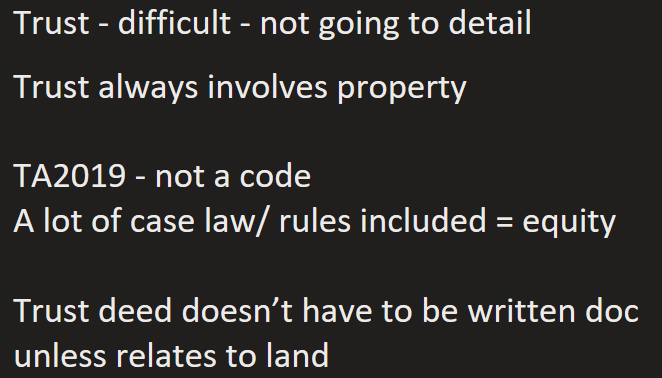
Trust - difficult - not going to detail
Trust always involves property
TA2019 - not a code
A lot of case law/ rules included = equity
Trust deed doesn’t have to be written doc unless relates to land
Limited Partnership (LP): Detailed Notes (NZ Legal Context)
1. “An entity (legal person)”
A limited partnership is a separate legal entity, like a company. It can:
Own property,
Enter contracts,
Sue and be sued in its own name.
This separates it from ordinary partnerships, which are not separate from the partners.
The LP must be registered with the NZ Companies Office, and it receives a unique NZ Business Number (NZBN) and registration number.
✅ Practical advantage: The LP’s liability is limited to the partnership itself; limited partners are shielded from personal liability (if they follow the rules).
2. “Limited Partnerships Act 2008 applies”
The LP structure is governed by the Limited Partnerships Act 2008 (LPA 2008), which was designed to:
Encourage private investment (especially venture capital),
Offer legal certainty and flexibility for investors and managers.
The Act outlines:
The registration process,
Duties of general and limited partners,
Disclosure and reporting obligations,
Rules on transfer and termination of interests.
3. “Written partnership agreement governs internal matters”
The internal operation of the LP is governed by a written partnership agreement (similar to a partnership deed), which should cover:
Capital contributions from each partner,
Profit and loss allocations,
Roles and duties of the general and limited partners,
Decision-making procedures,
Exit and transfer rules.
Unlike a general partnership under PLA 2019, this agreement is mandatory and must be submitted at registration.
⚠ If disputes arise, courts will interpret the agreement alongside the Limited Partnerships Act 2008.
4. “Name must end with ‘limited partnership’ or ‘LP’”
By law, the name of a limited partnership must end with:
“Limited Partnership” or the abbreviation “LP”.
This gives notice to the public that the entity is not a general partnership or a company.
It helps protect third parties and creditors, as they are aware of the potential limitations on liability.
📝 Example: “Sunrise Investments Limited Partnership” or “Sunrise Investments LP”.
5. “General partner assumes business risks and manages; general and limited partners share profits”
A general partner:
Has unlimited liability (they are personally liable for debts and obligations),
Manages the day-to-day operations of the partnership,
Can be an individual or a company (often a company is used to limit risk).
A limited partner:
Contributes capital and shares in profits,
Has limited liability, meaning they can only lose what they invested,
Cannot take part in management (or they risk losing their limited liability protection).
Profits are shared as agreed in the partnership agreement — not necessarily equally.
🎯 This structure is commonly used in private equity, venture capital, or property development, where investors want to commit funds without being actively involved.
6. “Transfer of interest is possible”
Limited partnership interests (especially for limited partners) can be transferred — either:
By assignment (e.g. selling the interest to someone else),
Or via rights built into the partnership agreement.
Transfer typically requires:
Consent of the general partner, and
Compliance with terms in the agreement or the Act.
Transferred interests must be recorded with the Companies Office to maintain registration accuracy.
✅ Why this matters: It allows flexibility for investors who may want to exit or bring in new capital.
Company: Detailed Notes (NZ Legal Context)
1. “An entity (legal person)”
A company is a separate legal person under New Zealand law.
This means:
It can own property, enter contracts, sue and be sued in its own name.
The company is distinct from its shareholders and directors.
This principle of separate legal personality comes from the famous UK case Salomon v A Salomon & Co Ltd [1897], and is reflected in NZ law.
✅ Example: If “Aroha Foods Ltd” breaches a contract, the company is sued — not the shareholder.
2. “Companies Act 1993 applies”
The Companies Act 1993 is the main piece of legislation governing:
Company formation and registration,
Rights and duties of directors and shareholders,
Disclosure and reporting obligations,
Rules for insolvency and liquidation.
The Act allows for flexibility but imposes clear legal duties (especially on directors), including:
The duty to act in good faith and in the best interests of the company (s131),
The duty to avoid reckless trading (s135),
Requirements to keep proper accounting records (s194).
3. “Constitution governs internal affairs”
A company constitution is an optional but important document that:
Sets out the rules for how the company operates internally (e.g. shareholder voting rights, director appointments, dividend rules),
May override some default rules in the Companies Act (where permitted).
If the company doesn’t have a constitution, the default provisions in the Companies Act apply in full.
Most large or complex companies adopt a constitution to provide flexibility or customise governance rules.
⚠ Companies must not include provisions that are inconsistent with the Companies Act.
4. “Shareholders (almost always) have limited liability”
One of the key advantages of the company structure is limited liability.
Shareholders are only liable for:
Unpaid amounts on their shares (if any),
Or personal guarantees they’ve signed (e.g. for bank loans).
This protects personal assets of shareholders from business debts or legal claims.
✅ This is what makes companies attractive for business owners and investors.
5. “Name must end with ‘Limited’ or ‘Tāpui (Limited)’”
Every New Zealand company must have a name that ends with:
“Limited”, or
The te reo Māori equivalent: “Tāpui (Limited)”.
This signals to others that the business is incorporated and has limited liability.
The name must be unique and registered through the Companies Office.
You can reserve a company name before registering.
✅ Example: “GreenTech Limited” or “KaiOra Tāpui (Limited)”.
6. “Company assumes business risk; directors manage; shareholders share profits if any”
The company itself bears business risks (e.g. contracts, debts).
Directors:
Are appointed to manage the company and make strategic decisions,
Must act in good faith and in the best interests of the company (s131),
Are subject to fiduciary duties and can be personally liable for breaches (e.g. reckless trading).
Shareholders:
Usually do not manage the company,
Provide capital by buying shares,
Receive dividends if profits are distributed — but this is not guaranteed.
There is a separation of ownership and control:
Shareholders = owners,
Directors = managers.
7. “Transfer of interest (i.e. shares) is legally easy”
Shares in a company are personal property and can be easily:
Sold, gifted, or transferred (subject to any restrictions in the constitution or shareholders’ agreement).
The transfer simply requires:
A share transfer form,
An update to the share register (held by the company),
Notification to the Companies Office if changes affect directors or major shareholders.
This ease of transferability is one of the main benefits over structures like partnerships or trusts.
✅ Investors can buy in or exit easily, making companies ideal for capital raising and succession planning.