Saving and Investment Part 1
Saving and Investment in the Financial System
Overview of the Financial System
The financial system facilitates the movement of funds from savers to borrowers.
Comprises two main components: financial markets and financial intermediaries.
Financial Markets
Defined as systems where funds are directly lent to borrowers.
Allow lenders to choose who to lend their money to, which can be crucial for those wishing to support specific organizations.
The two major types of financial markets:
- Stock Market
- Bond Market
Bond Market
Understanding Bonds:
- Definition of a Bond: A bond is defined as a "certificate of indebtedness."
- Represents that the issuer owes the holder a debt that must be paid back, often with interest.
- Bonds can be purchased from various entities such as governments (e.g., U.S. government) or corporations (e.g., Ford).
Characteristics of Bonds
There are three main characteristics that influence the interest rates of bonds:
1. Term:
- Definition: The duration until the bond matures, meaning the time until all principal is paid back.
- Example: A bond might have a term of thirty years but can be bought and sold before maturity.
- Interest Relationship: Generally, longer-term bonds pay higher interest rates compared to shorter-term bonds.
2. Credit Risk:
- Definition: The probability of the borrower failing to pay part or all of the interest or principal.
- Example: Higher credit risk results in higher interest rates due to the increased risk to the lender.
- Safe bonds such as U.S. government securities typically offer lower interest rates, while riskier bonds must promise higher returns.
3. Tax Treatment:
- Some bonds, like municipal bonds (state and local), offer tax-exempt interest income at the federal level.
- Because of this tax exemption, municipal bonds generally pay lower interest rates than taxable bonds.
Introduction to Finance
Finance Definition: The study of how people allocate resources and deal with risk over time.
In finance, two critical formulas help to understand the value of money over time:
- Time Value of Money (TVM) formulas.
Present Value Formula
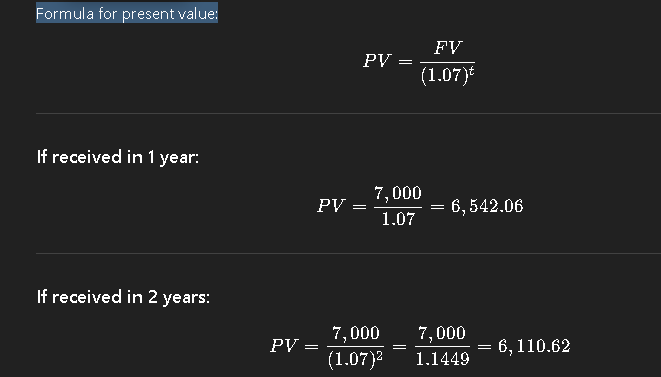
Definition: Present value is the current worth of a future sum of money given a specified rate of return.
Formula:
where:
- = Present Value
- = Future Value
- = interest rate
- = number of years until maturity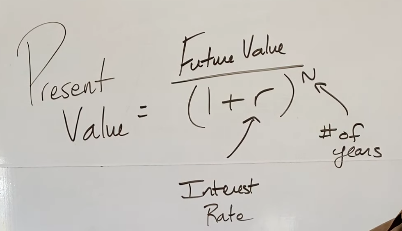
Example Scenario:
- Present value of a bond worth $7,000 maturing in three years with a coupon of $50 annually at a desired interest rate of 2%:
- Calculate present value for each cash flow:
- Year 1:
- Year 2:
- Year 3:
- Total Future Value:
- Adding these values gives the maximum price to pay for the bond:
- Total Present Value:
Future Value Formula
Definition: Future value is the amount of money an investment will grow to over a period of time at a given interest rate.
Formula:
where:
- = Future Value
- = Present Value
- = interest rate
- = number of years
Example Scenario:
- Future value of $10,000 earning 3% interest for twenty years:
- Calculation:
- Result:
Stock Market
Definition of a Stock: Represents a claim of partial ownership in a firm. Stocks are intended to reflect the expected future value of a company.
Stocks can be volatile and vary significantly based on market sentiment and company performance.
Dividends vs. Retained Earnings
Dividends: Portion of profits distributed to shareholders.
- Example: Companies like AT&T or Microsoft pay dividends, allowing shareholders periodic income.Retained Earnings: Profits that are reinvested into the company instead of distributed as dividends.
- Example: Companies like Amazon or Netflix often retain earnings for future growth and expansion.
Financing Methods
Equity Finance: Involves raising money through the sale of stocks.
Debt Finance: Involves raising money through the sale of bonds.
Stocks generally offer higher potential returns but come with higher risk compared to bonds, which provide steady but lower returns.
Financial Intermediaries
Defined as institutions that facilitate indirect lending between savers and borrowers.
Common types of financial intermediaries include:
1. Banks: Receive deposits, pay lower interest to depositors, and lend money at higher rates.
2. Credit Unions: Similar to banks but typically focused on serving specific groups and offering additional benefits to members.
3. Mutual Funds: Pool resources from multiple investors to invest in diversified portfolios, giving investors shares in the fund without direct control over underlying assets.
- Index Funds: A type of mutual fund that aims to track the performance of a specific index, known for low costs and consistent returns.
Conclusion and Future Topics
Financial knowledge is essential for individual decision-making and market understanding.
The next topic will cover savings and investment definitions, focusing on loanable funds in macroeconomics.