Chapter 3 - Movement In and Out of Cells
Cell Transport
Diffusion
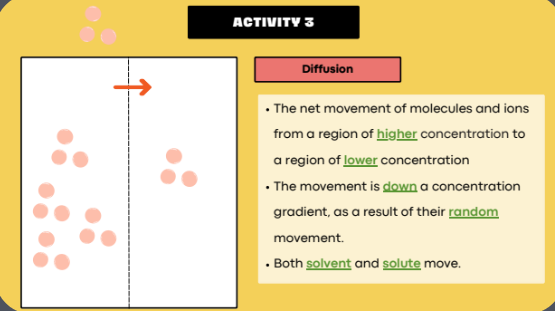
Definition: Net movement of particles from high to low concentration (down the concentration gradient).
Energy source: Kinetic energy of molecules/ions.
Factors affecting rate:
Surface area: Increased area, increased rate.
The larger the available surface area, the more space for substances to diffuse through.
Temperature: Increased temperature, increased rate.
Higher temperatures increase the kinetic energy of the molecules, causing them to move faster and thus diffuse more quickly.
Concentration gradient: Increased gradient, increased rate.
A steeper concentration gradient means there is a greater difference in concentration between two areas, leading to faster diffusion.
Diffusion distance: Increased distance, decreased rate.
The shorter the distance, the quicker diffusion occurs because molecules have less space to travel.
Adaptations:
Short diffusion distances.
Solutes and gases are able to diffuse in and out of thin cells across the cell membrane.
Maintained concentration gradients.
Crucial for metabolic reactions.
Large surface areas.
Enables efficient molecule diffusion.
Osmosis
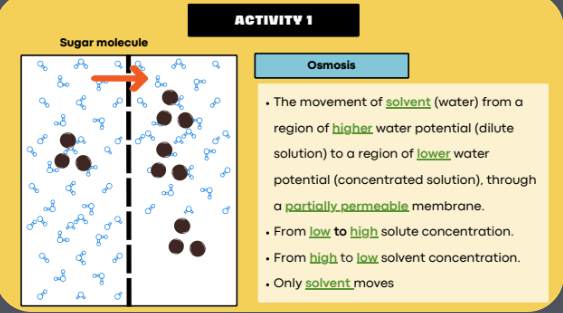
Definition: Net movement of water molecules through a partially permeable membrane.
Water moves from high water potential (dilute solution) to low water potential (concentrated solution).
Water moves in and out of cells through the cell membrane via osmosis until it reaches equilibrium.
High water potential = Low solute concentration.
Key Terms:
Turgid: Swollen cell due to high water content.
Turgor pressure: Pressure on cell wall from cell membrane as water moves into the cell.
Flaccid: Water moves out; cell shrinks.
Plasmolysis: Too little water; cell membrane peels away from cell wall.
Cells and Osmosis: Water diffuses from regions of high water potential to regions of low water potential.
Cell more concentrated: Water moves in (turgid).
Cell less concentrated: Water moves out (flaccid/plasmolysis).
Importance of Water as Solvent:
*Provides support for the cell structure by maintaining the turgor pressure.
*Provides a medium in which metabolic reactions occur.
*Water has a high specific heat capacity, and thus acts as a temperature buffer.
*Maintains the optimum temperature for enzyme reactions.
Active Transport
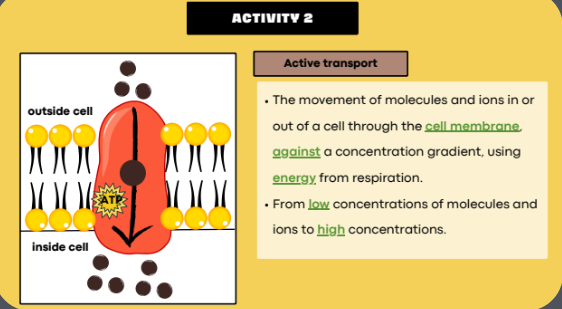
Definition: Movement of molecules against a concentration gradient using energy (ATP).
Molecules move from low to high concentration.
Carrier proteins facilitate transport by changing shape using energy from respiration.
Examples:
Uptake of ions by root hair cells.
Plants take up ions from the soil via root hair cells.
The concentration of ions in the root hair cell is greater than the concentration of ions in the soil.
Energy from respiration is used to transport ions into the cell against the concentration gradient
Uptake of glucose in the small intestine and kidney tubules.
Glucose is taken up in the small intestine and kidney tubules.
Glucose moves against the concentration gradient through carrier proteins.
Phagocytosis
For particles too large for diffusion or active transport.
Used by white blood cells.