The Revolution in Astronomy(1543-1687) 2/21/2024
Key things to note:
Nicolas Copernicus, De Revolutionibus (1543) [On the Revolutions of the Heavenly Spheres]
Tycho Brahe… Tychonic system
Johannes Kepler, New Astronomy (1609)
Galileo… telescopic observations (1609-)
Isaac Newton, Principia (1687) [Mathematical Principles of Natural Philosophy]
The Aristoteliean Universe
Cosmology
Universe: one, and the only possible world as is out there
Plenum: space = matter
concentric crystalline spheres of the stars, 7 spheres for the planets (means ‘wanderers’ in Greek; Moon, Mercury, Venus, Sun, Mars, Jupiter, Saturn)
superlunar (celestial) and sublunar (terrestrial) regions: ether and four elements (fire, air, water, earth)
the Earth as a unique, stable, and central place defines the places which constitute an absolute, finite space, or the universe
Physics
physics is the study of changes in nature [i.e. an acorn becomes a tree]
motion requires a ‘mover’
for unnatural or violent motions, external movers are required. [e.g. the trajectory of a stone is caused by displaced air]
Ptolemaic Astronomy
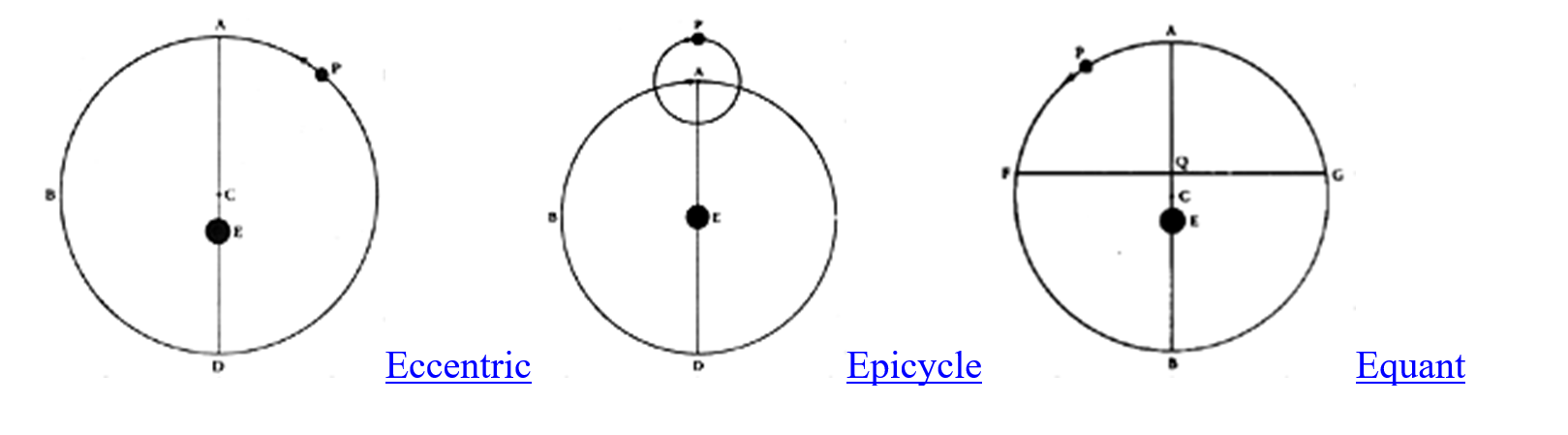
Eccentric, Deferent, Epicycles, Equant
Nicolas Copernicus (1473-1543)
educated in cannon law (Bologna) and medicine (Padua)
became a church administrator in Prussia
revived Hellenistic (Ptolemaic) astronomy, drawing on the Islamic astronomers who had been engaged from the 13th century in reformulating Greek astronomy to ‘save the phenomena; or to devise a consistent mathematical representation of planetary motions
Copernicus worked between 1508 and 1515 on devising a more accurate calendar, which led to his heliocentric system (mathematical, not physical)
De Revolutionibus was finished by 1530 but was not published because of the repercussions of the Reformation. Joachim Rheticus took the manuscript to the Protestant region; Andreas Osiander published it as a mathematical, not physical theory
De Revoltionibus Orbium Celestium Libri Sex (1543)
If we posit that the earth has a rotational motion on its axis and an orbital motion around the sun, then (1) all known celestial phenomena can be accounted for as accurately as with the best Ptolemaic theories (2) the annual component in the Ptolemaic models, an unexplained mirroring of the sun's motion, is eliminated (3) the planets can be ordered by their increasing sidereal periods from the sun and (4) the distances of the planets from the center of the universe can be calculated with respect to a 'common measure,' the earth-sun radius which remains fixed as the absolute unit of reference.
Merits
explained the retrograde motion of Mars, Jupiter, and Saturn.
A new order of planets according to the revolutionary period.
Explained why Venus and Mercury always stayed close to the sun.
Got rid of the equant to simplify the mathematics.
But:
it retained circle, eccentric, epicycle, and deferent.
The prediction was not superior
Reception:
Few copernicans until 1600.
Elite astronomers used it for mathematical innovation, without working out its physical implications. The
The Council of Trent did not discuss the theory
Tycho Brahe (1546-1601)
Danish High Noble
educated in Copenhagen and Leipzig, and then traveled through the German region, studying at the universities of Wittenberg, Rostock, and Basel.
Was given an island to the king because the king didn’t want Brahe in the court because he would take some power away from the king since he was a noble
Johannes Kepler (1571-1630)