Short Stories
Different Character Types
1. Protagonist
Definition: The main character around whom the story revolves.
Characteristics:
Faces challenges and conflicts.
Often undergoes significant growth or change.
Can be relatable or aspirational.
2. Antagonist
Definition: Opposes the protagonist; creates conflict.
Characteristics:
Can be a person, group, or force (e.g., nature, society).
Motivations may vary from evil to misunderstood.
Often has a complex backstory.
3. Supporting Characters
Definition: Characters that support the protagonist and enrich the story.
Types:
Sidekick: Loyal companion to the protagonist.
Mentor: Provides guidance and wisdom.
Love Interest: Romantic partner of the protagonist.
4. Dynamic Characters
Definition: Characters that undergo significant internal change.
Characteristics:
Evolve due to experiences and conflicts.
Often learn important life lessons.
5. Static Characters
Definition: Characters that remain largely unchanged throughout the story.
Characteristics:
Serve specific roles (e.g., comic relief, moral compass).
Often embody a particular trait or idea.
6. Round Characters
Definition: Well-developed characters with complex personalities.
Characteristics:
Exhibit a range of emotions and traits.
Often have backstories that influence their actions.
7. Flat Characters
Definition: Simple, one-dimensional characters.
Characteristics:
Represent a single trait or idea.
Often serve as stereotypes or archetypes.
8. Foil Characters
Definition: Characters that contrast with the protagonist.
Purpose:
Highlight specific qualities of the protagonist.
Enhance the story's themes and conflicts.
9. Stock Characters
Definition: Stereotypical characters that are easily recognizable.
Examples:
The "dumb jock," "nerdy genius," or "damsel in distress."
Purpose: Provide familiarity and quick understanding of roles.
10. Anti-Hero
Definition: A protagonist who lacks conventional heroic qualities.
Characteristics:
Themes
Definition of Theme
The central idea or underlying message in a narrative.
Often reflects broader societal issues, human experiences, or moral questions.
Types of Themes
1. Universal Themes
Common across cultures and time periods.
Examples: Love, friendship, sacrifice, good vs. evil.
2. Specific Themes
Unique to a particular story or author.
Examples: The impact of technology, the struggle for identity.
Importance of Themes
Guides the Narrative: Shapes the plot and character development.
Engages Readers: Invites reflection and emotional connection.
Conveys Messages: Offers insights into human nature and society.
Identifying Themes
Character Actions: What characters do can reveal thematic elements.
Conflict: Central conflicts often highlight key themes.
Setting: The environment can reflect or enhance themes.
Symbols: Objects or events that represent larger ideas.
Common Themes in Literature
Coming of Age: Growth and self-discovery (e.g., "To Kill a Mockingbird").
Love and Relationships: Exploration of romantic and familial bonds (e.g., "Pride and Prejudice").
Power and Corruption: The effects of power on individuals and society (e.g., "Animal Farm").
Survival: The struggle to endure against odds (e.g., "The Road").
Theme vs. Subject
Subject: The topic or focus of the story (e.g., war, family).
Theme: The deeper meaning or message derived from the subject.
Techniques for Developing Themes
Foreshadowing: Hinting at future events to reinforce themes.
Imagery: Using descriptive language to evoke emotions related to the theme.
Dialogue: Conversations that reveal characters' beliefs and values.
Conclusion
Themes are essential for enriching narratives and providing depth.
Understanding themes enhances the reading experience and fosters critical thinking.
Point of View (POV)
Definition
Point of View refers to the perspective from which a story is narrated. It influences how readers perceive the narrative and characters.
Types of Point of View
1. First Person
Pronouns: I, me, my, we, us
Characteristics:
Narrator is a character in the story.
Provides personal insights and emotions.
Limited to the narrator's knowledge and experiences.
2. Second Person
Pronouns: You, your
Characteristics:
Directly addresses the reader.
Creates an immersive experience.
Less common in literature; often used in instructional writing.
3. Third Person
Pronouns: He, she, they, it
Types:
Third Person Limited:
Focuses on one character’s thoughts and feelings.
Offers a more intimate understanding of that character.
Third Person Omniscient:
All-knowing narrator.
Provides insights into multiple characters’ thoughts and backgrounds.
Third Person Objective:
Reports only observable actions and dialogue.
No access to characters' internal thoughts.
Importance of POV
Influences Reader's Connection: Affects empathy and understanding of characters.
Shapes Narrative Structure: Determines how much information is revealed and when.
Establishes Tone and Style: Different POVs can create varying atmospheres and moods.
Choosing the Right POV
Consider the story's theme and emotional depth.
Assess the level of intimacy required with characters.
Think about the narrative complexity and scope.
Conclusion
The choice of point of view is crucial in storytelling, affecting how the narrative unfolds and how readers engage with the text. Understanding different POVs can enhance both writing and reading experiences.
Plot
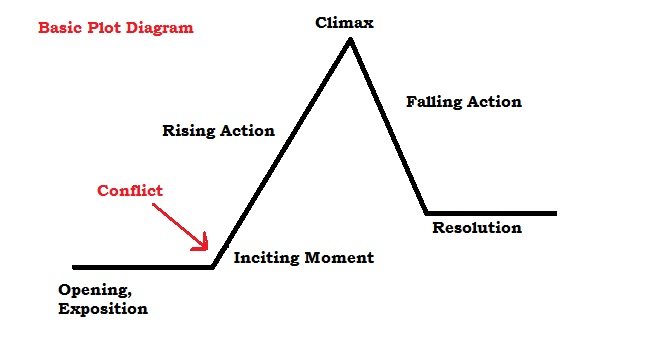
Definition
The plot is the sequence of events and actions that make up a story.
It encompasses the main storyline and the structure that guides the narrative.
Elements of Plot
Exposition
Introduces characters, setting, and background information.
Sets the stage for the conflict.
Rising Action
Series of events that create suspense and tension.
Develops the conflict and builds towards the climax.
Climax
The turning point of the story.
The moment of greatest tension where the main conflict reaches its peak.
Falling Action
Events that follow the climax.
Leads towards resolution and begins to tie up loose ends.
Resolution (Denouement)
The conclusion of the story.
Conflicts are resolved, and the story comes to a close.
Types of Plot Structures
Linear Plot
Events unfold in chronological order.
Non-linear Plot
Events are presented out of chronological order (flashbacks, flash-forwards).
Circular Plot
The story ends where it began, creating a sense of closure.
Subplots
Secondary plots that complement or contrast the main plot.
Adds depth and complexity to the narrative.
Importance of Plot
Drives the narrative forward and keeps the audience engaged.
Establishes the framework for character development and themes.
Influences the pacing and emotional impact of the story.
Tips for Writing a Strong Plot
Start with a clear premise and conflict.
Develop well-defined characters whose goals drive the plot.
Ensure a logical progression of events.
Create tension and stakes to maintain reader interest.
Consider the emotional arc and thematic elements throughout the plot.
Examples of Plot Types
Hero’s Journey: A common narrative structure involving a hero who goes on an adventure, faces challenges, and returns transformed.
Tragedy: A plot that leads to a disastrous conclusion, often highlighting human flaws and moral lessons.
Comedy: A light-hearted plot that typically resolves in a happy ending, often involving misunderstandings and mistaken identities.
Conclusion
The plot is essential for storytelling, providing a roadmap for the narrative journey.
Understanding plot structure enhances both writing and analysis of literature.
Unknown
Stream of Consciousness
Definition
A narrative mode that attempts to capture the flow of thoughts and feelings in a character's mind.
Often disregards traditional narrative structure, focusing instead on internal monologue and free association.
Characteristics
Non-linear Narrative: Events and thoughts are presented in a seemingly random order, reflecting the natural thought process.
Interior Monologue: Direct presentation of a character's thoughts, often without punctuation or clear transitions.
Subjectivity: Emphasizes personal perspective, allowing readers to experience the character's emotions and perceptions intimately.
Fragmentation: Use of fragmented sentences and ideas to mimic the chaotic nature of thought.
Techniques
Free Association: Thoughts flow freely, often jumping from one idea to another without logical connections.
Sensory Details: Vivid descriptions of sensory experiences to enhance emotional depth and realism.
Repetition: Recurrent themes or phrases to emphasize a character's preoccupations or obsessions.
Notable Authors
James Joyce: Known for "Ulysses," which employs stream of consciousness extensively.
Virginia Woolf: Works like "Mrs. Dalloway" and "To the Lighthouse" showcase this technique.
William Faulkner: Utilizes stream of consciousness in novels such as "The Sound and the Fury."
Examples in Literature
"Ulysses" by James Joyce: Captures a single day in the life of Leopold Bloom through his thoughts and experiences.
"Mrs. Dalloway" by Virginia Woolf: Explores the inner lives of characters as they navigate a day in post-WWI London.
"The Sound and the Fury" by William Faulkner: Features multiple perspectives, with a focus on the fragmented thoughts of its characters.
Purpose
To provide deeper insight into characters' psyches.
To challenge traditional narrative forms and engage readers in a more immersive experience.
To reflect the complexity of human consciousness and the nature of reality.
Conclusion
The stream of consciousness technique is a powerful literary tool that offers a unique way to explore characters' inner worlds, emphasizing the fluidity and complexity of thought and experience.
Diction vs. Syntax
Diction
Definition: The choice of words and style of expression used by a writer or speaker.
Types of Diction:
Formal: Elevated language, complex sentences, often used in academic or professional contexts.
Informal: Casual language, conversational tone, often includes slang or colloquialisms.
Colloquial: Everyday language specific to a region or group.
Jargon: Specialized terminology used within a particular field or profession.
Abstract: Language that refers to ideas or concepts rather than tangible objects.
Concrete: Language that describes specific, observable things.
Impact of Diction:
Sets the tone of the text.
Influences the reader's perception and emotional response.
Can establish character voice and authenticity.
Syntax
Definition: The arrangement of words and phrases to create well-formed sentences in a language.
Elements of Syntax:
Sentence Structure: Simple, compound, complex, and compound-complex sentences.
Word Order: The sequence in which words are arranged (e.g., Subject-Verb-Object).
Punctuation: Use of commas, periods, semicolons, etc., to clarify meaning and indicate pauses.
Parallelism: Similar structure in phrases or clauses to create rhythm and clarity.
Impact of Syntax:
Affects readability and flow of the text.
Can create emphasis and highlight important ideas.
Influences the mood and tone of the writing.
Key Differences
Focus:
Diction is about word choice; syntax is about sentence structure.
Function:
Diction conveys meaning and tone; syntax organizes that meaning into coherent sentences.
Examples:
Diction: Choosing "child" vs. "youth" vs. "youngster" affects tone and connotation.
Syntax: "The dog chased the cat" vs. "Chased by the dog, the cat ran" changes emphasis and perspective.
Conclusion
Understanding the distinction between diction and syntax is crucial for effective writing. Both elements work together to enhance clarity, tone, and overall impact of the text.
Tone
Definition
Tone refers to the author's attitude or emotional quality conveyed through their writing.
It shapes the reader's perception and influences the overall mood of the text.
Types of Tone
Formal: Professional, serious, and objective. Often used in academic or business writing.
Informal: Casual, conversational, and personal. Common in blogs, personal letters, and some fiction.
Optimistic: Positive and hopeful, often encouraging the reader.
Pessimistic: Negative and doubtful, highlighting challenges or failures.
Sarcastic: Ironic or mocking, often used to convey contempt or humor.
Sympathetic: Understanding and compassionate, often used to connect with the reader emotionally.
Humorous: Light-hearted and funny, aiming to entertain the reader.
Nostalgic: Reflective and sentimental, evoking memories of the past.
Elements Influencing Tone
Word Choice (Diction): Specific words can evoke different feelings (e.g., "child" vs. "youth").
Sentence Structure: Short, abrupt sentences can create urgency; longer, complex sentences can convey sophistication.
Imagery: Descriptive language that appeals to the senses can enhance emotional impact.
Punctuation: Exclamation marks can indicate excitement, while ellipses can suggest hesitation or contemplation.
Importance of Tone
Engagement: A well-established tone can draw readers in and keep them interested.
Clarity: Helps convey the intended message and reduces misunderstandings.
Connection: Establishes a relationship between the author and the reader, influencing how the message is received.
Analyzing Tone
Context: Consider the genre, audience, and purpose of the text.
Voice: Identify the narrator's or speaker's perspective and how it shapes tone.
Emotional Response: Reflect on how the text makes you feel and what language contributes to that feeling.
Examples
Literary Works:
Pride and Prejudice by Jane Austen: Witty and ironic tone.
The Road by Cormac McCarthy: Dark and bleak tone.
Speeches:
Martin Luther King Jr.'s "I Have a Dream":
Irony
Definition
Irony is a rhetorical device or literary technique where the intended meaning of words is different from the actual meaning, often highlighting a contrast between expectation and reality.
Types of Irony
Verbal Irony
Occurs when a speaker says one thing but means another.
Example: Saying "Great weather we're having!" during a storm.
Situational Irony
Involves a discrepancy between what is expected to happen and what actually occurs.
Example: A fire station burns down.
Dramatic Irony
Happens when the audience knows more about a situation than the characters do.
Example: In a horror movie, the audience knows the killer is in the house, but the characters do not.
Purpose of Irony
Emphasizes Contradictions: Highlights the absurdity or contradictions in situations.
Enhances Humor: Often used in comedy to create humor through unexpected twists.
Critique Society: Can serve as a tool for social commentary, exposing flaws in societal norms or behaviors.
Examples in Literature
"Romeo and Juliet" by William Shakespeare: The audience knows Juliet is alive, but Romeo believes she is dead, leading to tragic consequences.
"The Gift of the Magi" by O. Henry: A couple sacrifices their most prized possessions to buy gifts for each other, resulting in an ironic twist.
Irony in Everyday Life
Common in daily conversations and situations, often used to express sarcasm or humor.
Can also be found in news headlines or social media, where the outcome is contrary to expectations.
Conclusion
Irony is a multifaceted literary device that enriches storytelling and communication by creating layers of meaning and engaging the audience in critical thinking about the contrasts between appearance and reality.
Style
Definition
Literary Style: The way an author expresses their thoughts through language, encompassing word choice, sentence structure, figurative language, and tone.
Elements of Style
Diction:
Choice of words; can be formal, informal, colloquial, or slang.
Influences the mood and tone of the text.
Syntax:
Arrangement of words and phrases to create well-formed sentences.
Can vary from simple to complex structures.
Tone:
The author's attitude toward the subject or audience.
Can be serious, humorous, sarcastic, etc.
Imagery:
Descriptive language that appeals to the senses.
Helps create vivid pictures in the reader's mind.
Figurative Language:
Use of metaphors, similes, personification, etc.
Enhances meaning and adds depth to the text.
Voice:
The unique style of the author, reflecting their personality and perspective.
Can be distinct in first-person narratives.
Types of Style
Narrative Style:
How a story is told; can be linear, non-linear, or fragmented.
Descriptive Style:
Focuses on detailing characters, settings, and events.
Expository Style:
Aims to inform or explain; often found in essays and articles.
Persuasive Style:
Seeks to convince the reader of a particular viewpoint.
Importance of Style
Characterization: Reveals character traits and motivations.
Theme Development: Enhances the central ideas of the work.
Reader Engagement: Captivates and maintains the reader's interest.
Cultural Reflection: Mirrors societal norms and values.
Examples of Distinctive Styles
Ernest Hemingway: Known for concise, straightforward prose.
Virginia Woolf: Utilizes stream of consciousness and lyrical language.
F. Scott Fitzgerald: Rich, descriptive imagery and complex characters.
Conclusion
An author’s style is integral to the identity of their work and significantly impacts how the reader interprets and enjoys the text. Understanding style can deepen appreciation and analysis of literature.
Allusions
Definition
An allusion is a brief and indirect reference to a person, place, thing, or idea of historical, cultural, literary, or political significance.
It does not describe in detail the person or thing to which it refers.
Purpose
To create connections between the text and the referenced subject.
To evoke emotions or ideas without lengthy explanations.
To enrich the meaning of a text by drawing on the connotations of the alluded subject.
Types of Allusions
Literary Allusions
References to works of literature (e.g., Shakespeare, the Bible).
Example: "He met his Waterloo" (referring to Napoleon's defeat).
Historical Allusions
References to historical events or figures.
Example: "This place is a Garden of Eden" (referring to the biblical paradise).
Cultural Allusions
References to popular culture, including movies, music, and art.
Example: "He’s a real Romeo" (referring to Shakespeare's romantic character).
Mythological Allusions
References to myths or mythological figures.
Example: "She has the Midas touch" (referring to King Midas from Greek mythology).
Examples in Literature
"The Great Gatsby" by F. Scott Fitzgerald
Alludes to the American Dream and historical figures like Jay Gatsby.
"The Waste Land" by T.S. Eliot
Contains numerous allusions to various texts, including Dante's "Divine Comedy."
Importance in Writing
Enhances depth and layers of meaning.
Engages readers by prompting them to make connections.
Can provide insight into characters or themes.
How to Identify Allusions
Look for references that seem familiar but are not elaborated upon.
Consider the context and the broader cultural or historical significance.
Recognize that allusions often require background knowledge to fully understand.
Tips for Using Allusions
Ensure the reference is relevant and enhances the text.
Consider the audience's familiarity with the alluded subject.
Use allusions sparingly to avoid confusion or alienation.
Conclusion
Allusions are a powerful literary device that can enrich writing and deepen understanding.
They rely on shared knowledge between the writer and the reader to create meaning
Foreshadowing
Definition
Foreshadowing: A literary device used to give an indication or hint of what is to come later in the story.
Purpose
Builds anticipation and suspense.
Prepares the reader for future events.
Enhances thematic depth.
Creates a cohesive narrative structure.
Types of Foreshadowing
1. Direct Foreshadowing
Explicit hints about future events.
Often found in dialogue or narration.
2. Indirect Foreshadowing
Subtle clues that require interpretation.
Can be symbolic or thematic elements.
3. Dramatic Foreshadowing
The audience knows something that the characters do not.
Creates tension and engagement.
4. Symbolic Foreshadowing
Objects, colors, or motifs that suggest future events.
Enhances the story's themes.
Techniques
Imagery: Vivid descriptions that hint at future events.
Dialogue: Characters may make statements that foreshadow outcomes.
Flashbacks: Past events that suggest future implications.
Character Actions: Choices made by characters that hint at their fate.
Examples in Literature
Romeo and Juliet: The prologue foreshadows the tragic fate of the lovers.
Of Mice and Men: The death of Candy's dog foreshadows Lennie's fate.
The Great Gatsby: The green light symbolizes Gatsby's unattainable dreams.
Importance
Engages readers by creating a sense of curiosity.
Encourages re-reading to uncover hidden clues.
Strengthens emotional impact when foreshadowed events occur.
Tips for Writers
Use foreshadowing sparingly to maintain its effectiveness.
Ensure that hints are relevant and not misleading.
Balance subtlety with clarity to avoid confusion.
Conclusion
Foreshadowing is a powerful tool in storytelling that enhances the reader's experience by creating anticipation and deepening the narrative. Understanding and effectively employing foreshadowing can elevate a story's emotional and thematic resonance.
Flashbacks
Definition
Flashback: A narrative technique that interrupts the chronological flow of a story to present events that occurred earlier.
Purpose
Character Development: Provides background information that helps to understand characters' motivations and emotions.
Plot Advancement: Reveals crucial information that influences current events or decisions.
Theme Exploration: Highlights themes such as memory, trauma, or nostalgia.
Types of Flashbacks
Direct Flashback: A clear shift in time where the narrative explicitly moves to a past event.
Memory Flashback: A character recalls past events, often triggered by a current situation or emotion.
Dream Sequence: A character's dream that reveals past experiences or desires.
Techniques
Visual Cues: Changes in tone, lighting, or scenery to signal a flashback.
Narrative Voice: Shifts in perspective or voice to indicate a transition to the past.
Dialogue: Characters discussing past events can serve as a flashback.
Effects on the Reader
Engagement: Creates intrigue and deepens the reader's connection to the story.
Suspense: Withholding information until a flashback can build tension.
Emotional Impact: Evokes feelings of empathy or understanding for characters.
Considerations
Clarity: Ensure the transition to a flashback is clear to avoid confusing the reader.
Relevance: Flashbacks should serve a purpose and not detract from the main narrative.
Pacing: Balance the use of flashbacks to maintain narrative flow and pacing.
Examples in Literature
"The Great Gatsby" by F. Scott Fitzgerald: Uses flashbacks to reveal Gatsby's past and his motivations.
"One Hundred Years of Solitude" by Gabriel García Márquez: Interweaves past and present to explore family history and themes of time.
Conclusion
Flashbacks are a powerful storytelling tool that enriches narratives by providing depth, context, and emotional resonance. When used effectively, they enhance the reader's understanding and engagement with the story.
Symbolism
Definition
Symbolism: The use of symbols to represent ideas or qualities.
Symbols can be objects, characters, figures, or colors that convey deeper meanings beyond their literal sense.
Purpose of Symbolism
Enhances Themes: Adds depth to the narrative and reinforces the central themes.
Evokes Emotion: Creates emotional resonance and connection with the audience.
Encourages Interpretation: Invites readers to explore and derive personal meanings.
Types of Symbols
Universal Symbols: Recognized across cultures (e.g., light = knowledge, darkness = ignorance).
Cultural Symbols: Specific to a particular culture or society (e.g., the lotus in Buddhism).
Personal Symbols: Unique to an individual or character (e.g., a family heirloom).
Common Examples
Colors:
Red = passion, love, or danger.
Black = death, mystery, or evil.
Objects:
The green light in The Great Gatsby symbolizes Gatsby's unattainable dreams.
The conch shell in Lord of the Flies represents civilization and order.
Characters:
The mockingbird in To Kill a Mockingbird symbolizes innocence and the idea of harming the innocent.
Analyzing Symbolism
Identify Symbols: Look for recurring objects, colors, or themes.
Contextual Understanding: Consider the context in which the symbol appears.
Explore Multiple Meanings: Symbols can have layered meanings; explore different interpretations.
Connect to Themes: Relate symbols back to the overarching themes of the story.
Importance in Literature
Depth and Complexity: Adds layers to the narrative, making it richer and more engaging.
Reader Engagement: Encourages active reading and critical thinking.
Cultural Reflection: Often reflects societal values, beliefs, and issues.
Conclusion
Symbolism is a powerful literary device that enhances storytelling by adding depth, evoking emotions, and encouraging interpretation. Understanding symbolism enriches the reading experience and deepens comprehension of the text.
Allusions in Literature
Definition
Allusion: An indirect reference to a person, place, event, or literary work that is not elaborated on but relies on the reader's familiarity with the subject.
Purpose
Enhance Meaning: Adds depth and layers to the text.
Create Connections: Links the text to broader cultural, historical, or literary contexts.
Evokes Emotion: Can trigger specific feelings or memories in the reader.
Character Development: Reveals character traits or motivations through their references.
Types of Allusions
Literary Allusions: References to other literary works (e.g., Shakespeare, the Bible).
Historical Allusions: References to historical events or figures (e.g., World War II, Martin Luther King Jr.).
Mythological Allusions: References to myths or mythological figures (e.g., Achilles, Pandora).
Pop Culture Allusions: References to contemporary culture (e.g., movies, music, celebrities).
Examples
Biblical Allusion: "He met his Waterloo" refers to Napoleon's defeat, implying a significant failure.
Shakespearean Allusion: "To be or not to be" evokes Hamlet's existential dilemma.
Mythological Allusion: "He has the strength of Hercules" suggests immense physical power.
Techniques for Effective Allusion
Subtlety: Should be woven seamlessly into the narrative.
Relevance: Must relate to the themes or characters of the work.
Cultural Awareness: Requires an understanding of the audience's background knowledge.
Impact on Readers
Engagement: Encourages readers to think critically and make connections.
Interpretation: Can lead to multiple interpretations based on individual experiences.
Memorability: Creates a lasting impression through familiar references.
Conclusion
Allusions enrich storytelling by connecting texts to a wider cultural and historical framework, enhancing the reader's experience and understanding.
Types of Writing
1. Fiction
Definition: Narrative writing that originates from the author's imagination.
Sub-genres:
Novels: Long-form narratives (e.g., literary, historical, romance).
Short Stories: Brief narratives focusing on a single theme or character.
Flash Fiction: Extremely short stories, often under 1,000 words.
Novellas: Short novels, typically between 20,000 and 40,000 words.
2. Non-Fiction
Definition: Writing based on facts, real events, and real people.
Sub-genres:
Biographies: Life stories of individuals.
Autobiographies: Self-written life stories.
Essays: Short pieces expressing the author's viewpoint.
Journalism: Reporting on news and current events.
Self-help: Guides aimed at personal improvement.
3. Poetry
Definition: Expressive writing that uses aesthetic and rhythmic qualities of language.
Forms:
Lyric: Personal and emotional expression.
Narrative: Tells a story with characters and a plot.
Sonnet: 14-line poem with specific rhyme schemes.
Haiku: Japanese form with three lines (5-7-5 syllable structure).
4. Drama
Definition: Writing intended for performance, focusing on dialogue and action.
Types:
Plays: Scripts for theatrical performances.
Screenplays: Scripts for films and television.
Teleplays: Scripts specifically for television shows.
5. Genre Fiction
Definition: Fiction that fits into specific categories with established conventions.
Examples:
Mystery: Focuses on crime and solving puzzles.
Fantasy: Involves magical elements and imaginary worlds.
Science Fiction: Explores futuristic concepts and technology.
Horror: Aims to evoke fear and suspense.
6. Creative Non-Fiction
Definition: Non-fiction that employs literary styles and techniques.
Examples:
Memoirs: Personal accounts focusing on specific themes or events.