Unit 5.2: Classical Conditioning - Associating Stimuli
One of the major contributors to the study of learning was a Russian physiologist named Ivan Pavlov (1849-1936)
To get a dog to produce saliva, he put food on the dog’s tongue. He noticed the dog was salivating before he put the food on the tongue.
Salivating is a reflexive response — a largely involuntary automatic response to an external stimulus.
Principles of Classical Conditioning
The process of conditioning that Pavlov discovered was the first to be extensively studied, and it’s called classic conditioning.
Classical Conditioning:the basic learning process that involves repeatedly pairing a neutral stimulus with a response-producing stimulus until the neutral stimulus elicits the same response. (process of learning between two stimuli)
Deals with behaviors that are elicited (drawn out, brought forth) automatically by a stimulus.
Stimulus does not produce a new behavior but causes an existing behavior to occur.
Classic conditioning almost always involves reflexive behavior.
Ex.) Sneezing, yawning, shivering when cold, salivating.
In Pavlov’s original study, the dogs salivated reflexively when it was placed. But when they started salivating in response to the sight of Pavlov, a newly learned stimulus elicited the salivary response.
Classical conditioning involves pairing a neutral stimulus (the sight of Pavlov) with an unlearned, natural stimulus (food in the mouth) that automatically elicts a reflexive response (the dog salivates). If the two stimuli (Pavlov + Food) are repeatedly paired, eventually the neutral stimulus (Pavlov) elicits the same reflexive response.
Unconditioned stimulus (UCS): the natural stimulus that reflexively elicts a response without the need for prior learning.
Ex.) The unconditioned stimulus is the food in the dog’s mouth
Unconditioned response (UCR): The unlearned, reflexive response that is elicited by an unconditioned stimulus
Ex.) The dog’s salivation
Beyond Pavlov
Charloes Henry Turner (1867-1923) was an African American zoologist and a leader in the civil rights movement.
Not a psychologist, but conducted research that used classical conditioning
Referred to as the “first African American psychologist”
in 1914, Turner wanted to determine whether moths of certain species could hear
First found that only 3/78 responded to sound
Used Pavlovian techniques to find out if they were deaf or had a sluggish temperament
Factors That Affect Conditioning
Pavlov discovered many factors that could affect the strength of the conditioned response
Ex.) Discovered that the more frequently the conditioned stimulus and unconditioned were paired, the stronger the association between the two.
Also discovered that the timing of stimulus presentations affected the strength of the conditioned response
Conditioning was most effective when the conditioned stimulus was presented immediately before the uncondtioned stimulus.
Stimulus Generalization and Discrimination
Palov noticed that once a dog was conditioned to salivate, new stimulus that were simular to the original conditioned stimulus could also elict the conditioned salivary response.
Ex.) Pavlov conditioned a dog to salivate to a low-pitched tone. When he sounded a slightly higher pitched tone, the conditioned salivary response would also be elicited. He called this “stimulus generalization”
Stimulus Generalization: the occurrence of a learned response not only to the original stimulus but to other, similar stimuli as well.
Ex.) Owning a dog that salivates when you shake a box of biscuits that also drools when you shake a bag of cat food.
A dog can learn to distinguish between similar stimuli.
Ex.) Pavlov repeatedly gave a dog some food following a high-pitched tone but did not give the dog any food following a low-pitched tone. The dog learned to distinguish between the two tones. This is called stimulus discrimination.
Stimulus Discrimination: the occurrence of a learned response to a specific stimulus but not to other similar stimuli.
Higher Order Conditioning
Higher order conditioning/second order conditioning: a procedure in which a conditioned stimulus from one learning trial functions as the unconditioned stimulus in a new conditioning trial.
Pavlov repeatedly paired a new neutral stimulus (a black square) with an existing conditioned stimulus (a ticking metronome)
Eventually, the block square alone began producing the conditioned response (salivation) even thought it was never paired with food.
Extinction and Spontaneous Recovery
“Can conditioned responses be eliminated?”
Pavlov found that conditioned responses could be gradually weakened
If the conditioned stimulus was repeatedly present without being paired with the unconditioned stimulus (food), the conditioned response seemed to gradually disappear. He called this extinction
Extinction: the gradual weakening and apparent disappearance of conditioned behavior
After the response was extinguished, the conditioned response would reappear when the conditioned stimulus was again presented. This was called spontaneous recovery
Spontaneous Recovery: the reappearance of a previously extinguished conditioned response after a period of time without exposure to the conditioned stimulus
! Extinction is NOT unlearning !
Pavlov to Waston: The Founding of Behaviorism
Over the course of three deaces, Pavlov systematically investigated different aspects of classical conditioning. But, he didn’t apply his findings to human behavior, which is what John Watson did.
He believed that early psychologists were following the wrong path by focusing on the study of subjective mental processes, which could not be objectively observed
He advocated that psychology should be redefined as the scientific study of behavior which, unlike mental processes, could be objectively observed.
Behaviorism: the school of psychology and theoretical viewpoint that emphasizes the study of obseravle behaviors, especially as they pretain to the process of learning
Pavlov’s discovery of the conditioned response provided the model Watson was seeking to explain human behaviorism
Watson believed that virtually all human behavior is a result of conditioning and learning. He said:
“Give me a dozen healthy infants, well-formed, and my own specified world to bring them up in and I’ll guarantee to take any one at random and train him to become any type of specialist i might select regardless of his talents, penchant, tendencies, abilities, vocations, and race.”
He never carried out this experiment. But him and his wife tried to raise his children according to these principles.
Conditioned Emotional Reactions
Watson believed that as much as Pavlov’s dogs reflexively salivated food, human emotions could be thought of as reflexive response involving the muscles and glands.
In studies with infants, he identified three emotions he believed represented inborn and natural unconditioned reflexive responses; fear, rage, and love
Each of these innate emotions could be reflexively triggered by a small # of specific stimuli according to Watson.
The Famous Case of Little Albert
In 1920, Watson and Rayner (wife) set out to demonstrate that classical conditioning could be used to deliberately establish a conditioner emotional response in a human subject, named as “Little Albert”.
They first assessed him when he was 9 months old.
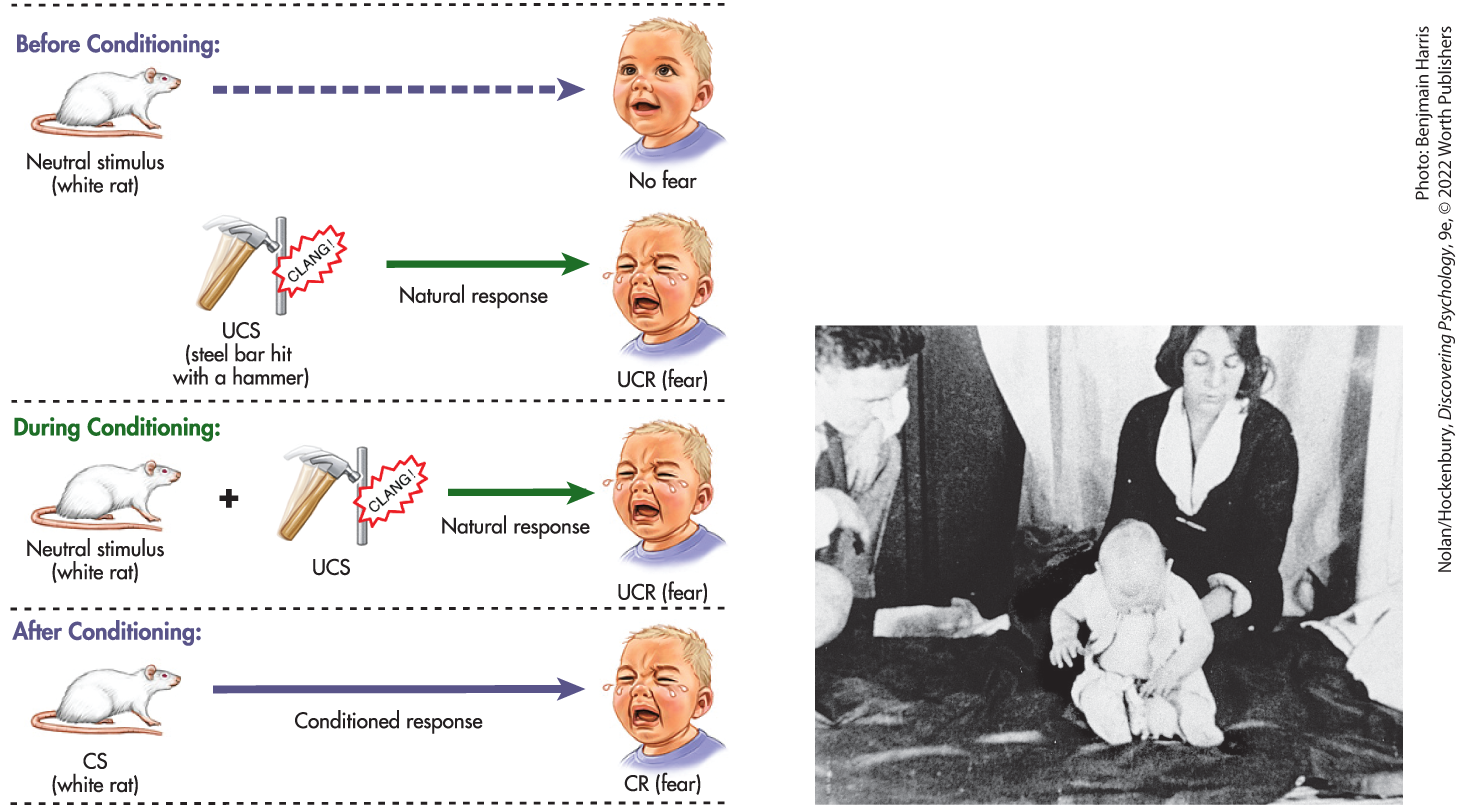
Two months later, they trued to condition little albert to fear the rat (conditioned stimulus).
After only 7 pairings of loud noise and rat, the rat alone triggered the response of fear
Other Classically Conditioned Responses
Virtually any automatic response can become classically conditioned.
Ex.) some aspects of sexual responses can be classically conditioned, even on accident
A Neutral stimulus, such as a scent of a cologne is regularly paired with the person with whom you are romantically involved with
Classical conditioning also seems to be involved in some instances of placebo response, also called placebo effect.
Placebo response: an indivudal’s psychological and physiological response to what is actually a fake treatment or drug