Histology

Epithelial Tissue

Connective Tissue

1. Connective Basics

  • Most abundant of the tissues in the body

  • Can be vascular (blood flow) or avascular (no blood flow)

2. Components of Connective Tissues

  • Cells

  • Extracellular Matrix

    • Fibers

      • Collagen

      • Elastic Fibers

      • Reticular Fibers

    • Ground Substance (GS)

      • Water

      • Proteins

      • Large polysaccharides

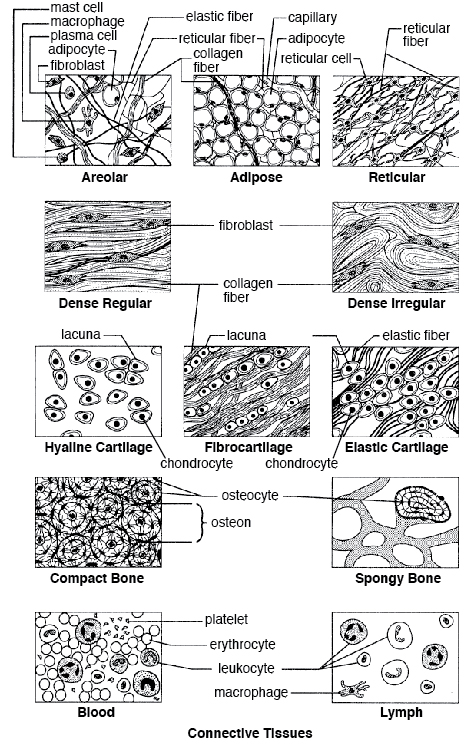
3. Types of Connective Tissues

Name

Type

Characteristics

Function

Parts

Location

Bone (osseous)

specialized CT

  • Very rigid

  • Highly vascular

  • Supports & enables movement, protection, produces blood cells

  • Cells: osteocytes in lacunae

  • Fibers: collagen

  • GS: calcium salts

Hyaline Cartilage

Cartilage - specialized CT

  • Most abundant & least flexible cartilage

  • Smooth/glassy appearance

  • Allows for growth & expansion

  • Cells: chondrocytes

  • Fibers: collagen

  • GS: water and water retaining proteins

  • Ribs to sternum, ends of long bones, trachea, larynx

  • Skeleton of fetus

Fibrocartilage

Cartilage - specialized CT

  • Compressible; very dense & firm

  • Fibers packed b/w cells in rows

  • Strength & shock absorption

  • Cells: chondrocytes

  • Fibers: collagen

  • GS: less water & water retaining proteins

  • Vertebral discs, pubic symphysis, knee meniscus

Elastic Cartilage

Cartilage - specialized CT

  • Very flexible & resilient

  • Shape maintenance

  • Cells: chondrocytes

  • Fibers: elastin

  • GS: slightly more water & water retaining proteins

  • Outer ear, nose, epiglottis

Elastic CT

Dense CT

  • Flexible & resilient

  • Support in movement for structures constantly expanding & contracting

  • Cells: fibroblasts

  • Fibers: elastic

  • GS: sparse

  • Walls of blood vessels, lungs

Dense Regular CT

Dense CT

  • Fibers parallelly arranged, rope-like

  • Strong structures

  • Cells: fibroblasts & some immune

  • Fibers: collagen

  • GS: sparse

  • Tendons & ligaments

Dense Irregular CT

Dense CT

  • Fibers randomly arranged

  • Strength & ability to withstand forces from multiple directions

  • Cells: fibroblast & some immune

  • Fibers: collagen

  • GS: sparse

  • Dermis

Areolar CT

Loose CT

  • Cobwebby/net-like appearance

  • Lots of fluid, loose consistency

  • Cushions & protects organs

  • Cells: fibroblasts & many immune

  • Fibers: reticular, elastic, & collagen

  • GS: plentiful, gel-like

  • Under epithelial layers & mucous membranes

  • Filler b/w organs

  • Around & b/w blood vessels & muscle

Adipose

Loose CT

  • Cells very prominent

  • Stores fat for energy reservoir, insulation, & cushioning

  • Cells: adipocytes

  • Fibers: small amount of collagen & reticular

  • GS: sparse

  • Subcutaneous tissue

  • Around internal organs & joints

Reticular CT

Loose CT

  • More dense than areolar, somewhat cobwebby appearance

  • Internal structural support

  • Filters blood & lymph

  • Cells: fibroblasts & immune

  • Fibers: reticular

  • GS: plentiful

  • Lymphatic organs

  • Bone marrow

  • Kidneys

Blood

specialized CT

  • Vascular

  • Transports various molecules and nutrients

  • Regulates body functions

  • Protects immune function & clotting

  • Cells: leukocytes (white), erythrocytes (red), thrombocytes (platelets)

  • Fibers: proteins

  • GS: plasma

  • Blood vessels

Muscle Tissue

Nervous Tissue