Class 6 In Class Notes: Cell Membranes
Lipids
Building blocks are fatty acids
phospholipids have two fatty acid chains
carboxyl group and hydrocarbon chain
saturated vs unsaturated
impacts packing structure
unstaurated has a double bond, unsaturated with hydrogens
creates a bend in the unsaturated → fluid membranes
nic elong chians = saturated →solid membranes
saturated
most animal fats
solid at room temp
unsaturated
plant fats and fish fats are usually unsaturated
liquid at room temperature
Fluid mosaic
the lipid layer forms the foundation of cells membranes is a bilayer fromed by phospholipids
more promienent
proteins float in or on the fluid lipid bilayer
also common to find in there
integral proteins
peripheral proteisn
cholestroal
glycoproteins
glyco means carbohydrate
not static
roataion, lateral diffusion, swinging movement, dransversal diffusion
phospholipids
two fatty acids and a phosphate group are attached to glyceral
the two fatty acid tails are hydrophobic because they are non polar
the phosphate group and its attachments give it a hydrophillic head , which is polar ( attracted to water )
Hydrophobic tails point toward the interior away from the aqueous enviornment
hydrophillic ends are outside and hydrophobic tails are in inside
when lplace sin aqueos → these amphipathic molecules SPONTANEOUSLY assemble into larger structures → impede dpassgae of water soluble substances
impermeable to water
Membrance composition varies fluidity
cholesteral (Lipid) has difference effects on membrane fluidity at different tmperatures
if you change clomposition you can change the lfuidity of these membranes
need Cholestrel ato maintian membrane
at warmer tempreaturse, cholesteraol helps to restrain movement of phosphoipids → keeping it together
at cool temp. helps maintain fluidity → keeping cel lmemebrane functional
membranes; more than just a bilayer

carbohydrates
glycoproteins (>)
proteins
integral proteins
peripheral proteins
membrane properties
sleective permeability
two dimensional fluids
asymmetrical
phospholid sturcture informs function
phospholipids spontaneously form bilauers
phospholipids are amphipathic
polar and non polar end
phospholid bilayer is fluid
fluidity
how many saturated fatty acid tails there are affect fluidity
more unstatured ( more double bounds ) means more fluid
phospholipid length and membrane function
short molecules dont have lots of interactions
long molecules have tons of interactions
long chains have low fluidity, short chains have high fluidity

selective permeability
Co2 can go out and O2 can go in
small nonpolar moleucles like benzene can go through cell membrane
these are small so they can get through
small polar molecules can also ge trhoguh
large polar molecuels cannot get throguh
cant get thorugh non polar region
Charged molecules cannot get in because they are ionically charged
more likely to stick and stay with water on one side than pass through the hydrophoic barrier ( inteiror )
membrane repels large polar moleucle sand ions, but not small nonpolar or small uncharged molecuels
Membrane proteins
peripheral proteins
non-covalently bond swith membrane proteins or membrane lipids
so bonds are weakly associated with membrane → more temporary
can be removed by disrupting noncovalent interactions ( low pH or high salt solutions )
tend to be on the outside
integral proteins
span the lipid bilayer
nonpoalr regions of the protein are embedded inthe interior of the bilayer
polar regions of the protein protrude from both sides of the bilayer
tend to be on outside
R group impacts what makes them nonpolar or protein
intergral proteins and their functions

transporters
enzymes
cell surface receptors
cell surface makrers
if you dont have identifying markers → immunse syste might attack the cells
cell to cell adhesion
attachments to cytoskeleton
two types of transport across membarnes
passive
doesnt use energy
diffusion
faciliatated diffusion ( ex; channel proteins )
use a protein to help move from high concnetartion to low concentration
protein might change conformationcal shape but doenst use ATP ( like a aquapore )
osmosis
high concentration to low concentration ( diffusion )
active transport
use ATP
facilitated transport ( coupled transprt )
using a protein with atp involved
moving against gradient
low concentration to high concentraton
bulk tranpsot
endocytosis
exocytosis
moving parts can be passive transport

all channel proteins are passiv e
some carrier proteins are passive, some are active ( loop for energy input)
Osmotic pressure
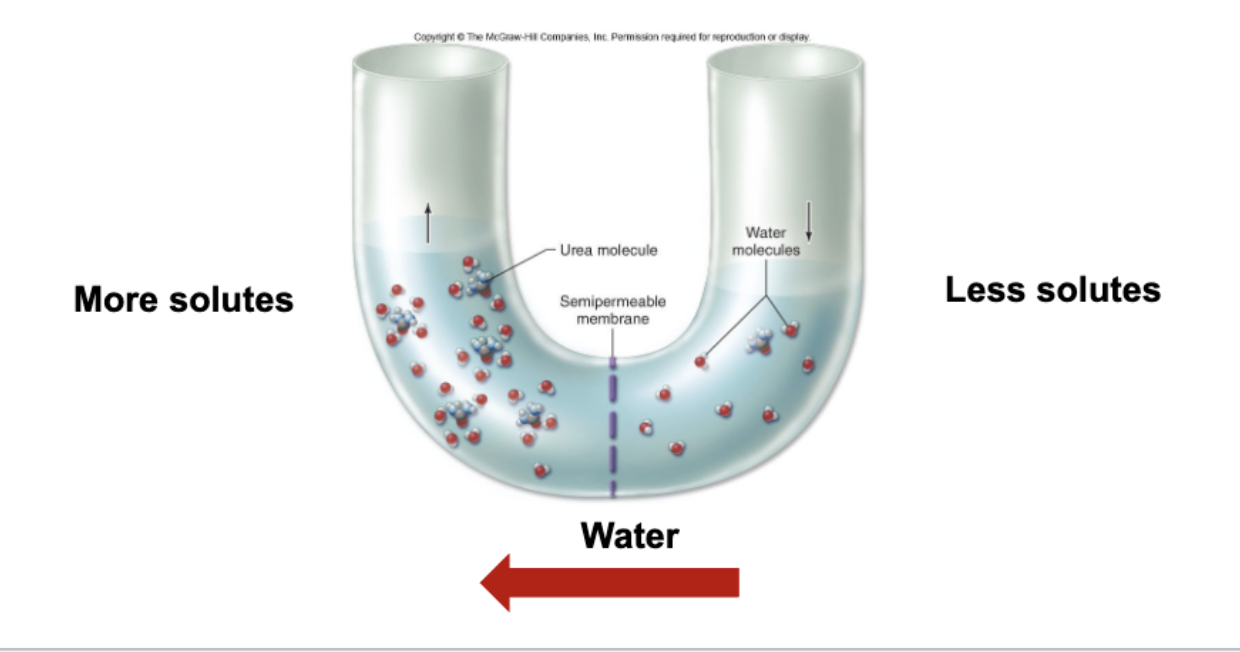
passive
water wants to go down its gardient, to higher solute concentartion
have to consider tonicty = amount of solutes in solution
wants to hypertonic
wants to go from less solutes to more solutes
so moving form low tonicity to high tonicity
becuase there is less oslutes, there is more water
becuase there is more solutes, there is less water
Active transport across membranes

require energy to move solutes against their gradients
performed by specific proteins embedded inthe membranes
Sodium potassium runs directly on ATP
coupled transport uses ATP indirectly
Coupled trasnport doesnt use ATP
uses the concentration graduate established by active transport
Carrier vs channel proteins
channels are faster
always passively
can be gated or always open
carriers are slower
passively or actively
move larger oleucles
Bulk tranpsort
active transport
exocytosis = out of the cells
endocytosis = into the cell
phagocytosis = cell eating
pinocytosis = cell drinking