Embryology
Defintions
Embryogenesis - formation of body structures and organs
Embryonic period - time period from fertilization to earliest stages of organogenesis
Fetal period - time period between the embryonic period and parturition in which organs grow and begin to function
Fertilization - union of two haploid gametes to form a diploid zygote
Clevage - series of mitotic division increasing in cell number, but not cell size
Blastomere - daughter cells formed by mitotic divisions of a large zygote
Morula - compacted zygote created in late clevage; solid ball of blastomeres within a zona pellucida (pluripotent stem cells)
Holoblastic clevage - the egg divides into seperate blastometes (whole cell divides)
Meroblastic clevage - incomplete clevage; only a portion of the egg divides due to large yolk
Cell differentiation - result of cell expressing some genes and suppressing others within a common genome
Blastulation - process that a morula will undergo; beginning of cell differentiation
Outer blastomere - becomes flattened and develops the capacity to secrete fluid (trophoblasts)
Inner blastomeres - from gap junctions to maximize intercellular communication (inner cell mass; embryoblasts)
Blastocyst - consists of a large number of blastomeres arranged to form a hollow, fluid-filled, spherical, or cylindrical structure (pluripotent stem cell)
Gastrulation - Begins with a blastocyst and the formation of the embryonic disc; inner cell mass begins to differentiate (hypoblasts and epiblasts)
Embryonic disc - group of thickened cells (made by embryoblasts) that degrades trophoblast cells overlaying the inner cell mass layers
Primitive streak - forms as cell growth creates a pair of ridges seperated by a depression on the epiblast surface
Coelom - fluid-filled body cavity that develops inside the mesoderm; epiblast cells in the primitive streak will proliferate and fall here
Ectoderm - germ layer that forms the epidermis, hair, nails, brain, spinal cord, peripheral nervous system
Mesoderm - germ layer that forms muscle, bone, connective tissue, notochard, kidney, gonads, circulatory system
Endoderm - germ layer that forms epithelial lining of the digestive tract: stomach, colon, liver, pancreas, bladder, lung
Monozygotic twins - twins that originate from one fertilization; same genetic composition
Dizygotic twins - twins that originate from two fertilizations; both sharing the same pregnancy
Notochord - rod-shaped aggregate of cells between the ectoderm and endoderm along the primitive streak; induces formation of head process, nervous system development, and the formation of somites; future vertebral column
Neurulation - notochord induced transformation of ectoderm into nervous tissue
Notes
Embryogenesis requires cell division and differentiation (proliferation and specialization); produces variety of cell types and extracellular bodily products
Fertilization ends with the initiation of mitosis (clevage)
Fusion of a spermatozoon with an oocyte takes place in the uterine tube near the ovary, binds to glycoprotein on the zona pellucida surrounding the oocyte - spermatozoon releases degradative enzymes that denatures the zona pellucida allows the sperm to penetrate the barrier - oocyte cancels its membrane potential and denatures its zona pellucida, preventing additional sperm fusion
Cells in the center of a morula will differentiate, as opposed to cells in the surface
Cell differentation occurs due to different protein/peptide (secretory products, enzymes, and channels/pumps) production
During the separation of the trophoblasts and the inner cell mass, the zona pellucida will begin to degrade
Eventually blastocyst attaches to or implants within the uterine wall
Only after the degradation of the zona pellucida
Morphogenic process that give rise to the three primary germ layers: Ectoderm, mesoderm, and endoderm
Trophoblast cells overlaying the inner cell mass degenerate
Inner cell mass cells proliferate, break loose, and migrate to form the endoderm
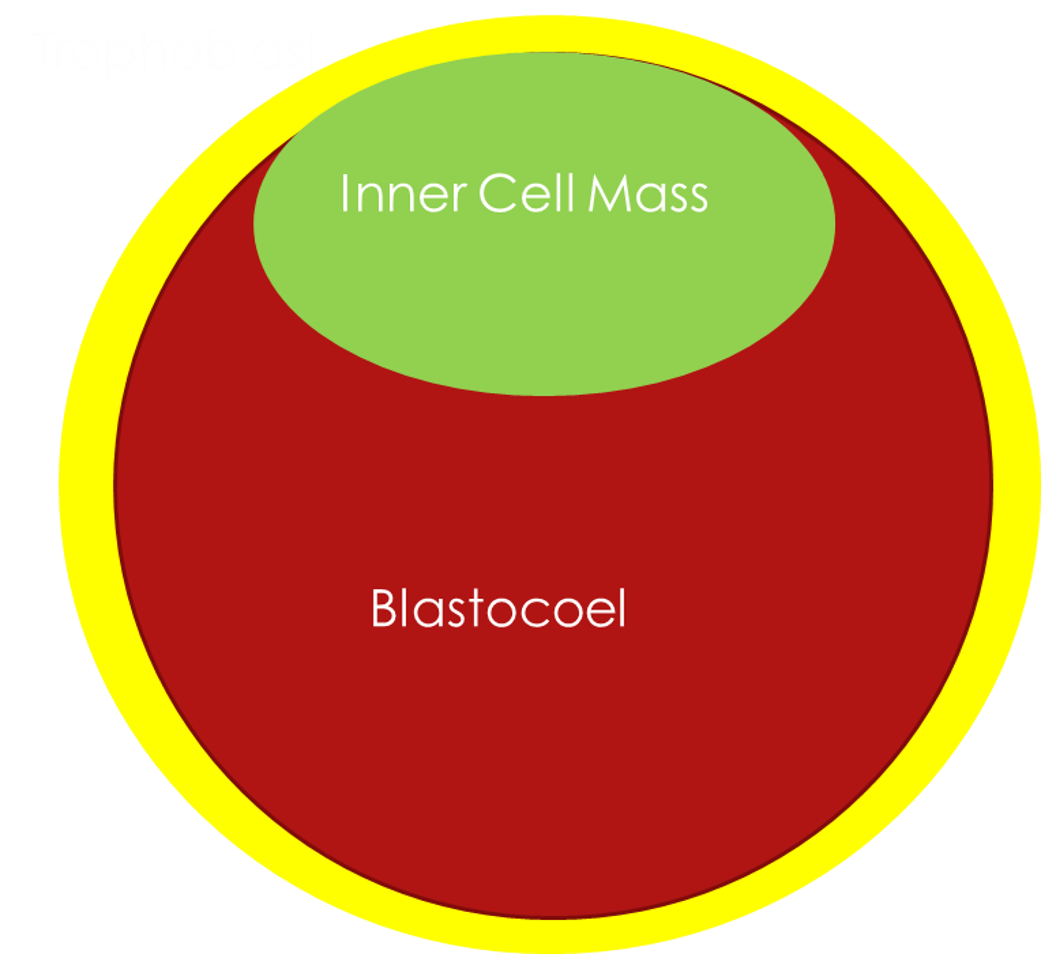
Begins with a blastocyst and the formation of the embryonic disc
Inner cell mass begins to proliferate
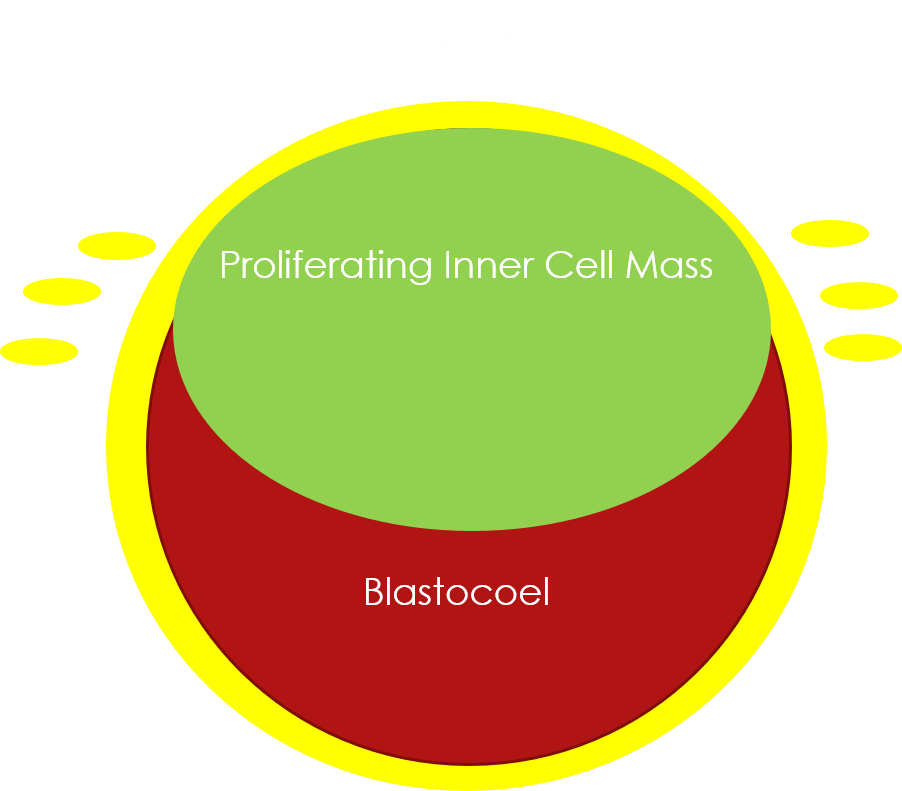
Trophoblast cells overlaying the inner cell mass layers begins to degenerate due to the increase in cells below (embryonic disc)
Once the embryonic disc is formed, the inner cell mass begins to differentiate (epiblast and hypoblast)
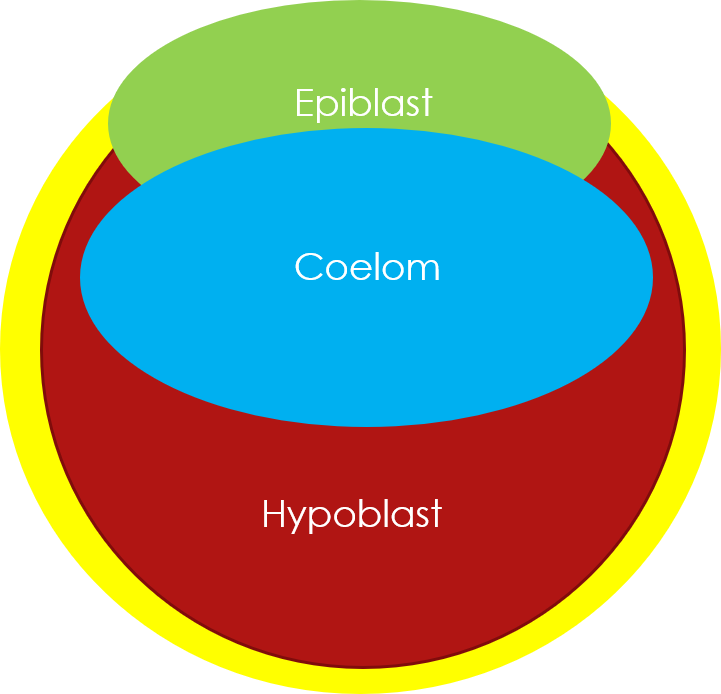
The hypoblast cells will detach from the epiblast cells and form the yolk sac
On the epiblast surface(embryonic disc), a primitive streak forms as cell growth creates a pair of ridges separated by a depression.
Deep to the primitive streak a space (coelom) is evident between the hypoblast layer and epiblast layers (proliferating epiblast cells fall into space)
primitive streak

Epiblast cells proliferate along primitive streak and migrate through. The migrating cells form the endoderm and mesoderm

Morula splits and each part becomes a separate conceptus in monozygotic twins
Morula inner cells separate, and each becomes an embryo, sharing and same placenta
Review - Prenatal Development Stages: Fertilization → Clevage → Morula → Further cell division → Blastulation - Blastocyst (trophoblast +inner cell mass (embryoblast)) → Zona pellucida hatching → Trophoblast implants into uterine wall and is enveloped by endrometrium → Inner cell mass differentates → Hypoblast and epiblast form inside blastocyst (embryotic disc) → amnion forms from epiblast and yolk sac from hypoblast → Primitive streak developes on epiblast (gastrulation) → hypoblast cells detach from the epiblasts and sink into the coelom → Epiblast cells proliferate along primitive streak and migrate through streak → Epiblast differentiates into endoderm and mesoderm → Remaining epiblast becomes ectoderm
Neurolation steps:
Ectodermal cells (neuroectoderm) over the notochord become tall and form the neural plate
A neural groove forms as edges of the plate become raised on each side of a midline depression
Neural tube is formed as the sides of the neural groove touch (The tube separates from non neuroectoderm which unites dorsal to the neural tube)
Where the neural groove is joined to non neural ectoderm, cells detach as groove closes; the cells proliferate and move dorsolateral to neural tube forming the neural crest
Neural Tube
Central Nervous System
Neural Crest Cells
Pigmented cells in skin
Neurons and glial cells of the peripheral nervous system
Adrenal Medulla Cells
Meninges
Cranial bones
Fascia
Teeth


