Section 7: Sources of Long-Run Economic Growth
Long-Run Economic Growth: Measurement, Drivers, and Sustainability
Measuring Long-Run Economic Growth
Definition: Long-run economic growth is typically measured as the increase in real GDP per capita.
Real GDP per Capita Calculation:
Example (Macronesia):
In : Real GDP = million, Population = . Real GDP per capita =
\frac{$200,000,000}{100,000} = $2,000.In : Population increases to (a increase). Real GDP increases by to
200,000,000 \times 1.05 =.Real GDP per capita in =
\frac{$210,000,000}{105,000} = $2,000.In this scenario, real GDP per capita stayed constant.
Historical Trends in Real GDP per Capita
United States: The U.S. economy currently produces more than eight times as much per person as it did in . By , U.S. real GDP per capita was of its level.
Global Disparities: As of , roughly a quarter of the world's population lives in countries where the standard of living is lower than it was in the United States in .
Varying Growth Rates: While countries like the United States have grown quickly, some nations have experienced stagnation.
Benefits and Costs: Economic growth, such as China's dramatic rise, often comes with associated costs, like increased air pollution.
The Rule of : The Power of Compounding
Concept: Even small differences in annual growth rates become significantly magnified over long periods due to compounding.
Formula: The number of years it takes for a variable to double is approximated by dividing by its annual growth rate.
Examples:
If real GDP per capita grows at an annual rate of : it will double in
years.If real GDP per capita grows at per year: it will double in
years.Application (India vs. Italy): If India's GDP per capita is
$3,000and grows at per year, and Italy's current GDP per capita is$24,000:Each doubling takes
years.To reach
$24,000from$3,000, India needs to double its GDP per capita three times (3,000 \to 12,000 \to).Total years =
years.
Implication: Small, consistent improvements in growth rates yield substantial economic gains over time.
The Crucial Role of Productivity in Long-Run Growth
Labor Productivity (Productivity): Defined as output per worker.
Drivers of Productivity Growth: Productivity growth, which is essential for long-run economic growth, is driven by three main factors:
Physical Capital: Human-made resources such as buildings, machinery, and infrastructure that enhance a worker's ability to produce goods and services.
Human Capital: The improvement in labor quality resulting from education, training, and knowledge embodied in the workforce. A more educated and skilled workforce is more productive.
Technological Progress: Advances in the means of producing goods and services, leading to new products, more efficient processes, or better ways to utilize existing resources.
The Aggregate Production Function and Diminishing Returns
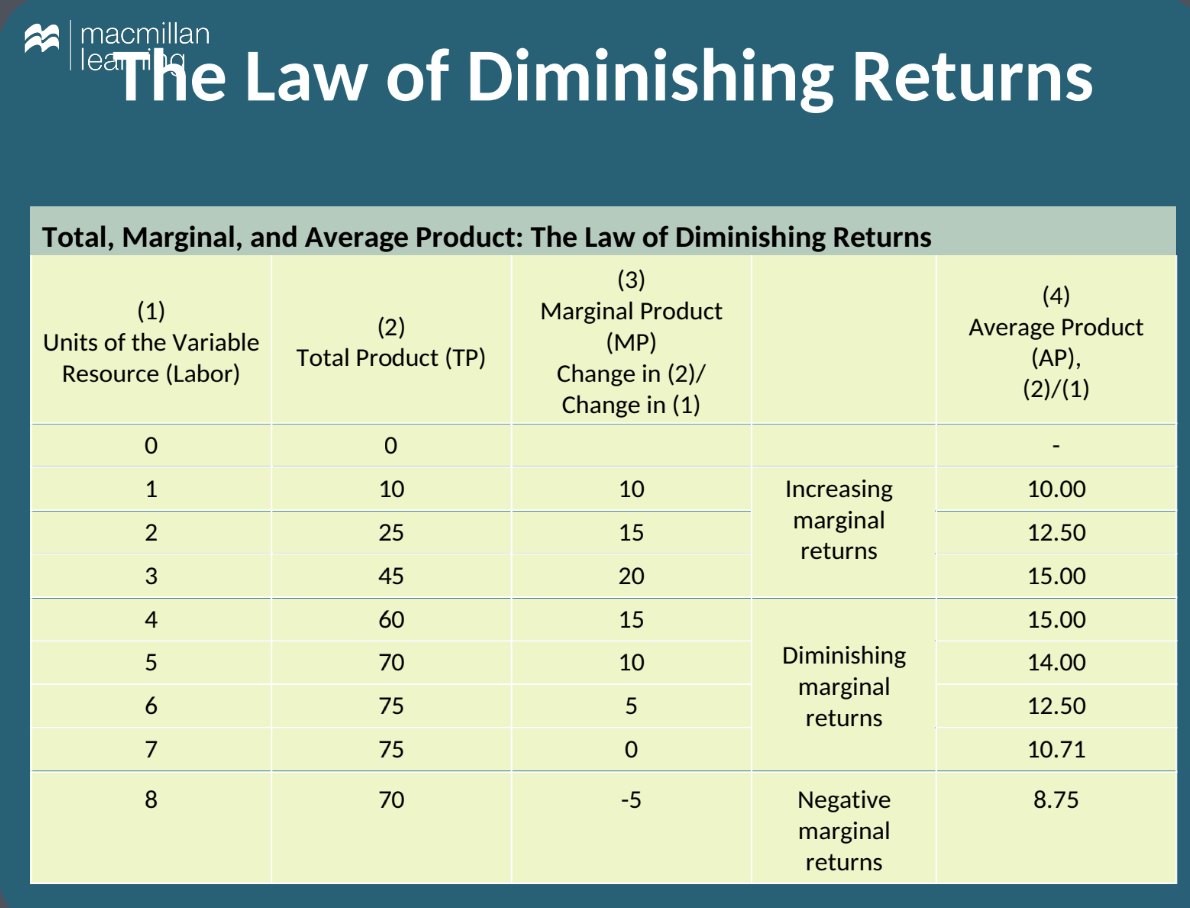
Aggregate Production Function: A hypothetical function illustrating how productivity (real GDP per worker) depends on:
The quantities of physical capital per worker.
The quantities of human capital per worker.
The current state of technology.
Diminishing Returns to Physical Capital: When the amount of human capital per worker and the state of technology are held constant, each successive increase in the amount of physical capital per worker leads to a smaller, or diminishing, increase in productivity.
Example: While a first computer monitor significantly boosts productivity, a second monitor provides a smaller, inmental improvement.
The Law of Diminishing Returns Illustrated: This principle describes how, after a certain point, adding more of a variable input (like labor or physical capital) while holding other inputs fixed will eventually lead to smaller increases in output per unit of the variable input.
Overcoming Diminishing Returns: The effects of diminishing returns to physical capital can be offset if there are simultaneous increases in human capital per worker or improvements in technology, or both.
Total Factor Productivity (TFP)
Definition: Total factor productivity (TFP) represents the amount of output that can be produced with a given amount of factor inputs (physical capital, human capital, and raw labor).
Significance: When total factor productivity increases, the economy can produce more output even with the same quantities of physical capital, human capital, and labor. This indicates an overall increase in efficiency or technological advancement.
Growth Accounting: TFP is a key component in understanding what causes economic growth, as it captures the part of growth that cannot be explained by increases in individual inputs.
Impact of Technology: Rising total factor productivity is often driven by technological progress, which effectively shifts the productivity function upwards, allowing more output for any given level of physical capital per worker.
Natural Resources in Modern Economic Growth
In the modern global economy, human capital and physical capital generally play a more significant role in driving economic growth for the majority of countries than the abundance or scarcity of natural resources.
Sustainability of World Growth
Sustainable Long-Run Economic Growth: This refers to long-run growth that can continue indefinitely despite the limited supply of natural resources and the environmental impact of economic activity.
Key Questions for Sustainability:
How extensive are the available supplies of crucial natural resources?
How effective will technological innovation be in discovering or developing alternatives to scarce natural resources?
Can long-run economic growth persist in the face of resource scarcity and environmental limitations?
Climate Change: A significant challenge to sustainable growth is climate change, largely attributed to human activities.
Environmental Impact of Growth: Economic growth generally intensifies the human impact on the environment.
Lack of Automatic Incentives: Unlike resource scarcity (which can drive price increases and innovation), environmental problems do not automatically create market incentives for behavioral change.
Paris Agreement (2015): nations committed to reducing greenhouse gas emissions to limit the rise in Earth's temperature to no more than
degrees Celsius.The Great Energy Transition: The shift from heavy reliance on fossil fuels to clean energy sources is crucial for mitigating catastrophic climate change.
Future Outlook:
It is plausible to maintain long-run growth while addressing climate change.
The costs associated with clean energy technologies are decreasing due to rapid technological innovation.
Current estimates suggest that a substantial reduction in greenhouse gas emissions over the next few decades would result in only a modest reduction in the long-term rise of real GDP per capita.
Achieving Sustainable Growth: Policy Interventions
Societies need to implement integrated strategies to achieve sustainable long-run economic growth and environmental protection:
Regulations and Environmental Standards: Establish and enforce rules to limit pollution and resource depletion.
Market Incentives: Institute policies (e.g., carbon taxes, subsidies for green technologies) that encourage individuals and firms to transition towards clean energy sources and sustainable practices.
International Cooperation: Collaborative efforts among nations are essential to address global environmental challenges like climate change.
Government Policies to Promote Economic Growth
Governments play a vital role in fostering an environment conducive to long-run economic growth:
Government Subsidies to Infrastructure: Investing in critical infrastructure such as roads, power grids, ports, and information networks forms the physical backbone for economic activity.
Government Subsidies to Education: Supporting education at all levels enhances human capital, making the workforce more skilled and productive.
Government Subsidies to Research & Development (R&D): Encouraging spending to create and implement new technologies (like Thomas Edison's innovations) fuels technological progress, which is a key driver of TFP.
Maintaining a Well-Functioning Financial System: An efficient financial system facilitates savings and channels investment into productive physical and human capital projects.
Protection of Property Rights: Secure property rights provide individuals and businesses with the incentive to invest and innovate, knowing their assets are protected.
Political Stability and Good Governance: A stable political environment with transparent and effective governance reduces uncertainty and encourages long-term investment.
Factors Explaining Growth Rates Around the World
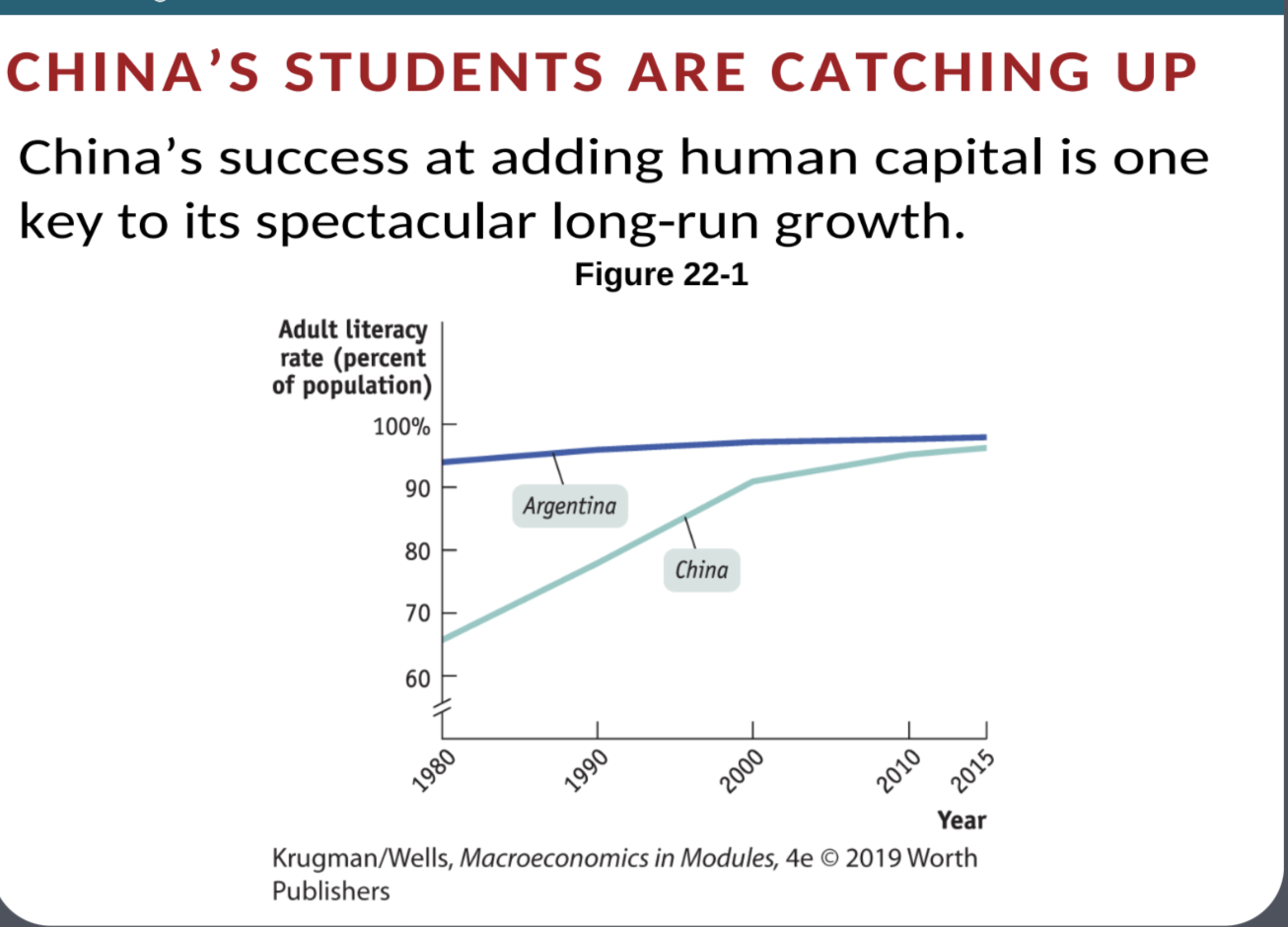
Common Traits of Faster-Growing Countries:
High Savings and Investment: Rapidly add to their physical capital through significant savings rates translated into investment spending.
Increased Human Capital: Upgrade their educational levels and workforce skills.
Fast Technological Progress: Successfully adopt and develop new technologies.
Example: China has demonstrated spectacular long-run growth, partly due to its success in rapidly adding human capital (e.g., increased student enrollment).
Case Study: East Asia's Miracle:
Very High Savings Rates: Enabled businesses to borrow and invest heavily in physical capital per worker.
Excellent Basic Education: Led to rapid improvements in human capital.
Substantial Technological Progress: Contributed significantly to productivity gains.
Case Study: Argentina (and Latin America): Factors hindering growth include:
Irresponsible Government Action: High inflation eroded savings, discouraging investment.
Lack of Emphasis on Education: Limited human capital development.
Political Instability: Created an unpredictable environment for long-term planning and investment.
Case Study: Africa's Challenges and Promises: Factors hindering growth include:
Government Corruption: Misallocation of resources and lack of trust.
Civil Wars and Political Instability: Disrupt economic activity and discourage investment.
Unfavorable Geography: Can pose barriers to trade, infrastructure development, and agricultural productivity.
Debate: The relationship between poverty and political instability is often circular.
Positive Note: Some African countries like Nigeria, South Africa, and Angola showed increased growth rates (around annually) from .
The American Middle Class and Growth Distribution
Historically, rising real GDP per capita tended to translate into real income gains for the majority of the population in the United States.
However, this trend has become less consistent in recent times, suggesting a widening gap in the distribution of economic growth's benefits.
The Convergence Hypothesis
Definition: The convergence hypothesis posits that international differences in real GDP per capita tend to narrow over time, meaning poorer countries grow faster and catch up to richer ones.
Evidence: While there is some evidence that real GDP per capita tends to converge, this only holds true when