Practical Research 2
Identifying a Quantitative Research Problem
Importance of topic choice
A well-chosen topic is an essential skill to start a good research paper.
Must be relevant, valuable, interesting, and feasible within available resources.
Allows maximization of time, data, and literature.
Steps in Identifying an Area of Inquiry
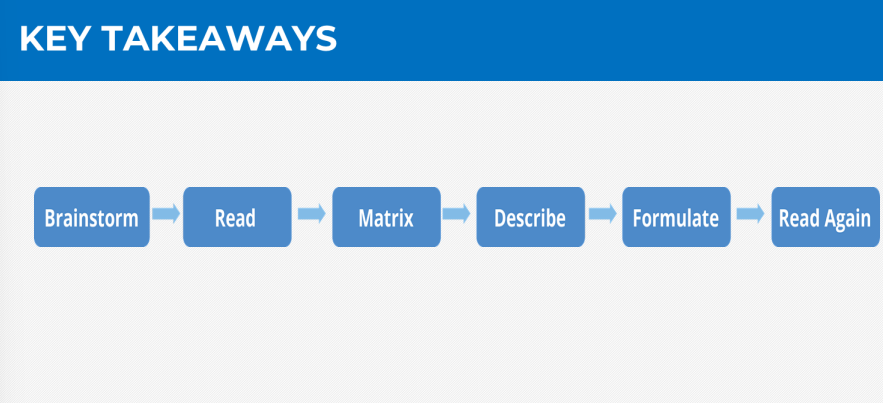
Brainstorm for ideas
Focus on personal interests and your field of specialization.
Generates intrinsic motivation and domain expertise.
Read, read, and read
Confirm availability of literature; preview scope and depth.
Use keywords and related concepts across databases, journals, books.
Make your matrix
Track past studies, variables, methods, findings.
Identify research gaps—unanswered questions or under-researched angles.
Prevents exact replication and answers the "So what?" challenge.
Scan "recommendations for future research" and study limitations for gaps.
Describe your topic briefly
Pinpoint the specific angle, value, and relevance.
Early feasibility check.
Read again
Re-verify literature depth; be ready to adjust topic or variables.
Formulate your working title
Serves as compass for variables, scope, and direction.
Working titles evolve during the writing process.
Designing Research Useful in Daily Life
Choose topics that intersect personal interest, field relevance, and societal need.
Sample fields & potential topics
Accounting: Accounting systems, forensic accounting, collusion in auditing, tax minimization, e-commerce practices, financial markets.
Business & Management: Green marketing, online shops, work environment, marketing/budgeting strategies, leadership styles.
Environmental & Earth Science: Marine pollution, genetics, conservation, recycling, sustainability, soil contamination, environmental ethics.
Health Science: Homeopathy, tolerance, vaccination, stress, mental health, global health security.
Education: Grit, inclusive education, teaching strategies, -century learning, homeschooling, motivation.
Social Sciences: Discrimination, electoral equality, stereotyping, patriotism, migration, juvenile delinquency.
Humanities: Taboos, symbolism in art, folklore, film aesthetics, indigenous cultures, religious influences.
Early exploration clarifies purpose, scope, and contribution to knowledge.
Writing a Research Title
Competency: Writes a research title.
A research title concisely summarizes the study’s content and distinguishes it from prior work.
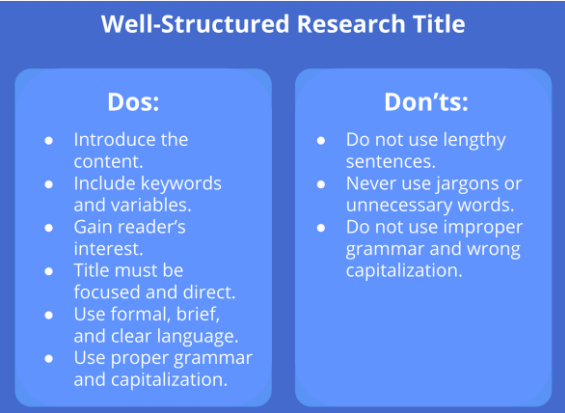
Characteristics of a Well-Structured Title
Focused and Direct – names variables and field.
Formal – avoids abbreviations, jargon, colloquialisms unless central.
Brief but Substantial – commonly essential words.
Clear – understandable even to non-experts; aids indexing.
Proper Grammar & Capitalization – capitalize major words; observe punctuation.
Steps in Writing a Good Title
Segment research details
Primary objective, variables, method, respondents.
Example: studying whether classical music improves students’ memorization.
Independent Variable: classical music
Dependent Variable: memorization skills
Method: experiment
Respondents: engineering students at XYZ University
List keywords – e.g., "listening to classical music," "experiment," "memorization," "engineering students".
Draft a sentence with keywords – then compress.
Formulate the title – revise repeatedly while keeping essence.
Variants (word counts shown):
An Experimental Research on the Effects of Classical Music to the Improvement of Memorization Skills of Engineering Students of XYZ University ( words )
Effects of Classical Music to the Memorization Skills of Engineering Students of XYZ University: A Research Experiment ( words )
The Effects of Classical Music on the Memorization Skills of Engineering Students in XYZ University ( words )
Basic Guidelines
Use specific descriptors; avoid generic "Study of…" openers.
Include main independent & dependent variables.
Avoid or limit abbreviations (exceptions: DNA, ICT).
Declarative form preferred; question form acceptable sparingly.
Exclude year unless historical context demands.
Prefer words (institution dependent); italicize full scientific names: Allium sativum.
Maintain an academic tone—no humor or casual language.
Writing the Research Background
Competency: Describes background of research.
Purpose: situate current study within existing knowledge, justify relevance, introduce variables.
Steps in Writing the Background
Conduct preliminary research – establishes parameters and prevents redundancy.
Identify a writing style
Deductive: general → specific.
Inductive: specific → general.
Emphasize the field – nature and the field of the current study. Let readers quickly grasp the study’s domain.
Read and integrate related literature – provide historical and theoretical contexts.
Focus on relevance & contribution – relevance and potential contributions. emphasize significance and potential impact.
Summarize appropriately – balance, avoid both scant details and redundant elaboration; outlines help.
Outlines are helpful in writing the research background. Initial contents of the outline can come from preliminary research on the topic.
Characteristics of a Good Background
Written in formal, academic language; correct grammar and spelling.
Concise, organized, coherent.
Evidence-based; excludes personal opinion.
Focused on the research problem; omits unrelated info.
Explains study goals and potential contributions.
Clearly introduces variables (for quantitative work).
Cites related literature.
Guiding Questions Addressed
What is already known?
What is not known (research gap)?
Why address those gaps?
What is the study’s rationale?
Writing a Research Statement / Research Questions
Good research questions guide data collection, analysis, and interpretation.
Categories of Quantitative Research Questions
Descriptive – describe patterns; single, non-complex variables.
Example: "How frequent is the production of essential oils for herbal medicines?"
Comparative – contrast groups or variables.
Example: "What is the difference between the quality of natural and synthetic ink?"
Evaluative – assess phenomena using models or standards; common in program assessment.
Example: "How satisfied are you with the implementation of the K-12 curriculum?"
Explanatory – explain or predict relationships and causality.
Example: "How does nurse intervention affect a patient’s pre-surgery stress level?"
Desired Attributes of Research Questions
Relevant – aligned with the research problem.
Specific – neither overly broad nor excessively narrow.
Clear – simple, unambiguous language.
Analytical – demand more than a yes/no answer.
Measurable – feasible via instruments, tests, or experiments.
Guidelines for Writing the Research Statement (Statement of the Problem)
Finalize topic – ensures coherence.
Example topic: Effect of Facebook photo "likes" on teenagers’ self-esteem.
Draft research questions – map onto category type.
Explanatory: "How do Facebook photo ‘likes’ affect the self-esteem of female adolescents?"
Descriptive: "What factors affect the number of Facebook photo ‘likes’?"
Compose general problem statement
Contains topic, main objective, variables.
Example: "This study aims to find out the effect of Facebook photo ‘likes’ on the level of self-esteem of female senior high school students in XYZ School."
Refine – include sub-questions, scope, and potential benefits; keep language concise.
Keep the statement of the problem short and simple. Make sure that the statement of the problem reflects the research problem, research questions, and the aims of the study.
Sample Detailed Statement (Bangus-Turmeric Seatwork)
Objective hierarchy
Test effect of turmeric extract at , , and on shelf life of raw Bangus belly via
Antimicrobial activity
Lipid oxidation
Assess sensory qualities (color, taste, odor) of cooked Bangus belly treated with turmeric.
Determine significant differences among treated vs. control samples across all criteria.