Unit 4 - Food Chemistry
FOOD CHEMISTRY
THE CHEMISTRY AND FUNCTIONALITY OF WATER, CARBOHYDRATES, LIPIDS AND PROTEINS IN FOOD SYSTEMS
WATER
Learning Outcomes
After completing this subunit, these objectives will have been achieved:
Describe the physical and chemical properties of water including polarity, solubility, boiling point, freezing point, water activity, and specific heat.
Explain the impact of these properties on food quality.
Identify the role of water in food spoilage.
WATER IS ESSENTIAL FOR LIFE
Water (H2O) is the most abundant molecule in food.
Characteristics:
Colorless, odorless, and tasteless at room temperature.
Essential for all living organisms, thus every organism contains water.
The water content in various foods varies widely:
Raw ripe tomatoes: 94% water
Milk: approximately 88% water
Cooked chicken: about 65% water
Cooked salami: 45% water
Butter: approximately 15% water
Generally, fruits and vegetables contain more water than meats and grains.
PROPERTIES OF WATER
Polarity: Water is a polar molecule enabling it to form hydrogen bonds with other molecules.
Solubility: Water acts as a nearly universal solvent, capable of dissolving a variety of substances through:
Ionization: Example: Common salt (NaCl) ionizes in water, forming a true solution.
Hydrogen Bonding: Larger organic molecules, like sugar, dissolve in water by forming hydrogen bonds, also creating a true solution.
Hydrophilic vs. Hydrophobic:
Hydrophilic substances dissolve readily in water.
Hydrophobic substances do not dissolve in water.
Suspension: Example: Starch in water.
Emulsions: Types include oil-in-water (e.g., milk) and water-in-oil (e.g., butter).
CONTINUED PROPERTIES OF WATER
Boiling Point:
Defined as the temperature at which vapor pressure (VP) equals atmospheric pressure (AP).
Normal boiling point of water is 100 °C.
At higher altitudes, water boils at lower temperatures due to decreased atmospheric pressure.
The boiling point can rise when solutes like salt or sugar are added.
Freezing Point:
Pure water freezes at 0 °C at sea level.
Water's unique structure makes it less dense in its frozen state than in liquid state; maximum density occurs at 4 °C.
The presence of solutes lowers the freezing point of water.
Faster freezing rates produce smaller ice crystals which reduces damage to food texture upon thawing.
Thawing: The process of bringing a frozen product back to its unfrozen state.
VAPOR PRESSURE
Vapor pressure (VP) influences the boiling point of water.
WATER ACTIVITY (aw)
Defined as: “Water activity (aw) is the partial vapor pressure of water in a substance divided by the partial vapor pressure of water at the same temperature.” (Reference: Principles of Food Chemistry by DeMan et al. (2018))
Represents relative humidity around the food system.
Water activity does not correlate with the amount of water but rather with solute concentration in the mixture.
Water migrates from areas of high water activity to areas of low water activity.
SPECIFIC HEAT OF WATER
Water has high specific heat due to hydrogen bonding, enabling it to absorb and lose significant amounts of heat for small temperature changes.
This property is crucial for temperature regulation in cooking:
Food cooks faster in boiling water (100 °C) than in a dry oven at the same temperature.
High moisture content in air increases the perceived heat; steam is more painful than dry heat.
ROLE OF WATER IN OSMOTIC PRESSURE
A living cell is filled with fluid and surrounded by a semipermeable membrane:
An increase in fluid can lead to cell rupture, whereas too little fluid can cause the cell to shrink, risking cell death.
Osmosis: The process by which water moves across a semipermeable membrane from an area of low solute concentration to high concentration. This is critical for maintaining cell integrity.
OSMOTIC PRESSURE AND CRISPINESS
The water content within fruits and vegetables contributes to their crispiness.
Water loss from cells impacts their texture.
Paraffin wax is applied to fruits to minimize water loss by sealing pores.
CARBOHYDRATES (CHO)
Learning Outcomes
Upon completion, you will:
Classify carbohydrates based on saccharide count.
Enumerate sources of various carbohydrate types.
Justify Canada Food Guide's recommendation for whole fruits and vegetables over juices.
Differentiate between lactose intolerance and milk allergy.
List properties of various carbohydrates, including sugars, starch, and fibers.
Explain the impact of these properties on food quality traits like color, texture, and flavors.
WHAT ARE CHO? HOW ARE THEY CLASSIFIED?
Carbohydrates are hydrates of carbon consisting of carbon, hydrogen, and oxygen.
Synthesized in plants through photosynthesis:
Sun's energy converts CO2 and water into glucose (C6H12O6).
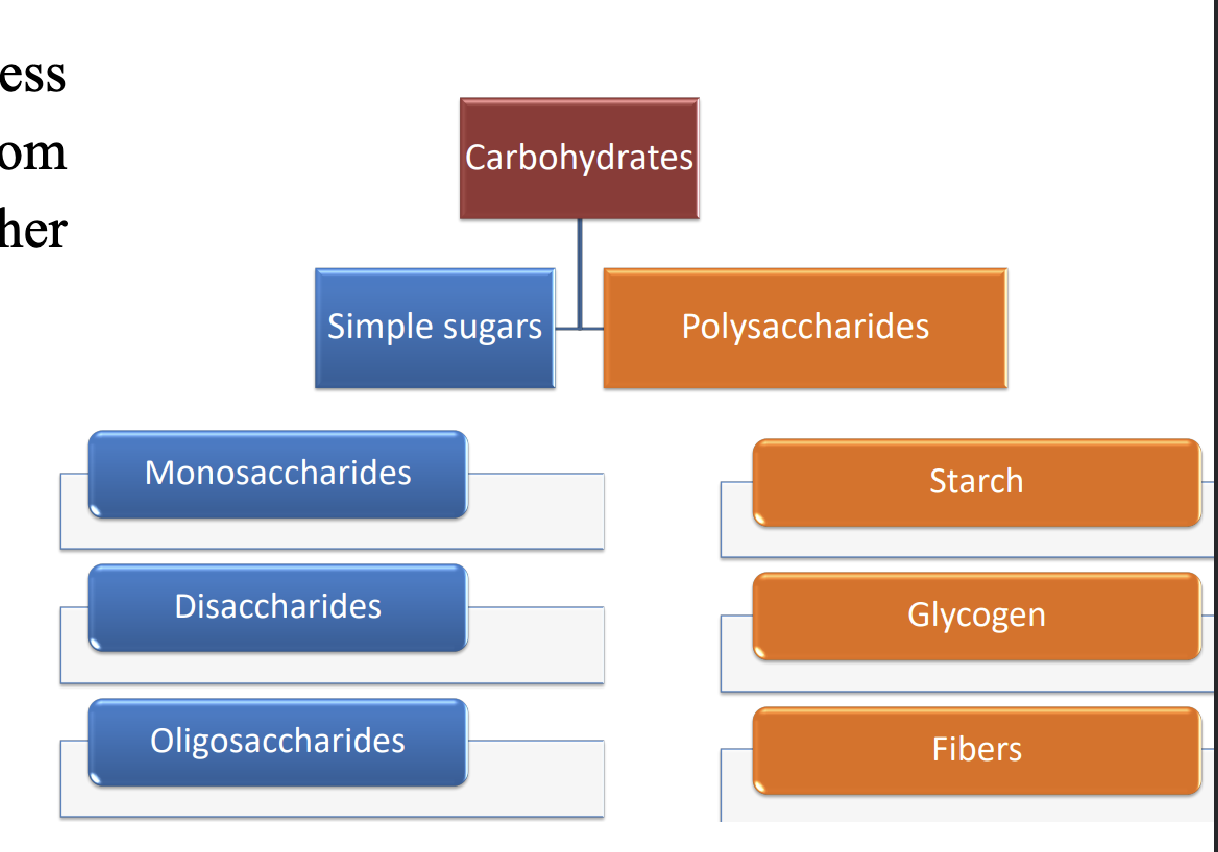
Carbohydrate classification:
Sugars: Monosaccharides, Disaccharides.
Oligosaccharides.
Polysaccharides.
A Saccharide is a sugar molecule
CHO: SUGARS
Monosaccharides
Definition: Simple sugars, composed of one sugar molecule (e.g., glucose, fructose, galactose).
Characteristics:
Sweet in taste.
Do not require digestion.
Rarely occur freely in nature.
Disaccharides
Definition: Sugars containing two interconnected sugar molecules.
Examples:
Sucrose: (glucose + fructose); digested with sucrase.
Maltose: (glucose + glucose); digested with maltase.
Lactose: (glucose + galactose); digested with lactase.
SOURCES OF SUGARS
Sugars are found naturally in plant tissues and milk.
Common free forms are present in fruits and honey.
Sugar cane and sugar beets are primary sources of sucrose for table sugar.
SWEETENER
Not all sugars have the same level of sweetness:
Reference: Sucrose (sweetness level of 1).
Lactose: 0.16.
Maltose: 0.33 - 0.45.
Glucose: 0.74 - 0.8.
Fructose: 1.17 - 1.75 (much sweeter than sucrose).
Sweetness perception is genetically influenced.
Sugars taste sweeter at higher temperatures.
Hygroscopicity: Sugars attract and bind water; they can act as humectants (retaining moisture) and desiccants (removing moisture).
FUNCTIONALITY OF SUGARS
Contribute colors and flavors to foods via:
Caramelization: When dry-heated, sugars melt and turn brown, developing distinct flavors.
Maillard Reaction: Non-enzymatic reaction between reducing sugars and amino acids producing melanoidins—giving aromas and brown color.
Starch Recrystallization and Crystallization
When cooling a supersaturated sugar solution, crystals separate from the solution:
Slow cooling yields large sugar crystals (e.g., rock candy).
Rapid cooling with agitation results in fine crystals (important for fudge).
CHO: OLIGOSACCHARIDES
Definition: Contain 3-10 sugar molecules connected (oligo means a few).
Solubility: Water soluble.
Common examples: Raffinose, stachyose, verbascose.
Digestion: Humans lack enzymes to digest oligosaccharides; thus, they ferment in the colon leading to gas production.
Common in dried beans; soaking in water can help reduce oligosaccharides before cooking, reducing flatulence.
CHO: POLYSACCHARIDES
Definition: Complex carbohydrates with 10 or more sugar molecules, often hundreds (poly means many).
Classification:
Starches: Storage form in plants.
Fibres: Dietary fibers, indigestible.
Glycogen: Storage form in humans.
CHO: POLYSACCHARIDES, STARCH
Nature of Starch:
Storage form of carbohydrates in plant cells; a white, tasteless, odorless powder insoluble in cold water.
Composed of glucose molecules; starch granules vary in size.
Human enzymes can digest starch into glucose monomers.
Sources of starch: Potatoes, yam, cassava, cereals, beans, lentils.
FUNCTIONALITY OF STARCH
**Gelatinization and Gelation: ** Starch granules absorb water when heated, leading to thickening; upon cooling, they create a gel-like structure.
Primary use in kitchens includes thickening soups and gravies; also a binder in various foods.
Dextrinization
Defined as? Heating starch without water, resulting in a breakdown into sweeter, smaller chains, creating dextrins (e.g., in turkey gravy).
Dextrinized starch is less effective at forming gels.
FUNCTIONALITY OF STARCH, CONTINUED
Starches can be hydrolyzed to release glucose, leading to sweeteners (corn syrup). High fructose corn syrup (HFCS) is a syrup from corn starch converted to include fructose.
Example: HFCS 42 contains 42% fructose and 58% glucose.
CHO: POLYSACCHARIDES: GLYCOGEN
Definition: Glycogen is a highly branched polysaccharide, comprised of glucose, serving as the primary carbohydrate storage in animals, mainly in liver and muscles.
Upon slaughter, glycogen is used up, leading to lactic acid formation in meat, making it a negligible source of carbohydrates.
CHO: POLYSACCHARIDES: DIETARY FIBER
Definition: A type of polysaccharide found in plant materials, resistant to digestion.
Classification:
Soluble fibers: dissolve in water, thickening the mixture (e.g., oats).
Insoluble fibers: do not dissolve in water, beneficial for digestive health.
DIETARY FIBERS: SOLUBLE VS INSOLUBLE
Water-Soluble Fibers
Soluble in water, lead to increased viscosity (also called viscous fibers).
Sources: Beans, fruits (like apples), oats.
Benefits: Slow glucose absorption, lower blood cholesterol, reduce heart disease risk.
Water-Insoluble Fibers
Do not dissolve in water, found in outer layers of plants, bind nutrients, impact digestion.
Sources include: fruits’ peels, vegetables, whole grains.
Consumption of whole grains advised over refined grains due to fiber loss in processing.
APPLICATIONS OF FIBERS IN FOOD INDUSTRY
Improve texture:
Soluble fibers retain moisture in baked goods and slow starch retrogradation.
Act as bulking agents and retain moisture in low-fat products, providing creaminess.
Add color through interactions with food color compounds.
Gel formation aiding in fruit jams and jellies due to pectic substances.
LIPIDS
Learning Outcomes
After completing this subunit, you will:
Differentiate between fats and oils and identify dietary sources.
Identify structures of triglycerides, phospholipids, sterols, saturated, unsaturated fatty acids.
Explain hydrogenation chemical changes.
Defend Canada Food Guide recommendations regarding protein sources.
Discuss health impacts of various lipids.
List lipid properties in foods and their effects on quality traits (color, texture, flavor).
LIPIDS, FATS, AND OILS
Lipids predominantly consist of carbon (C), hydrogen (H), and oxygen (O).
Primarily classified into:
Fats: Solid at room temperature (22 °C).
Oils: Liquid at room temperature.
Sources of fats mainly from animal products; these are solid lipids. Plant sources include coconut and palm oil, misnamed as oils.
Oils originate largely from canola, rapeseed, grapeseed, olive, sunflower, and fish.
CLASSIFICATION OF LIPIDS, TRIGLYCERIDES
Lipids can also be classified based on chemical structure:
Triglycerides (Triacylglycerols): Comprising three fatty acids esterified to a glycerol molecule, accounting for 95% of all natural lipids.
Video clip link shared to learn about triglyceride structure and fatty acid types.
Solid lipids have higher saturated fatty acid content, while oils have lower saturation and higher unsaturation.
Health implications discussed regarding saturated and trans fats, notably their association with heart disease.
CLASSIFICATION OF LIPIDS: PHOSPHOLIPIDS
Composed of two fatty acids linked to a phosphorus-containing molecule, phospholipids have both hydrophilic and hydrophobic portions making them emulsifiers, thus blending fats and water.
Video clip link shared for phospholipid structure.
CLASSIFICATION OF LIPIDS: STEROLS
Sterols contain a four-ring structure with hydrocarbon side chains.
Cholesterol, primarily present in animal cells, supports pivotal biological functions but can raise health risks in a subset of the population.
Phytosterols present in plant foods may provide health benefits but require further evidence from research.
SPECIAL TOPIC: LIPIDS AND HUMAN HEALTH
Discussion prompts:
Is margarine healthier than butter?
Identifying ideal cooking oils.
Comparing olive and canola oils.
PROPERTIES AND APPLICATIONS OF LIPIDS IN FOODS
Lipids are utilized for frying due to high-temperature tolerance beyond water boiling points (100 °C), allowing quicker cooking.
Plasticity: Enables solid fats to deform under force, utilized in various products.
FLAVORING PROPERTY
Fats and oils impart unique flavors and can mask undesired notes in low-fat products requiring additives for taste improvement.
Oils preserve aromatic compounds from herbs and spices, sometimes under danger of bacterial growth if improperly stored.
TENDERNESS IN FOODS
The plasticity characteristic of fats contributes to the tenderness of baked goods.
The marbling of meat affects its tenderness through fat distribution.
PROTEINS: CHEMISTRY AND FUNCTIONALITY IN FOOD
Learning Outcomes
By the end of this unit, you will be able to:
Identify amino acid structures.
Explain protein structures (primary, secondary, tertiary, quaternary).
Define denaturation and its effects on food quality.
Discuss desirable and undesirable effects of denaturation.
List protein properties and their impact on food quality traits.
PROTEIN CHEMISTRY
Proteins consist of amino acids linked by peptide bonds.
There are twenty standard amino acids that form the building blocks of proteins in food and human bodies.
The interaction among amino acids leads to various formed proteins impacting food systems.
PROTEIN STRUCTURE
Proteins exhibit four structural levels:
Primary Structure: Linear arrangement of amino acids.
Secondary Structure: Backbone hydrogen bonding resulting in shapes like alpha helices and beta sheets.
Tertiary Structure: Three-dimensional folding influenced by interactions between side chains of amino acids.
Quaternary Structure: Multi-chain combinations to form larger protein complexes.
PROPERTIES AND APPLICATIONS OF PROTEINS IN FOODS
Denaturation
Defined as a reversible or irreversible change in a protein’s structural shape.
Denaturation agents include:
pH changes: Hydrochloric acid in the stomach denatures proteins.
Heat: Cooking denatures egg proteins.
Alcohol: Penetrates cells causing protein denaturation.
UV Radiation: Causes skin cell protein denaturation, leading to sunburn.
Heavy Metals: E.g., mercury causing poisoning by denaturing proteins.
Water Holding Capacity and Solubility
Important for meat juiciness and tenderness.
Major muscle proteins include actin and myosin; connective tissue proteins include collagen and elastin.
Post-slaughter, lower pH (5.5) is desired for soft, juicy meat; higher pH yields tougher texture.
Dairy Proteins: Addition of acid (like vinegar) curdles casein in milk, leading to cheese formation.
Texture and Gelation
Proteins contribute to the fibrous texture of meat; muscle fibre characteristics determine the texture.
Proteins capable of gelation like collagen result in products like gelatin used in desserts.
Color
Proteins such as myoglobin give meat its pink/red color, influenced by oxygen exposure (oxymyoglobin turns red, metmyoglobin turns brown).
Emulsification and Fat Holding Capacity
Proteins facilitate emulsification due to their hydrophilic and hydrophobic nature.
Casein in milk acts as an emulsifier in meat products preventing fat separation.
Enzymes derived from proteins catalyze chemical reactions in food processing (e.g., meat tenderization).
Foaming Properties of Proteins
Foams trap air in liquids, forming structures; ovalbumin from eggs is highly effective in this role, providing texture to baked goods.