5. Lexicology
Size of English vocabulary:
Oxford English dictionary: 600,000+ entries
Varying size of individual’s vocabulary → Problems of definition:
What counts as word?
What counts as knowing a word?
Structural properties of English vocabulary
Dissociation (lack of formal coherence of semantically related words) e.g. city and urban
Homophony and homonymy (related to monosyllabicity)
Over time: loss of unstressed syllables and phonological mergers
Synonymy (near-equivalence of meaning) e.g. freedom, liberty
Complex lexical items
collocations (words frequently occuring together) e.g. come to an end
light verb constructions e.g. do one’s hair
phrasal and prepositional verbs e.g. turn up
idioms e.g. down to earth
→ decrease compositionality
“meaning of complex expression derived from meaning of its parts) → have to be learned by heart
English has tendency to weaken meaning of indivdual words and assign meaning to fixed combinations which can be lexicalised
Problems of synchronic analysis
Morphophonemic alternation, base allomorphy:
many English morphemes undergo irregular transformation in morphological processes
e.g. belief - to believe, crime - criminal
→ Allows tolerance in description of synchronic word-formation
Unique morphs
compound families contain elements that don’t appear elsewhere, have no clear meaning of their own
e.g. CRAN-berry
certain elements recur in related forms but don’t carry identifiable meaning → formatives
e.g. con-sist, in-sist, per-sist
Internationality:
Major influences in premodern times:
Old Norse 8th-11th century, e.g. egg, they
French after 1066 e.g. Chapter, dress, …
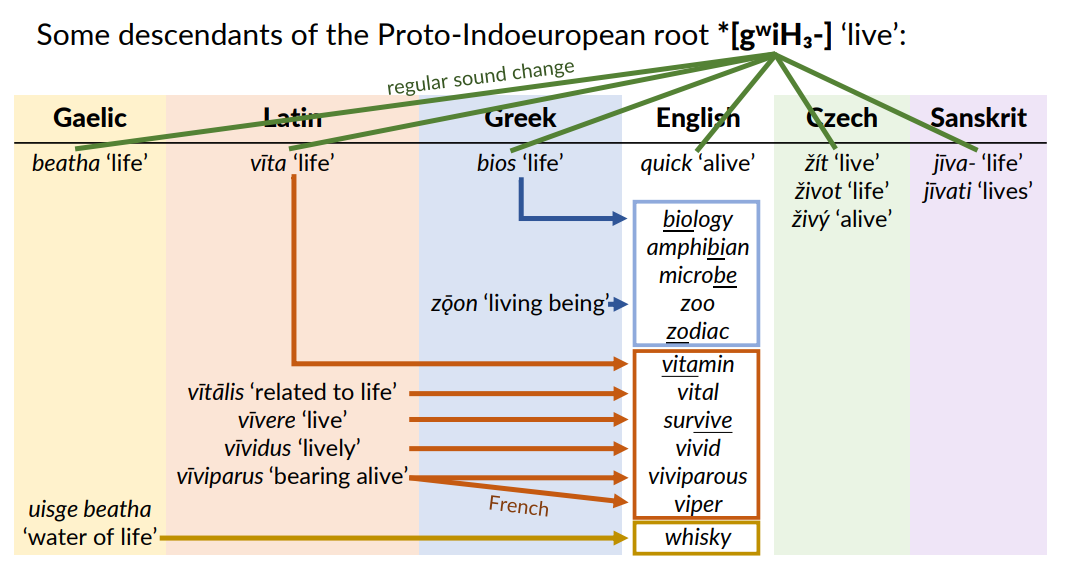
Latin via French & Renaissance e.g. abbreviate, benefit, …
Ancient Greek via French & Renaissance e.g. astronomy, crisis, …
→ Hard-word problem for less educated speakers
Hybrid fomrations combine elements from different languages within word e.g. air-craft, count-less, drink-able
Internationality cause for high degree of dissociation, wealth of synonyms and heterogeneity in spelling
The Oxford English Dictionary OED
comprehensive (1150 onward), historical, documented (quotations)
1860 start
1928 first edition completed (10 volumes)
1989 second edition (20 volumes)
Etymology of etymology
Greek étymo = true, real
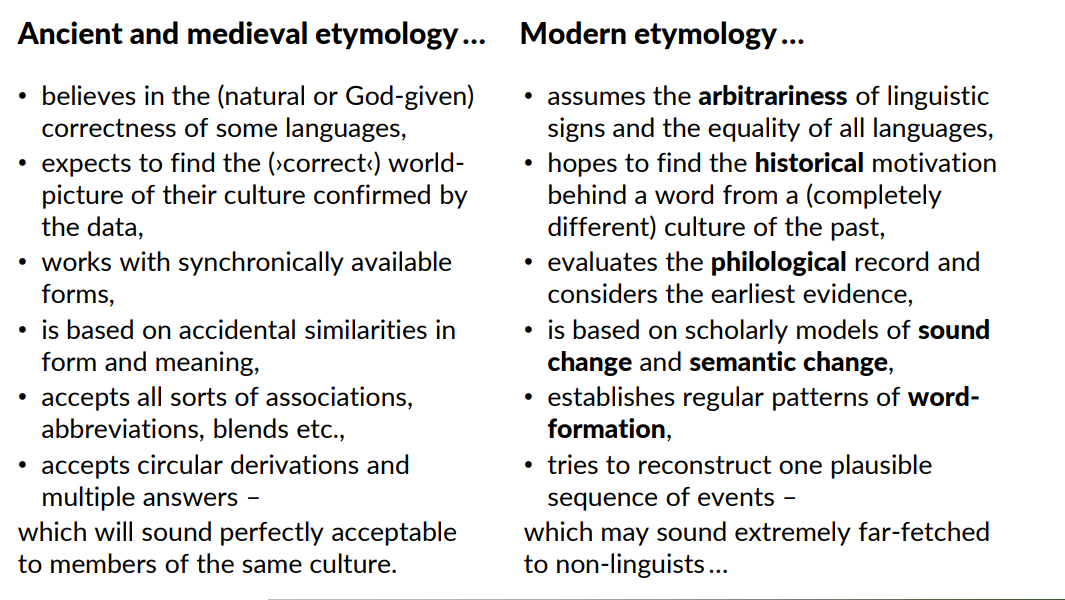
Ancient etymology: origin of word contains true, timeless definition of concept, correctness on vocabulary
Etymologiae written by Isidore Seville (560-636) extracts order of world from vocabulary
Etymological fallacy
idea lingers when people argue “Original meaning” of word should be preserved/reactivated
But:
established origin of a word not absolute beginning, but arbitrary, earliest form we can reconstruct
Meanings change, snychronic status determindes by intuitive judgement of speakers
Some word stories are suprising:
nice from Latin nescius (ignorant) meant trivial
glamour and grammar historically the same
travel and travail same word
Obscured compunds: morphological transparency lost through phonological/lexicological change e.g. wif-mann (female human) → woman
Folk etymology: New transparency given by speakers through popular association e.g. “bride-man” → bridegroom (groom = male servant)