Ethical Issues in Supervision
Definition (#f7aeae)
Important (#edcae9)
Extra (#fffe9d)
Supervision:
An integral part of professional training, and a way to acquire the competence needed to fulfil one’s professional responsibilities. It requires guidance to put knowledge into practice.
One can never know all that they’d like to know, nor can they attain all the skills required to effectively intervene with allclient populations or all types of problems.
This is where the processes of supervision and consultation come into play, and why supervision remains a relevant process throughout the career.
Administrative supervision: Involves directions given to do job competently.
Clinical supervision: Overseeing professional work as a trainee.
4 major goals of clinical supervision:
To protect the welfare of the client.
To promote supervisee growth and development.
To monitor supervisee performance and to serve as a gatekeeper for the profession.
To empower the supervisee to self-supervise and carry out these goals as an independent professional
Ethical supervision involves balance on supervisor’s part - protecting the client’s welfare vs. providing training for supervisees.
Effective supervision – Practice that encourages supervisee development and autonomy, facilitates the supervisory relationship, protects the client, and enhances both client and supervisee outcomes.
Informed consent in supervision:
The standard of practice is to incorporate clear informed consent material for supervisees, both orally and in writing.
It is beneficial to discuss the rights/responsibilities of both the supervisee & supervisor from the beginning of the supervisory relationship.
When supervisees learn what they can expect in supervision and what to do to achieve success, they are empowered to express expectations, make decisions, and become active participants in the supervisory process.
Misunderstandings may then be minimized.
Responsibilities of supervisees:
Come prepared to each supervision session. Bring your files and notes as well as a written list of questions for your supervisor.
Be an active participant and collaborate in your supervision. Take the initiative to ask for what you need from your supervisor.
Do related research and reading between sessions to enhance your work with clients.
If you are having trouble with colleagues or fellow supervisees, bring these matters into supervision.
Ask for feedback about both your strengths and areas where you need to improve.
Be open to feedback from supervisors, fellow supervisees, and your clients.
Let your supervisor know if you are feeling overwhelmed by your work with clients.
Talk about insecurities and anxieties you have that pertain to your work.
Provide feedback to your supervisor about what you find helpful or unhelpful in your supervisory relationship.
Rights of supervisees:
Supervisory sessions free from distractions.
To be fully informed of supervisor’s approach.
Confidentiality with regard to supervisee’s disclosure.
To provide feedback to supervisors concerning supervision experience.
To seek consultation from other professionals as necessary.
Supervisor’s roles & responsibilities:
Clinical supervisors: Operate in multiple roles as teacher, mentor, consultant, counselor, adviser, administrator, evaluator, and documenter.
Supervisors are responsible, both ethically and legally, for the actions of their trainees:
Supervisors to provide the training and supervised experiences that will enable supervisees to deliver ethical and effective services.
Supervisors themselves must be competent both in the practice of supervision and in the area of counseling being supervised i.e. after receiving the needed education & training themselves.
Check on trainees’ progress and be familiar with their caseloads. Supervisors are encouraged to also maintain records pertaining to their work with trainees.
Supervisors are expected to be aware of the power differential and to discuss the power dynamics in this relationship with supervisees.
Supervisors should strive to minimize the power differential by establishing a collaborative relationship and encouraging open discussion, yet also maintain appropriate authority.
Supervisor may consult with faculty on trainee’s progress, though personal information shall remain confidential.
Methods of supervision:
Supervisors need a clear supervision framework and rationale for their methods to practice ethically.
Self-report: Commonly used method, not be the best representation of a student’s performance, limited by their own ability to understand/observe.
Video recordings: Can enhance self-report, which is otherwise limited by the supervisee’s own conceptual and observational ability.
Verbal exchange: Commonly used forms of supervision. The supervisor and supervisee discuss cases, ethical and legal issues, and personal development.
Direct observation: Supervisor observes a supervisee’s practice. Direct observation, even though it demands time and effort, provides a unique reflection of the skills and abilities of the supervisee.
Philosophy & style of supervision:
One may require & benefit from different styles of supervision at different stages of professional development.
One may require a more directive at the start of training, but it is also a good idea to foster reflection & questioning that will lead to self-initiated discovery.
Promoting autonomy: oversee the work of supervisees & to help them refine their own insights & work.
Expectation is that supervisees will be able to find their own words & voice, rather than take on that of their supervisor’s.
Competence of supervisor:
Many are vulnerable & at risk for ethical & legal risks; yet many supervisors continue to lack education and training in supervision.
Possibly only rely on past supervisory experience as trainees and their clinical knowledge to inform their practice as supervisors.
Professional and also personal factors may negatively impact the supervisory relationship. Ex: Boundary violations, misuse of power, sexual contact with supervisees.
Good supervisors demonstrate the 4 A’s:
Available
Accessible
Affable
Able
Incompetence of supervisors:
Important that supervisors know their limits & to assess them from time-to-time.
At times, supervisors may be unable to effectively carry out their supervisory role due to personal or external factors or because of physical and psychological depletion.
Ethical risks may also include boundary violations, misuse of power, sexual contact with supervisee, diminished clinical judgment.
The power differential, and personalities of the supervisor & supervisee are factors to be considered.
Legalities regarding supervision:
Supervision contract: An explicit agreement between supervisor and supervisee.
Represents a vital, ongoing process of mutual understanding of the parameters of training.
3 areas pertaining legalities within the supervisory relationship:
Informed consent:
To ensure trainees provide adequate information to clients to make informed choices. i.e. clients fully aware they are seeing trainees.
Confidentiality & limits:
Trainee meets on a regular basis with supervisor to discuss case, and case may also be discussed during group supervision with other trainees.
Sessions may also be recorded or observed.
Liability:
Direct liability: Incurred when the actions of supervisors are the cause for harm.
Vicarious liability: Pertains to the responsibilities supervisors have to oversee the actions of their supervisees.
General risk management practices:
Don’t supervise beyond your competence.
Evaluate and monitor supervisees’ competence.
Be available for supervision consistently.
Formulate a sound supervision contract.
Maintain written policies.
Document all supervisory activities.
Consult with appropriate professionals.
Maintain a working knowledge of ethics codes, legal statutes, and licensing regulations.
Multiple roles and relationships in the supervisory process:
Supervisor has concurrent or consecutive professional or nonprofessional relationships with a supervisee in addition to the supervisor–supervisee relationship.
Rather common, & for some, unavoidable and can be beneficial. Avoiding all nonprofessional relationships (multiple relationships) may limit opportunities for deeper supervisory & emotional relationships.
Potential problems: The core issue of multiple-role relationships in the training and supervisory process is the potential for abuse of power due to power imbalance.
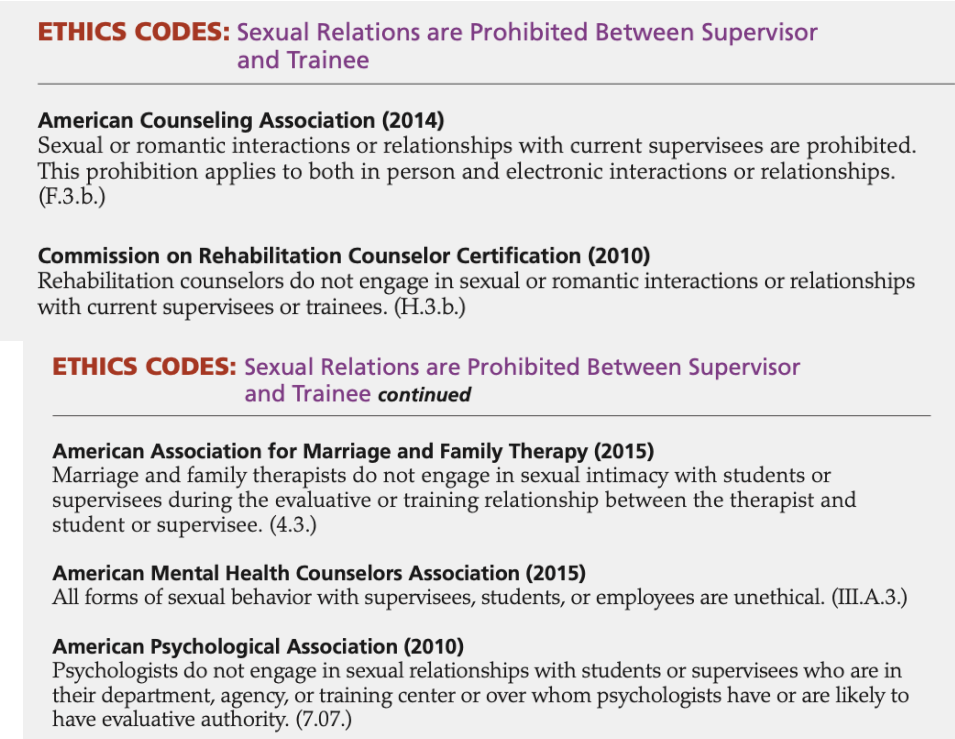
Sexual intimacy:
Supervisees at the beginning are typically innocent, & regard supervisors as experts.
Higher dependence at the start on their supervisors may make it difficult to resist sexual advances from supervisors too.
Supervisees also become vulnerable when they disclose personal concerns and intense emotions during supervision.
McMurtery, Webb, & Arnold: perceptions and attitudes of intimate behaviours in clinical supervision among counselors, social workers, and psychologists.
Findings: None reported engaging in a sexual relationship during the supervision, though a few endorsed high-risk behaviours that could potentially lead to sexual behaviour.