Potential Difference and Capcitance
Work done in bringing a charge from one point to another in an electric field does not depend on the path taken.
Potential Difference
The amount of work that must be done to bring a charge of one coulomb from B to A is called the potential difference between A and B.
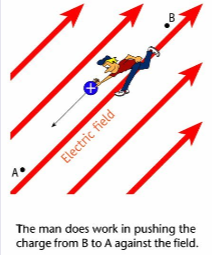
Potential difference between two points in an electric field is the work done in bringing a charge of +1 coulomb from one point to the other.
SI Unit: volt (V)
One volt is one joule per coulomb.
Battery

Has two terminals. The negative terminal has an excess of negative charge and the positive one has an excess of positive charge.
There is thus an electric field in the space between the terminals. The higher the voltage of the battery the stronger this electric field is.
Electric Current
Flow of electric charge.
Potential at a Point
Potential difference between a point and the Earth is called the potential difference of a point.
Work must be done to bring a positive charge from the ground up to the charged conductor.
This is because the positive charge is repelled by the positive charge on the conductor as it gets near it.
As charge is added to the conductor the potential difference between it and the ground increases. Thus its potential increases.
The charge on the conductor and its potential are directly proportional to each other.
As you add positive charge to a conductor its potential increases.
Different conductors reach different potentials even if they carry the same amount of charge.
The potential reached depends on the shape and size of a conductor.
The potential reached is directly proportional to the charge on the conductor.
Capacitance
Ratio of the charge on the conductor to its potential.
SI Unit: farad (F)
1 Farad = 1 coulomb per volt.
The capacitance of a charged conductor is increased by bringing an oppositely charged conductor or an earther conductor near it.
Parallel Plate Capacitor
A parallel plate capacitor is two identical parallel conducting plates separated by an insulator (dielectric).
Capacitance of a Parallel Plate
Energy Stored in a Charged Capacitor
A charged capacitor blocks D.C.
A.C flow is allowed by capacitor.
Charges and discharges as the A.C changes direction.