CLIMATE CHANGE AND ENVIRONMENTAL POLITICS
Session 1 (15-01-25)
Albeto Effect: The phenomenon where lighter surfaces reflect more sunlight, thus influencing local and global temperatures. Surface Reflectivity.
Sessions 2-6
Ecosystems: System theory of ecology that emphasizes the interdependence of organisms and their environment, highlighting the complex interactions that sustain biodiversity and influence climate resilience.
Use conecepts of IT to undeertand how nature works.
Fedback loops are crucial mechanisms in ecosystems that can either amplify or dampen changes in environmental conditions, thus playing a vital role in regulating climate dynamics and maintaining ecological balance.
CHANCE: The likelihood of extreme weather events and their impacts on various ecosystems, necessitating a comprehensive approach to environmental policy that addresses both mitigation and adaptation strategies. Human behaviour and nature behavior.
System analysis: A method used to evaluate the components of ecological systems, allowing for a deeper understanding of how changes in one part of the system can affect others, thereby informing effective policy decisions.
System theory: A framework that emphasizes the interconnections and interactions within ecological and social systems, highlighting the importance of considering the whole system rather than individual components when crafting environmental policies.
Systems:
Structure (Pattern): the arrangemnet of and relations between the parts or elements of something complex
Function (process): an activity that is natural or purpose of an individual.
Function conditions structure
Consuption fetishisim: refers to the excessive focus on acquiring material goods, which can drive unsustainable practices and contribute to environmental degradation.
Political systems: the set of formal legal institutions that constitute a governmnet or a state.
Cultural system: inherited conceptions expressed in symbolic form by means of which men communicate, perpuate, and develop theor knowledge about and attitudes toward life. Shaped by social system.
Evolution of the word “Climate Change” to “Climate Crisis”
“Degradation frame”: That every intervention of human in environmnet is bad (which is not true)
Social systems: patterned series of interrelationships existing between individuals, groups, and institutions and forming a coherent whole.
Marx: relations of production. Social classes divides the community.(income groups and social class)
False conscionism: the belief that individuals in a capitalist society are misled about the realities of social and environmental issues, leading them to accept detrimental practices without questioning their impact.
Weber: status groups. Conditioning by culture, go with people that think like you. (cultural)
Economic systems: system of production and exchange of goods, services, and allocation if resources in a society. It includes the combination of various institutions.
Natural System: Biota and abiotic environment constitutes an ecosystem or natural system.
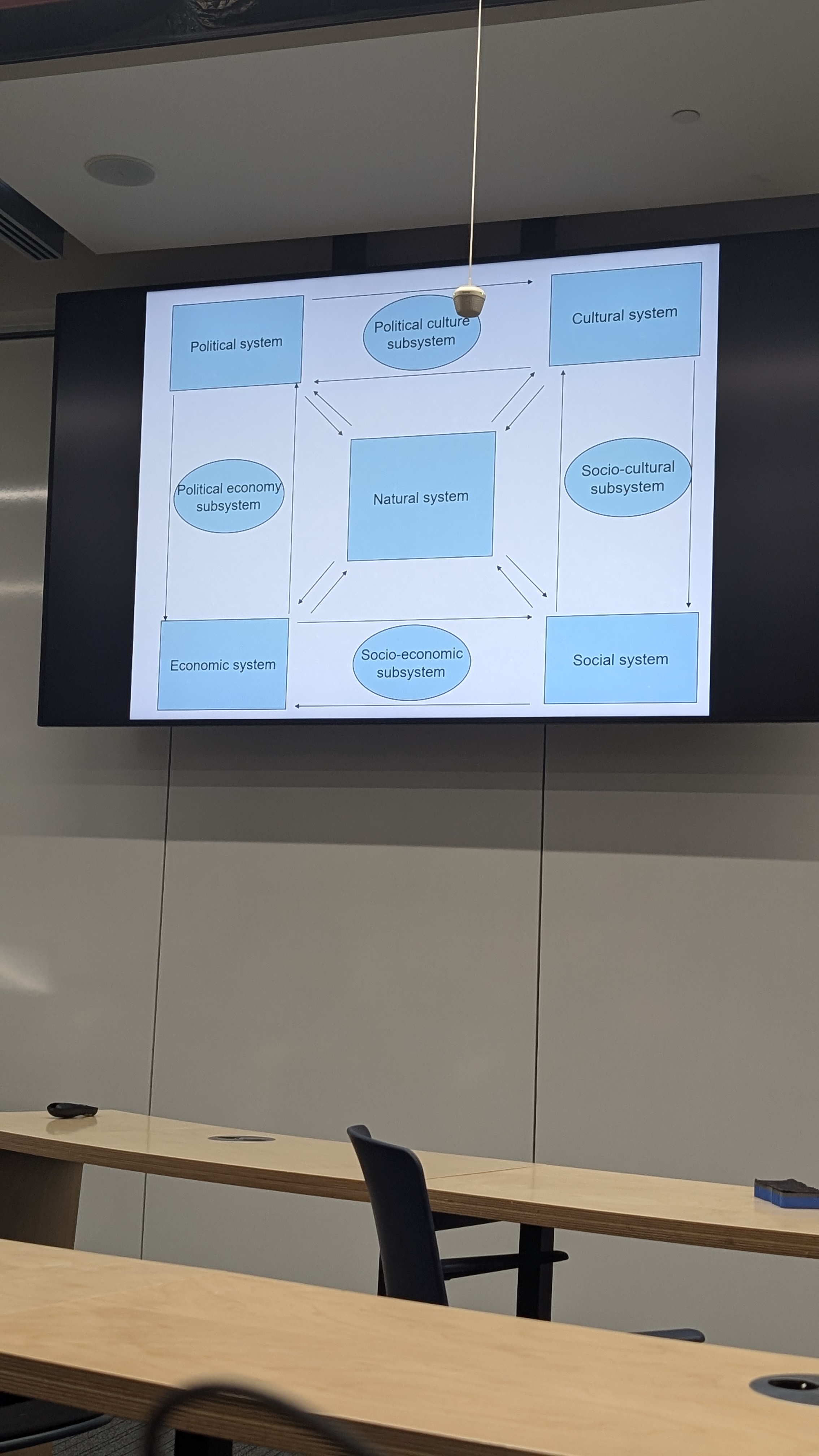
Positive and Negative feedback loop:
Positive feedback loop: A process in which an initial change will lead to further changes that amplify the original effect, such as the melting of polar ice reducing the Earth's albedo, causing more heat absorption and further warming.
Negative feedback loop: A process that counteracts changes, helping to stabilize the system, such as increased cloud cover reflecting sunlight, which can cool the Earth's surface.
System Boundries and Scales
System Boundaries: Refers to the limits that define a system, including what is included or excluded from the analysis, such as geographical areas, ecosystems, or socio-economic factors.
Scales: Can vary from local to global levels, influencing how climate change impacts are perceived and addressed, with different policies and strategies required at each scale.
Individuals
And how individuals operate inside institutions
Groups that an individual is associated: sytem of coordinate
System 1 and System 2 (baed in teh economy od the mind)
System 1: Refers to the fast, instinctive (unconscious and automatic), and emotional responses that individuals may have towards climate change, often leading to immediate but potentially unconsidered actions. Error prone.
System 2: Involves the slower, more deliberate (conscious effortful), reliable and analytical thinking processes that can help individuals and institutions develop comprehensive strategies for addressing climate change effectively.
Civil society: The aggregate of non governmmenta organizations and institutios that manifest interests and will of citizens. Or, individuals and organizations in a society which are independent of the governemnet.
Nation-states:
Nation: Imagined political communities- Benedict Anderson
States: It is a human orgaization that successfully claims the monopoly over the legitimate use of violence within a given territory. Human organization that is maximizer. Max Weber
Spain and UK problem with mining plans. Spain affecting UK (acid rain), and EU making them stop and reduce CO2
International Political System
Realist paradigm: Conflict/ War
Liberal paradigm: cooperation/commerce
Relevant Actors/ stakeholders:
Nation-states
International Governmental Organzations
Environmnetal NGOS
Multinational Corporations: ESG?
Epistemic communities: Group of experts
Civil society?: local communities, indigeneous groups?
Global System
Institutions
FSC certification: Forest Stewardship Council certification, which ensures that forestry practices are environmentally responsible, socially beneficial, and economically viable.
M30 tunnels: a crucial infrastructure project that highlights the intersection of environmental concerns and political negotiations, as they aim to mitigate flooding while also addressing the rights and needs of affected communities. The project has sparked debates about equitable resource distribution and the importance of including diverse voices in decision-making processes.
Common Pool Resorces
The ongoing CPR debate: focuses on the sustainable management of shared resources, emphasizing the need for collective action to prevent overexploitation and ensure that all stakeholders benefit equitably. This discussion underscores the importance of governance structures that support cooperation among users, as well as policies that promote transparency and accountability in resource management.
The tragedy of the commons: a concept that illustrates how individuals acting in their own self-interest can ultimately deplete shared resources, leading to detrimental consequences for the community as a whole.
Garrett Hardin: an ecologist and philosopher best known for his 1968 essay "The Tragedy of the Commons," which critiques the idea of shared resources and argues that without regulation, individuals will inevitably exploit resources to their own detriment.
Nature = Commonpool resources
Human = Rational egoist
Deductive model of gametheory to measure human activities
State and markets: one or both intervin
Rules and incentives
Elinor Ostrom: Local comunities coming out with their own rules. Self-organization.Important for midterm
Local community rules embedded in practices of them
No rational egoist
These practices demonstrate how collective management can lead to sustainable outcomes, challenging the notion that individuals will always act in their own self-interest.
She introduced complexity: attachment to environmnet (what motives people to care for the environmmet)
Governing the commons:
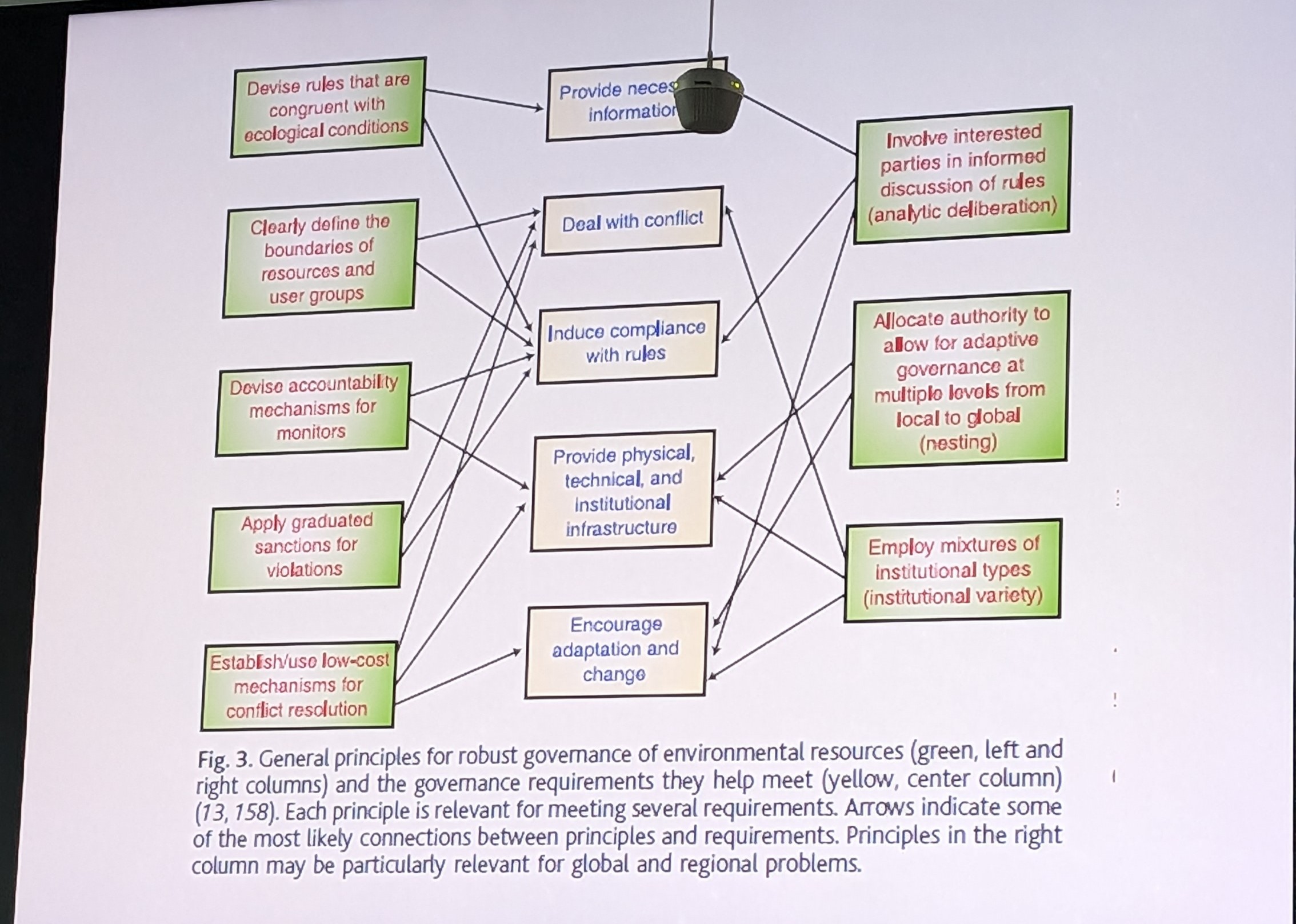
8 point framework for durable (sustainable) CPR intitutions:
Clearly defined boundaries: Ensuring that the resource system and its users are well-defined to prevent overuse and conflict.
Measure CO2
There is no consensus between differnet states about what us a “clear boundary”
Congruence between rules and ecosystem conditions: The rules governing resource use must align with the ecological realities of the area to ensure sustainable practices and effective management. How do we know if the rules we have are correct? (limit of 5 degrees, CO2 limits, etc)
Collective choice arrangements: Allowing all stakeholders to
participate in decision-making processes to enhance commitment and compliance.
Monitoring: Implementing systems for tracking resource use and conditions to ensure adherence to rules and detect violations.
Graduated sanctions: Establishing a system of penalties for users who violate the rules, which should be proportional to the severity of the offense.
Conflict-resolution mechanisms: Providing accessible and low-cost means for resolving disputes among users to maintain cooperation.
Minimal recognition of rights to organize: Ensuring that local communities have the authority to manage their resources without excessive external interference.
Nested enterprises: Creating multiple layers of governance to manage resources at different scales, allowing for more effective and localized management.
Critizism of the framework:
Hower, We cannot get the steakholder involve into the solutions since they do not care anymore. People do not participate in politicas anymore (local community politics)
The Gramework works just for medium size problems not for solving the whole climate change
General principles for robust governance of environmental resorces (green, left and right columns) and the governance requirements thet help meet (yellow, center coumn). Each principle is relevant for meeting sveral requirements. Arrows indicate some of the most likely connections between principles and requirements. principles in the right column may be particularly relevant for gloal and regional problms.
/
Readings
Complete Summary of General Systems Theory - The Skeleton of Science by Kenneth E. Boulding
General Systems Theory (GST): Definition and Purpose
GST lies between the abstract theoretical models of pure mathematics and the specific theories of individual disciplines.
Mathematics organizes general relationships in a coherent, abstract system without direct connections to real-world phenomena, serving as the language of theory rather than its content.
Specialized sciences like Physics, Chemistry, Biology, and Sociology focus on specific empirical segments and develop theories tailored to these areas.
In summary: It is a way (framework) to understand how different parts of the system interact and work together. It does not look to solve one specific problem or studying one field. It wants to find rules and structures that can apply to systems in general.
How ecosystems, organizations or families work as interconnected systems
One change affect all
It encourages people from different fails to work together in areas taht they have in common
Ecological sytmes
Political systems
economic systems
Paris Agreement: require cooperation across these interconnected systems
Paris Agreement (12 December 2015): a landmark international treaty aimed at combating climate change by limiting global warming to well below 2 degrees Celsius, with a goal of pursuing efforts to limit the temperature increase to 1.5 degrees Celsius. (currently 15 degrees Celsius)
Need for General Systems Theory
A growing demand exists for systematic constructs addressing general relationships across various empirical domains.
GST does not aim to replace specialized theories or create a single, all-encompassing theory, as excessive generalization sacrifices meaningful content.
Instead, GST seeks an intermediary level of abstraction, bridging the specific and the overly general, to address universal patterns and relationships in complex systems.
Key Features and Objectives
GST provides a unifying framework to identify and study commonalities across different scientific fields, emphasizing interdisciplinary approaches.
It aspires to foster better understanding of systems by focusing on their organization, structure, and dynamics, transcending disciplinary boundaries.
Origins and Influence
The foundational ideas of GST can be traced to Ludwig von Bertalanffy, who proposed a "new approach to the unity of science" through general system theory.
Boulding acknowledges Bertalanffy's contributions while expanding on the theoretical framework.
Applications and Relevance
GST is applicable to various domains, from biology to social sciences, and aids in addressing complex, interconnected problems.
By highlighting shared principles across systems, GST enhances collaboration and integration of knowledge across disciplines.
organization, structure, and dynamics,
See the Bigger Picture: Understanding how changes in one system (e.g., energy policy) affect others (e.g., biodiversity, public health).
Find Universal Principles: Identifying patterns or solutions that apply across different fields (e.g., feedback loops or system resilience).
Encourage Collaboration: Bridging the gap between experts from different disciplines to design solutions that work on multiple levels.
Complete Summary of Group Affiliations and the Individual Personality by Georg Simmel
Core Premise:
Simmel explores the interplay between individual personality and group affiliations, emphasizing how an individual's identity is shaped by the various groups they belong to.
The more groups an individual is part of, the more distinct and unique their personality becomes, as the combination of these affiliations is less likely to be shared by others.
Key Concepts:
Group Affiliations as a Coordinate System:
Each group to which an individual belongs acts as a coordinate, refining and circumscribing the individual’s identity.
Belonging to a single group allows for considerable personal leeway, but multiple affiliations create a unique intersection, making each individual’s personality distinctive.
Individuality through Group Diversity:
Just as concrete objects gain unique characteristics when examined under multiple perspectives, individuals achieve individuality through the diversity of their group affiliations.
This intersection of affiliations enhances the complexity and uniqueness of a person’s identity.
Reciprocal Relationship Between Individuality and Group Membership:
As individuals affiliate with groups, they contribute their subjective uniqueness to the group, while also being shaped by the group’s collective culture and structure.
individual shapes the group, and group shapes them
This dynamic interplay fosters both individual and collective growth.
Personality as a Synthesis:
An individual's personality is a synthesis of social influences, cultural heritages, and unique experiences derived from group affiliations.
Personality emerges as a subjective combination of these elements, distinguishing one person from another.
Challenges of Multiple Affiliations:
While multiple group memberships enrich individuality, they also pose challenges such as internal and external conflicts, psychological tension, and potential identity crises.
Simmel references the old English proverb, “He who speaks two languages is a knave,” to highlight the ambiguities and insecurities that arise from existing in multiple social spheres.
Opportunities for Growth:
Despite the tensions, the multiplicity of group affiliations offers opportunities for personal growth, moral development, and a broader perspective on life.
Individuals navigating these intersections may develop higher levels of consciousness and adaptability.
Conclusion: Simmel’s analysis demonstrates how group affiliations define, enrich, and complicate individual identity. The tension between group influence and personal uniqueness forms the basis of individuality, while also highlighting the dynamic, ever-evolving nature of human social life.
The Environment and International Relations" by Kate O'Neill
Comprehensive examination of how international relations theories and tools can be applied to global environmental challenges. The book provides an analytical framework for understanding these issues, identifying key actors and their roles in global environmental governance.
Key Themes and Content:
Analytical Framework: O'Neill develops a historical and analytical framework that integrates insights from various disciplines, enabling readers to grasp the complexities of global environmental issues.
Cambridge University Press & Assessment
Global Level
National Level
Local and Subnational Levels
Non-Sate actors
Actors in Environmental Governance: The book identifies and examines the roles of main actors, including governments, international bodies, scientists, activists, and corporations, in addressing environmental problems such as climate change, biodiversity loss, and ozone depletion.
Cambridge University Press & Assessment
States and governments
International Organizations
NGOs
Private Sector
Scientific Community:
Grossroot movememts: local and indigineous communities fight for environment
Theoretical Approaches: It introduces students to the ways in which international relations theories can be utilized to analyze and address environmental problems, encouraging critical engagement with the issues.
Realism: Focuses on how states prioritize their national interests, which can hinder international cooperation on environmental issues.
Liberalism: Highlights the potential for cooperation through institutions, trade, and shared norms to address global problems.
Constructivism: Examines how ideas, norms, and identities shape environmental policies and international collaboration.
Critical Approaches: Includes perspectives like feminism and postcolonialism, which critique the power dynamics in environmental governance and highlight issues of equity and justice.
Green Politics: Emphasizes the importance of ecological sustainability and advocates for policies that prioritize environmental health over economic growth, often challenging traditional power structures.
Governance Mechanism:
Treaties and Agreements: How they are negotiated, implemented, and enforced.
Market Mechanisms: Systems like carbon trading and green finance, which leverage economic tools to promote sustainability.
Voluntary Initiatives: Corporate social responsibility and partnerships that aim to complement formal governance.
Compliance and Enforcement: Examining how states and other actors are held accountable for their commitments.
Market Mechanisms: The second edition features a new chapter on the emergence and politics of market mechanisms as a mode of global environmental governance, reflecting recent developments in the field.
Recent Developments: The book incorporates the latest developments, including the December 2015 Paris Climate Agreement, providing up-to-date perspectives on global environmental politics.
Purpose and Audience:
This textbook is designed for students of environmental issues from both political science and environmental studies perspectives. It aims to equip readers with the knowledge to apply critical insights into global environmental governance and encourages engagement with interdisciplinary approaches to complex environmental challenges.
Cambridge University Press & Assessment
Overall, O'Neill's work serves as a valuable resource for understanding the intersection of environmental issues and international relations, offering both theoretical and practical insights into global environmental governance.
David Singer's "The Level-of-Analysis Problem in International Relations":
Introduction
Singer's paper addresses a fundamental methodological issue in international relations (IR): determining the appropriate "level of analysis" for theoretical inquiry. He contrasts two primary levels of focus—the international system as a whole and the national state or sub-systemic level—exploring their respective strengths, weaknesses, and implications for descriptive, explanatory, and predictive adequacy.
Analytical Model Requirements
An effective model for IR analysis must:
Accurately describe phenomena: Provide a realistic and comprehensive representation of international interactions, acknowledging inevitable distortions due to simplification.
Explain relationships: Offer valid, thorough, and parsimonious explanations of causal dynamics in IR.
Enable prediction: While less demanding than explanation, predictive accuracy is essential for practical utility.
Systemic Level of Analysis
Advantages:
Comprehensiveness: Encompasses the entirety of international interactions, enabling a holistic perspective.
Pattern recognition: Facilitates generalization about systemic phenomena like coalition dynamics, power configurations, and institutional stability.
Challenges:
Determinism risk: Overemphasis on the system's constraints may undermine the autonomy of national actors.
Homogenization: Tends to oversimplify differences among nations, portraying them as indistinct "black boxes."
Correlation over causation: Limits the ability to trace specific causal mechanisms, focusing instead on broad patterns.
National/Sub-Systemic Level of Analysis
Advantages:
Rich detail: Allows for nuanced differentiation among states, enabling comparative analysis of foreign policies.
Explanatory depth: Examines internal factors (e.g., decision-making processes, motivations, institutional frameworks) that shape national behavior.
Application of decision-making models: Provides a suitable framework for studying strategic choices made by states.
Challenges:
Over-differentiation: Risks overstating differences between states, which can hinder generalization.
Ethnocentrism: Analysts may project their national biases, skewing interpretations of global dynamics.
Methodological complexity: Requires sophisticated tools and data to analyze internal processes and perceptions accurately.
The Phenomenological Debate
Singer explores whether analysis should focus on objective realities or the perceptions of actors:
Objective perspective: Assumes states respond predictably to external stimuli.
Phenomenological perspective: Emphasizes how states perceive and interpret their environment, affecting their decisions.
He notes that integrating phenomenological insights is valuable but methodologically demanding.
Conclusion
Singer advocates for a pragmatic approach, recognizing that the choice of level of analysis depends on research goals. He stresses:
The importance of consistency: Avoid shifting levels of analysis mid-study without clear rationale.
Potential for integration: While challenging, a theoretical framework encompassing both systemic and sub-systemic levels could enhance IR analysis.
Systematic empirical research: Future progress in IR theory requires more coordinated data collection and theoretical synthesis across levels.
Singer concludes that thoughtful selection and consistent application of the chosen level of analysis are essential for advancing the theoretical and practical understanding of international relations.
Aspect | Systemic Level | Sub-Systemic Level |
Focus | Entire international system | Individual states |
Scope | Broad and comprehensive | Detailed and specific |
Primary Concern | Patterns, structures, and system behavior | Decision-making and state behavior |
Strengths | Holistic, identifies global trends | Nuanced, examines internal factors |
Weaknesses | Simplistic view of states, deterministic | Over-differentiates, methodologically complex |
Methodological Approach | Generalized, abstract | Specific, empirical |
Coupled Human And Natural Systems (CHANS)
Interdisciplinary frameworks that integrate social, economic, and environmental data to assess climate impacts. These frameworks facilitate informed decision-making and enable the identification of effective mitigation strategies across various sectors.
Feedback loops between coupled huamn and natural systems: These loops highlight how changes in the environment can influence human behavior, and vice versa, thereby affecting both ecosystem health and societal resilience.
CHANS can be defined as “integrated systems in which people interact with natural components” Liu 2007