PROPERTIES OF LANGUAGE
PROPERTIES OF LANGUAGE
Discreteness: Composed of discrete units used in combination to create meaning. Such as combination of words/morphemes to create a sentence that has meaning.
Displacement: The ability to communicate about something that is in the present, in immediate spacial or temporal context.
Arbitrariness: the relationship between a word or morpheme and what it refers to is not based on logic or inherent qualities. For example, there's nothing inherently "cat-like" about the word "cat"; it's simply a symbol that English speakers have agreed upon to represent the concept of a feline animal.
Infinity: Finite number of words in language but potential combination of these units to form meaningful sentences is limitless.
Recursion: Recursion is the property of language allowing for nesting structures within larger structures. This means that linguistic elements, such as phrases or clauses, can be embedded within other elements of the same type. For example, in the phrase "the book on the windowsill by the door," the prepositional phrase "on the windowsill" is nested within the larger prepositional phrase "by the door."
CORE FEATURES OF LANGUAGE
- Phonology: Governs the sequencing of phonemes (which are the basic units of sound that distinguish one word from another in a particular language, e.g., “ba” vs. “pa”)
- Morphology: Governs the sequencing of morphemes (smallest meaningful units that carry meaning (e.g., help vs. helper)
- Syntax: Arrangemnt of words into sentences in a language. (“I went to the store” vs. *”I store the to went”)
STRUCTURE OF LANGUAGE
- Semantics: deals with the meanings of words and sentences within a language. It encompasses various aspects such as vocabulary, word meanings, and the relationships between language and the world. Semantics explores how words and sentences represent concepts and how these representations relate to the external world. This involves understanding the denotative (literal) and connotative (implied) meanings of words and sentences. Furthermore, semantics examines the relationship between language and the speaker, including how speakers use language to express their thoughts, beliefs, and experiences, and how language shapes the speaker's understanding of the world.
- Pragmatics: Pragmatics refers to the knowledge underlying the use of language in context. It involves understanding how language is used to achieve communicative goals in social interactions. Pragmatics considers factors such as implied meaning, context, social norms, and the shared knowledge between speakers. It explores how speakers use language to convey meaning beyond the literal interpretation of words and sentences, including implied meanings, sarcasm, humor, and politeness. Pragmatics also encompasses aspects such as turn-taking in conversations, where speakers alternate between speaking and listening, and accounting for others' knowledge, where speakers adjust their language use based on their assumptions about what others know or believe.
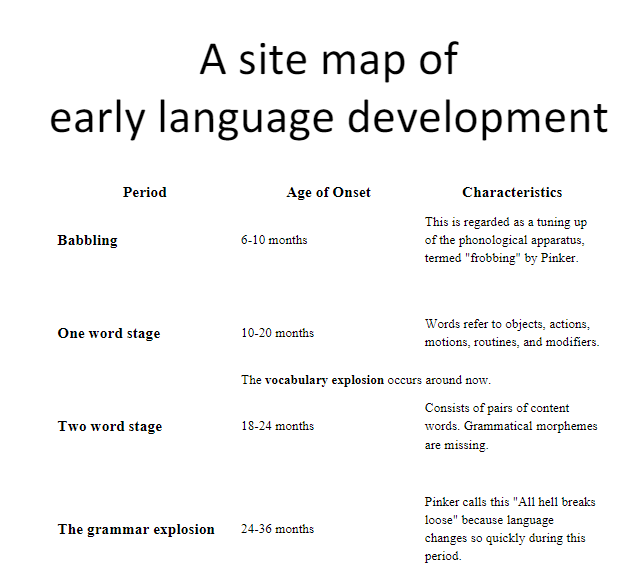
THEORIES OF LANGUAGE DEVELOPMENT
LEARNING/BEAHIORIST THEORIES
The mind is born with a blank state upon which knowledge is constructed through experience. Emphasis on the role of the environment.
- Classical conditioning: Involves learning association between stimuli. Classical conditioning may occur when a certain sound or word is associated with specific meaning or response through repeated pairing with other stimuli.
- Operant condition: Learning through the consequences of behavior. When reinforced (rewarded) for using correct language form and punished or correct when not.
- Imitation: Individuals learn by observing and imitating speech patterns.
-Critiques-
Referential Opacity: people learn by associating things they experience with specific responses they make. For example, if a child hears the word "dog" and sees a dog, they learn to associate the word with the animal. However, language can be tricky for behaviorists because sometimes words refer to things that aren't directly observable. In a sentence like "John was proud of himself," the word "himself" refers back to "John." This kind of reference isn't something you can see or touch, so it's hard to just associate it with something concrete like you would with a visible object.
Imitation: Research has shown that imitation plays a relatively minor role in language acquisition, particularly in early. Where they can demonstrate comprehension of language before producing it.
Reinforcement: people don't get consistent rewards or punishments for their language use. Also, whether a sentence is true or not doesn't always match up with whether it's grammatically correct. For example, you could say "The sky is green" grammatically correctly, but it's not true. So, behaviorist theories have a hard time explaining how reinforcement works in language learning because it's not always clear what's being rewarded or punished
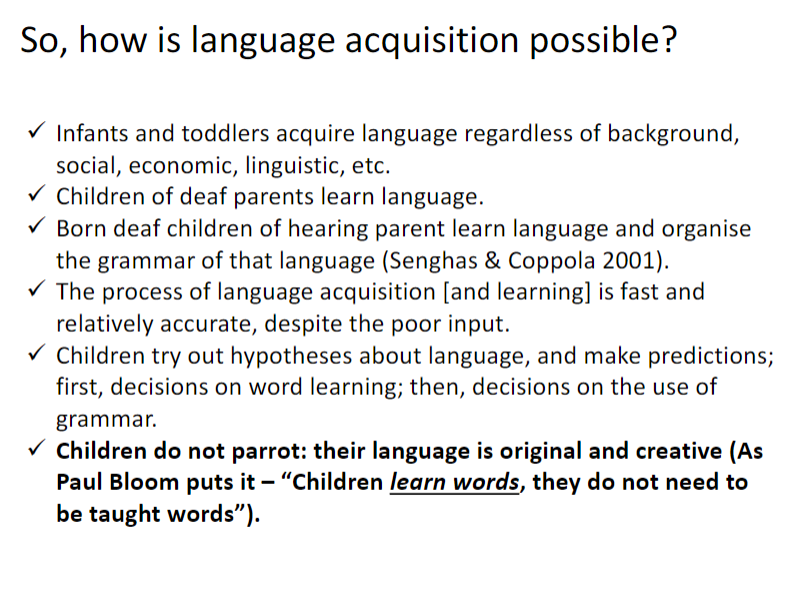
Poverty of the stimulus is a concept in linguistics that addresses the discrepancy between limited input children receive and complex language systems they develop. They may hear incomplete or grammatically incorrect sentences, and caregivers may not always correct linguistic errors or deviations from the standard language. Despite the limited and sometimes imperfect input, children acquire remarkably complex language systems. They not only reproduce the language they hear but also develop grammatical rules and structures that they have never directly encountered in their input. Language development in children is generally rapid and error-free, progressing from simple utterances to more complex sentences in a relatively short period.
BIOLOGICAL/NATVIST THEORIES
Language isn't learned it's a cognitive ability
Language Acquisition Device (LAD) a theoretical concept that states we have a special language-learning mechanism inhereted in the human brain.
2 types of knowledge we have:
- Formal and substantive universals: Characteristics like language organized in levels or layers and having categories (like nouns, verbs, etc.).
- Parameters: we have parameters that vary across language but are constrained within certain limits. They are like switches in our brains that can be set differently depending on the language we're learning. They determine how certain things work in a language. For example, one parameter might decide if we usually drop subject pronouns like "I" or "he" in a sentence. In some languages, like Spanish or Italian, it's common to drop these pronouns,
The LAD is "turned on" by exposure to linguistic input. When children are exposed to language through interactions with caregivers and their environment, the LAD processes this input and extracts linguistic patterns.
Evidence for innate grammar...
- Goldin-Meadow and Senghas conducted research on congenitally deaf children born to hearing parents who were not exposed to American Sign Language (ASL) or any other formal sign language. Here's a simplified explanation of their findings:
- Homesign: When these deaf children did not have access to a formal sign language like ASL, they spontaneously created their own gestural language, often termed "homesign." This homemade sign language allowed them to communicate with their families and others around them.
- Similarity to Spoken Languages: Despite not being exposed to a formal sign language, the gestural language invented by these children showed similarities to spoken languages in several ways. For example, it displayed similar ordering of linguistic categories such as nouns and verbs. This suggests that the children's innate language-learning abilities guided the structure of their homemade sign language.
- Lenneberg’s book “biological foundations of language” describes how language acquisitor is acquired in early infancy.
Maturational process: there is a specific timeframe during which language development occurs.
Critical period: acquisitions period during first year of life and extend till puberty.
Brain development: language acquisition is easiest when brain is developing
Late acquisition of left-hemisphere damage has larger impact on language skills (than early Acquistion)
Case of genie(1977), Johnson and Newport (1989) immigrant in America study where after puberty there were significant deficits after puberty.
Area’s in left hemisphere (Broca's wernicke’s) involved in language production and processing.
-Critiques-
Lack of specificity
Grammar in Deaf Children: Studies of deaf children who are not exposed to a formal sign language like American Sign Language (ASL) have shown that their grammar is limited compared to deaf children who are exposed to ASL from birth. This supports the idea that exposure to linguistic input plays a crucial role in language development, even for innate grammar abilities to manifest fully
Complexity of Grammar: Languages with more complex grammatical structures, such as those with multi-clause sentences, tend to require more sophisticated language input for acquisition.
Culture and Neural Structure: Research suggests that cultural factors can influence the neural structure and cognitive processes involved in language. For example, different languages may be associated with distinct patterns of brain activation and connectivity. This highlights the interaction between biological and environmental factors in shaping language abilities.
INTERACTIONIST THEORIES
Language develops from the interaction of biological, cogntiive and environmental influences.
Infant-directed speech
- Caregivers and adults produce rhythmic speech with accentuated pitch. Infants prefer this speech than other types of non-speech sounds.
The use of infant direct speech consists of
- Reduplicated syllables: repeated syllables like choo-choo for train and night0night for bedtime.
- Diminutive Endings: modify word to make it smaller or cuter. Doggy for dog and blankie for blanket.
- Use of nouns: parents often use nouns rather than first or second-person pronouns. say "mummy" or "daddy" instead of "I" or "you."
- They base speech on the here and now
- Speech based on child’s interest, current situation, and needs.
BIOLOGICAL PREDISPOSITION
- Fast mapping: refers to the children learning new words learned based on minimal exposure
- Indeterminacy of Reference: Despite the fast pace of word learning, there's a challenge: the indeterminacy of reference. This means that it's not always clear what a word refers to, especially considering that words can have multiple meanings or refer to different things in different contexts.
- Quine's Gavagai Problem: Philosopher Willard Van Orman Quine illustrated this challenge with his "Gavagai problem." If someone points to a rabbit and says "gavagai," how does a learner know whether "gavagai" refers to the rabbit, its color, its movement, or something else entirely? So, how do infants navigate this problem? One theory is that they rely on various cues, such as the context in which the word is used, the gestures or actions accompanying the word, and their existing knowledge about the world. Additionally, infants may engage in hypothesis testing and trial-and-error learning to gradually refine their understanding of word meanings.
WORD-LEARNING COGNITIVE MECHANISMS
- Whole Object Assumption: Children often assume that a new word refers to the entire object, rather than just a part of it or its properties. For example, if a child hears the word "duck" while looking at a rubber duck, they will likely assume that "duck" refers to the whole object, including its shape, color, and material.
- Taxonomic Assumption: This assumption is based on the idea of categorization and similarity. Children tend to assume that objects that are similar in appearance or function share the same label or name
- Mutual Exclusivity Assumption: Children often operate under the assumption that objects have only one label or name. if a child knows the word "hammer" and is introduced to a new tool, they will likely assume that the new tool has a different name, rather than being another type of hammer. Unfamiliar objects have different names.
COGNITIVE MECHANISM FOR FURTHUR LANGUAGE LEARNING
Bootstrapping refers to using what you already know to learn something new. Children use prior knowledge of 1 aspect of langue to learn another.
Syntactic Bootstrapping: Specifically, syntactic bootstrapping involves using knowledge of grammar or sentence structure to help determine the meanings of words. For example, if a child hears a sentence like "The duck is gorping the bunny," they may not know what "gorping" means, but they can infer that it's likely a verb based on its position in the sentence (between the subject "duck" and the object "bunny").
SOCIAL INTERACTION
Joint attention- Refers to the ability of two or more individuals to focus on the same object or event, with the intention of sharing the attention and meaning. Babies early on are sensitive to eye contact so that naturally pay attention to where other are looking, understanding what other are interested in. Joint attention is crucial in the language learning context because it allows infants to link language input with the objects or events in their environment. For example, when an adult labels an object they are looking at during joint attention, the infant can make connections between the spoken word and the referent, facilitating vocabulary acquisition.
Thos occurs in 9-10 month olds. By 11-12 month old they will follow if the eyes are open.
At around 18 months...
Infants begin to use an actor's eye gaze to understand and map objects to their referents in the environment. For example, if an adult looks at a ball and says "ball," the infant will likely understand that the word "ball" refers to the object the adult is looking at. Infants also start to consider intentionality when mapping verbs to actions. This means that they pay attention not only to the action itself but also to the intention or goal behind the action. For instance, if an adult points at a cookie and says "eat," the infant understands that the intention is to consume the cookie. infants begin to use another person's emotional expression to infer the target of their referent.
WHY IS LANGAUGE UNIQUE TO HUMANS?
The ape language projects
The most famous of these projects was conducted by psychologist Herbert Terrace in the 1970s with a chimpanzee named Nim Chimpsky. Inspired by the work of psychologist B.F. Skinner, Terrace attempted to teach Nim sign language using a method called "operant conditioning," where desired behaviors were reinforced with rewards.
Koko