7: Short Run Producer Theory
Producer: the basic producing-supply unit of economic theory. Usually a firm, though governments also produce goods and services.
We assume everything is sole proprietorship.
Firms & producers & types
Sole proprietorship: a firm with a single owner who has complete authority over the business decisions and is personally responsible for the debts.
Partnership (general or limited): a firm that has more than one owner. Decisions made jointly and each partner is severally responsible for the debts of the company.
General: partners share 50/50 revenues and expenses. Jointly and severally responsible for debts.
Limited: sign off document that splits portions of profits & responsibilities; goes with a portion of decision making.
Corporation: an entity upon itself. Single owner or more than one owner. Legal entity which has all the same rights and responsibilities as an individual. Limited liability because of the corporate veil. Not liable for anything more than the share value.
Public: trading on the stock market. Can purchase a share.
Private: not on the stock market. Would have to approach owners to buy a share
Crown: government owned.
Corporations must and always identify themselves.
Financing
Real capital: desks, buildings, land
Financial capital: bonds or stocks.
Bonds: debt issues that result in interest
Stocks: equity issue that results in dividends.
Production, Costs and Profits
Neoclassical firm: maximize profits while making decisions as a single decision making unit.
Accounting profits:
Revenue:
Total costs: explicit costs: a cost that you quantify
We never take accounting profits.
Economic profits:
Revenue:
Total costs: explicit costs + implicit costs (opportunity cost of time of the owner and the opportunity cost of capital for the owner.)
Maximizing profits:
Fixed costs: does not fluctuate with output, e.g. rent.
Variable cost: changes with output.
Time Horizons
Short run: at least one fixed factor. can’t change something.
Long run: able to swap at least one factor. fire, hire, etc.
Very long run: swap capital and the way you do something. fire, hire, and change the way the desk is produced.
Short Run
Total Product: TP = Q (count)
Fixed factor: something that doesn’t change.
Average product: total productivity / factor input
Marginal productivity: the change in total productivity over change in labour. (the slope of total productivity)
Law of diminishing marginal productivity: increasing quantities of a variable factor are applied to a given quantity of fixed factors, the marginal product of each factor will eventually decrease. Occurs at an inflection point.
Marginal and average productivities share a special relationship.
If MP > AP, then AP is rising.
If MP < AP, then AP is falling.
MP = AP is at AP max.
Costs in the Short Run
Intermediate goods or services: any good or service that are used as factor inputs. Sold to me as an output and I’ll use it as an input.
e.g. tires on a car that I’m purchasing.
Final goods or services: any good or service which is consumed by end-users.
Firm 1 → Firm 2 → Consumer
e.g. replacing tires.
All firms transform inputs into outputs.
Inputs → production function → outputs.
Measuring Costs & Output
Total cost = total fixed costs + total variable costs
Average total cost: = total cost / quantity OR = AFC + AVC
AFC = TFC / Q
AVC = TVC / Q
Marginal cost: change in total cost / change in quantity.
Measuring Output
TP = Q
AP = TP / L
MP = change in TP / change in L
Production function: Q = f(k, L)
Profits = total revenue - total costs
Measuring revenue
TR = P*Q
AR = TR / Q = PQ / Q = P
MR = change in TR / change in Q = (P1Q1 - P0Q0) / (Q1 - Q0)
If and only if P remains the same: P(Q1 - Q0) / (Q1 - Q0) = P.
Cost Curves
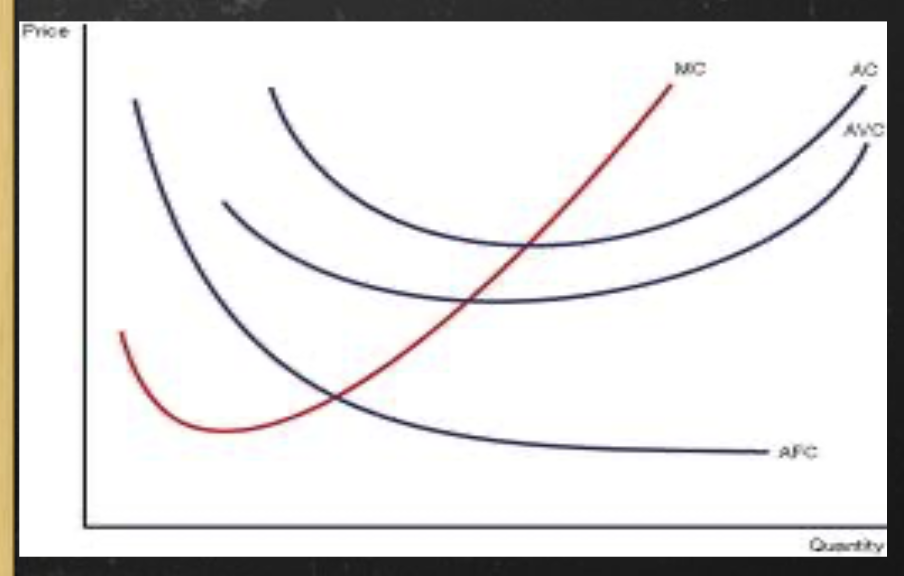
Intersect total cost at the minimum.
At some point, the bulk of costs becomes variable.
Marginal cost is bolted to average total cost.
Capacity: where the marginal costs are equal to the average total costs. How many units can this firm produce at the lowest total cost? The location where MC and ATC are bolted.
Break even: where I earn enough revenue to cover my costs. (profit = 0.)
Shut-down condition: where price intersects average variable costs. When you can’t cover your average variable cost.
P = ATC: break even
P < AVC: shut down.
MR = MC: this determines how much we produce.
Always when price intersects marginal revenue.
Derive a supply schedule from a marginal cost curve from various intersections between price, quantity; marginal cost and price.
Supply curve = firm’s marginal cost curve above their average variable cost.
To grab the market’s supply curve, horizontally add up all the individual supply curves.
Increase in costs: supply curve moves up.