Midterm Review
Bonding
Bonding Overview
Chemical bonding describes how atoms combine to form molecules and compounds. The three primary types of bonding are:
Ionic Bonding: Involves the transfer of electrons from a metal (low electronegativity) to a nonmetal (high electronegativity), resulting in cations and anions. Example: NaCl.
Covalent Bonding: Involves the sharing of electrons between nonmetals. This can be categorized as:
Nonpolar Covalent Bonding: Equal sharing of electrons. Example: H₂.
Polar Covalent Bonding: Unequal sharing of electrons due to differences in electronegativity. Example: HCl.
Metallic Bonding: Involves a "sea of electrons" that are delocalized over a lattice of metal cations. Example: Fe.
Electronegativity Scale (Pauling):
0-0.4: Nonpolar covalent
0.5-1.7: Polar covalent
>1.7: Ionic
Lewis Dot Structures
Lewis dot structures represent the valence electrons of atoms. Valence electrons are the outermost electrons involved in bonding. Follow these steps to draw Lewis structures:
Steps to Draw Lewis Dot Structures:
Count Valence Electrons: Determine the total number of valence electrons in the molecule. For ions, add electrons for negative charges and subtract for positive charges.
Arrange Atoms: The least electronegative atom (excluding hydrogen) is typically the central atom. Hydrogen and halogens are often terminal.
Place Bonds: Draw single bonds (each bond is 2 electrons) between the central atom and surrounding atoms.
Distribute Electrons: Place remaining electrons as lone pairs to satisfy the octet rule (8 electrons per atom, except hydrogen, which only needs 2).
Check Octet Rule: Adjust with double or triple bonds if needed to ensure that all atoms (except exceptions) satisfy the octet rule.
Formal Charge: Minimize formal charge using the formula: Molecules are most stable when formal charges are minimized.
Exceptions to the Octet Rule:
Incomplete Octet (Less than 8 electrons): Occurs in molecules with elements that can be stable with fewer than 8 electrons, often seen in:
Beryllium (Be): Stable with 4 electrons. Example: BeH₂.
Boron (B): Stable with 6 electrons. Example: BF₃.
Expanded Octet: Occurs when atoms have access to d-orbitals (period 3 and below in the periodic table). These atoms can hold more than 8 electrons.
Examples: SF₆ (12 electrons around S), PCl₅ (10 electrons around P).
Odd-Electron Molecules: Molecules with an unpaired electron, called radicals, do not follow the octet rule. Examples include NO and ClO₂.
Ionic Compounds: Some ions like sulfate (SO₄²⁻) or phosphate (PO₄³⁻) involve resonance structures and expanded octets.
Resonance Structures:
Some molecules have multiple valid Lewis structures where electrons are delocalized over different atoms. Examples:
Ozone (O₃): Two resonance structures.
Carbonate Ion (CO₃²⁻): Three resonance structures.
Resonance hybrids represent the true structure, which is an average of all valid resonance forms.
VSEPR Theory
Valence Shell Electron Pair Repulsion (VSEPR) theory predicts molecular geometry based on the repulsion between electron pairs (bonding and nonbonding). Electron pairs arrange themselves to minimize repulsion, determining the molecular shape.
Steps to Predict Molecular Geometry:
Draw the Lewis structure.
Count regions of electron density (bonds + lone pairs) around the central atom.
Use the VSEPR table to determine the geometry.
Electron-Domain Geometries and Molecular Shapes:
Electron Domains | Electron Geometry | Bonding Pairs | Lone Pairs | Molecular Shape | Bond Angle |
2 | Linear | 2 | 0 | Linear | 180° |
3 | Trigonal planar | 3 | 0 | Trigonal planar | 120° |
3 | Trigonal planar | 2 | 1 | Bent | <120° |
4 | Tetrahedral | 4 | 0 | Tetrahedral | 109.5° |
4 | Tetrahedral | 3 | 1 | Trigonal pyramidal | <109.5° |
4 | Tetrahedral | 2 | 2 | Bent | <109.5° |
5 | Trigonal bipyramidal | 5 | 0 | Trigonal bipyramidal | 120°, 90° |
5 | Trigonal bipyramidal | 4 | 1 | Seesaw | <120°,<90° |
5 | Trigonal bipyramidal | 3 | 2 | T-shaped | <90° |
5 | Trigonal bipyramidal | 2 | 3 | Linear | 180° |
6 | Octahedral | 6 | 0 | Octahedral | 90° |
6 | Octahedral | 5 | 1 | Square pyramidal | <90° |
6 | Octahedral | 4 | 2 | Square planar | 90° |
Multiple Bonds and Lone Pairs:
Lone pairs: Occupy more space than bonding pairs, reducing bond angles. Example: NH₃ (trigonal pyramidal) has bond angles <109.5°.
Double and Triple Bonds: Count as a single region of electron density in VSEPR.
Polarity of Molecules:
A molecule’s polarity depends on both bond polarity and molecular geometry:
Nonpolar molecules have a symmetrical distribution of charge. Example: CO₂ (linear).
Polar molecules have an asymmetrical distribution of charge. Example: H₂O (bent).
Examples of Bonding, Lewis Structures, and VSEPR:
Water (H₂O):
Lewis Structure: O has 2 lone pairs, and each H forms a single bond with O.
Electron Geometry: Tetrahedral (4 regions of electron density).
Molecular Geometry: Bent.
Bond Angle: 104.5°.
Carbon Dioxide (CO₂):
Lewis Structure: O=C=O (no lone pairs on C, 2 lone pairs on each O).
Electron Geometry: Linear (2 regions of electron density).
Molecular Geometry: Linear.
Bond Angle: 180°.
Phosphate Ion (PO₄³⁻):
Lewis Structure: Central P forms single bonds with four O atoms, with a formal charge of -1 on each terminal O.
Electron Geometry: Tetrahedral (4 regions of electron density).
Molecular Geometry: Tetrahedral.
Bond Angle: 109.5°.
Sulfur Hexafluoride (SF₆):
Lewis Structure: S forms single bonds with six F atoms, using an expanded octet.
Electron Geometry: Octahedral (6 regions of electron density).
Molecular Geometry: Octahedral.
Bond Angle: 90°.
Nomenclature
Covalent Compound Nomenclature
Covalent compounds consist of nonmetals bonded by shared electrons. Naming covalent compounds requires using prefixes to indicate the number of each type of atom.
Rules for Naming Covalent Compounds:
Identify the Elements:
Name the first element as it appears on the periodic table.
Name the second element by replacing the ending with "-ide."
Use Prefixes to Indicate Quantity:
Prefixes: Indicate the number of each type of atom. Omit "mono-" for the first element but use it for the second element if there is only one.
Prefixes for Covalent Compounds:
Number | Prefix |
1 | Mono- |
2 | Di- |
3 | Tri- |
4 | Tetra- |
5 | Penta- |
6 | Hexa- |
7 | Hepta- |
8 | Octa- |
9 | Nona- |
10 | Deca- |
Avoid Double Vowels: If the prefix ends in a vowel and the element begins with a vowel, drop the vowel from the prefix.
Example: "Mono-oxide" becomes "Monoxide."
Examples of Covalent Compound Naming:
CO: Carbon monoxide
CO₂: Carbon dioxide
N₂O₄: Dinitrogen tetroxide
SF₆: Sulfur hexafluoride
P₄O₁₀: Tetraphosphorus decaoxide
Ionic Compound Nomenclature
Ionic compounds consist of cations (positive ions) and anions (negative ions). Naming ionic compounds depends on whether the cation is a fixed-charge metal, a variable-charge metal, or a polyatomic ion.
Rules for Naming Ionic Compounds:
Name the Cation First:
For metals with a fixed charge (Groups 1, 2, and Al, Zn, Ag): Name the element.
For metals with variable charges (transition metals): Specify the charge using Roman numerals in parentheses.
Name the Anion Second:
For monatomic anions (single elements): Replace the ending with "-ide."
For polyatomic anions: Use the name of the polyatomic ion (see table below).
Polyatomic Ions to Memorize:
Ion Name | Formula |
Ammonium | NH₄⁺ |
Hydronium | H₃O⁺ |
Mercury(I) | Hg₂²⁺ |
Mercury(II) | Hg²⁺ |
Nitrate | NO₃⁻ |
Nitrite | NO₂⁻ |
Hydroxide | OH⁻ |
Permanganate | MnO₄⁻ |
Cyanide | CN⁻ |
Acetate | C₂H₃O₂⁻ |
Thiocyanate | SCN⁻ |
Cyanate | CNO⁻ |
Carbonate | CO₃²⁻ |
Chromate | CrO₄²⁻ |
Dichromate | Cr₂O₇²⁻ |
Sulfate | SO₄²⁻ |
Sulfite | SO₃²⁻ |
Thiosulfate | S₂O₃²⁻ |
Peroxide | O₂²⁻ |
Oxalate | C₂O₄²⁻ |
Arsenite | AsO₃³⁻ |
Arsenate | AsO₄³⁻ |
Phosphite | PO₃³⁻ |
Phosphate | PO₄³⁻ |
Perchlorate | ClO₄⁻ |
Chlorate | ClO₃⁻ |
Chlorite | ClO₂⁻ |
Hypochlorite | ClO⁻ |
Addition of "Bi-":
Adding a hydrogen to the ion reduces its charge by one and adds the prefix "bi-."
Example: HCO₃⁻ is Bicarbonate (or Hydrogen carbonate).
Examples of Ionic Compound Naming:
NaCl: Sodium chloride
Mg(NO₃)₂: Magnesium nitrate
Fe₂O₃: Iron(III) oxide
CuSO₄: Copper(II) sulfate
NH₄Cl: Ammonium chloride
Basic Organic Chemistry Nomenclature
Organic compounds are primarily based on carbon and hydrogen. The International Union of Pure and Applied Chemistry (IUPAC) system provides rules for naming organic compounds.
Prefixes for Carbon Chains:
Prefixes indicate the number of carbons in the main chain:
Number | Prefix |
1 | Meth- |
2 | Eth- |
3 | Prop- |
4 | But- |
5 | Pent- |
6 | Hex- |
7 | Hept- |
8 | Oct- |
9 | Non- |
10 | Dec- |
Suffixes for Functional Groups:
The suffix depends on the type of compound:
Functional Group | Suffix | Example |
Alkanes (single bonds) | -ane | Methane (CH₄) |
Alkenes (double bonds) | -ene | Ethene (C₂H₄) |
Alkynes (triple bonds) | -yne | Ethyne (C₂H₂) |
Alcohols | -ol | Methanol (CH₃OH) |
Hydrocarbons and the General Formula:
Alkanes (CₒH₂ₙ₊₂): Saturated hydrocarbons with only single bonds.
Example: Propane (C₃H₈)
Alkenes (CₒH₂ₙ): Unsaturated hydrocarbons with one double bond.
Example: Ethene (C₂H₄)
Alkynes (CₒH₂ₙ₋₂): Unsaturated hydrocarbons with one triple bond.
Example: Ethyne (C₂H₂)
Naming Substituents:
Identify and name the longest continuous carbon chain.
Name and number substituents (e.g., methyl, ethyl, bromo, chloro).
Arrange substituents alphabetically.
Examples of Organic Compound Naming:
CH₄: Methane
C₂H₆: Ethene
C₃H₈: Propane
CH₃OH: Methanol
CH₃CHBrCH₃: 2-Bromopropane
Periodicity
Introduction to Periodicity
Periodicity refers to the repeating patterns of chemical and physical properties of elements as you move across periods and down groups in the periodic table.
These trends are a result of the electronic structure of atoms and the periodic arrangement of elements.
Key Sections of the Periodic Table
Groups (Families): Vertical columns in the periodic table (numbered 1–18).
Elements in the same group have similar chemical properties due to the same number of valence electrons.
Examples:
Group 1 (Alkali Metals): Highly reactive metals with one valence electron.
Group 2 (Alkaline Earth Metals): Reactive metals with two valence electrons.
Group 17 (Halogens): Highly reactive nonmetals with seven valence electrons.
Group 18 (Noble Gases): Inert gases with a full valence shell.
Periods (Series): Horizontal rows in the periodic table.
Elements in the same period have the same number of principal energy levels (electron shells).
Sections of the Table:
s-block: Groups 1 and 2, plus Helium.
p-block: Groups 13–18.
d-block: Transition metals (Groups 3–12).
f-block: Lanthanides and actinides (inner transition metals).
Special Groups of Elements:
Transition Metals: Variable oxidation states, form colored compounds, and are good catalysts.
Lanthanides: Rare earth metals, often used in electronics and magnets.
Actinides: Radioactive elements, including Uranium and Plutonium.
Trends in the Periodic Table
1. Atomic Radius:
Definition: Distance from the nucleus to the outermost electron.
Trend:
Across a Period (Left to Right): Decreases due to increasing nuclear charge, which pulls electrons closer to the nucleus.
Down a Group: Increases due to the addition of electron shells, which outweighs the increased nuclear charge.
Examples:
Smallest Atomic Radius: Helium (He).
Largest Atomic Radius: Cesium (Cs).
2. Electronegativity:
Definition: The ability of an atom to attract electrons in a chemical bond.
Trend:
Across a Period: Increases due to higher nuclear charge and smaller atomic radius.
Down a Group: Decreases due to increased atomic radius and shielding effect.
Exceptions:
Noble gases are typically excluded since they don’t form bonds easily.
Fluorine (F) is the most electronegative element, while Francium (Fr) is the least.
3. Ionization Energy (IE):
Definition: Energy required to remove one mole of electrons from one mole of gaseous atoms.
First Ionization Energy (IE₁): Energy to remove the first electron.
Second Ionization Energy (IE₂): Energy to remove a second electron after the first has been removed. This is significantly higher if the second electron is being removed from a stable, full shell.
Trend:
Across a Period: Increases due to higher nuclear charge and smaller atomic radius.
Down a Group: Decreases due to increased atomic radius and shielding effect.
Exceptions:
Group 2 > Group 13: Full s-subshell is more stable (e.g., Be > B).
Group 15 > Group 16: Half-filled p-subshell is more stable (e.g., N > O).
Key Point on Higher Ionization Energies:
Higher ionization energies (IE₂, IE₃, etc.) increase dramatically when electrons are removed from stable, fully filled or half-filled subshells. For example, after removing the valence electrons from magnesium (Mg), the IE increases significantly when attempting to remove electrons from the filled 2p⁶ subshell.
4. Metallic Character:
Definition: The tendency of an element to lose electrons and form cations.
Trend:
Across a Period: Decreases due to increasing ionization energy.
Down a Group: Increases due to decreasing ionization energy.
Most Metallic Element: Francium (Fr).
5. Reactivity:
Metals:
Trend: Increases down a group (e.g., Group 1 elements).
Example: Cesium (Cs) is more reactive than Lithium (Li).
Nonmetals:
Trend: Decreases down a group (e.g., Group 17 elements).
Example: Fluorine (F) is more reactive than Iodine (I).
Key Concepts in Periodicity
Shielding Effect:
Definition: Inner electron shells block the attraction between the nucleus and outer electrons.
Trend: Increases down a group, leading to larger atomic radii and lower ionization energy.
Why It Matters: Shielding reduces the effective nuclear charge felt by valence electrons, making them easier to remove.
Effective Nuclear Charge (Z_eff):
Definition: The net positive charge experienced by an electron in a multi-electron atom.
Formula: Z_eff = Z - S, where:
Z: Total number of protons in the nucleus.
S: Number of shielding (core) electrons.
Trend:
Across a Period: Increases because Z increases while S remains relatively constant (valence electrons do not shield each other effectively).
Down a Group: Remains approximately the same because both Z and S increase proportionally.
Example: In Fluorine (F), Z = 9 and S ≈ 2, so Z_eff ≈ 7. This strong effective nuclear charge explains Fluorine's high electronegativity.
Full and Half-Filled Subshell Stability:
Atoms with half-filled (e.g., nitrogen) or fully filled (e.g., neon) subshells are more stable.
Example:
Nitrogen’s 1s² 2s² 2p³ configuration makes it more stable than oxygen’s 1s² 2s² 2p⁴.
Removing an electron from oxygen requires less energy because it disrupts the repulsion between paired electrons.
Examples to Illustrate Trends
Why Does Fluorine Have High Electronegativity?
Small atomic radius.
High nuclear charge relative to shielding.
Why Is Cesium Highly Reactive?
Large atomic radius.
Low ionization energy.
High metallic character.
Why Is the Ionization Energy of Nitrogen Higher than Oxygen?
Nitrogen has a stable half-filled p-subshell.
Summary of Periodic Trends
Property | Across a Period | Down a Group |
Atomic Radius | Decreases | Increases |
Electronegativity | Increases | Decreases |
Ionization Energy | Increases | Decreases |
Metallic Character | Decreases | Increases |
Reactivity (Metals) | Decreases | Increases |
Reactivity (Nonmetals) | Increases | Decreases |
Atomic Theory & Light
1. Structure of the Atom
The atom is the smallest unit of matter that retains the identity of an element. It is composed of three subatomic particles:
Proton (p⁺):
Positively charged particle (+1).
Located in the nucleus.
Mass: ~1 atomic mass unit (amu) or 1.0073 amu.
Determines the atomic number (Z) of an element.
Neutron (n⁰):
Neutral particle (0 charge).
Located in the nucleus.
Mass: ~1 amu (slightly heavier than a proton, ~1.0087 amu).
Determines isotope identity of an element (affects atomic mass).
Electron (e⁻):
Negatively charged particle (-1).
Located in the electron cloud surrounding the nucleus.
Mass: Negligible (~0.00055 amu).
Involved in chemical bonding and reactions.
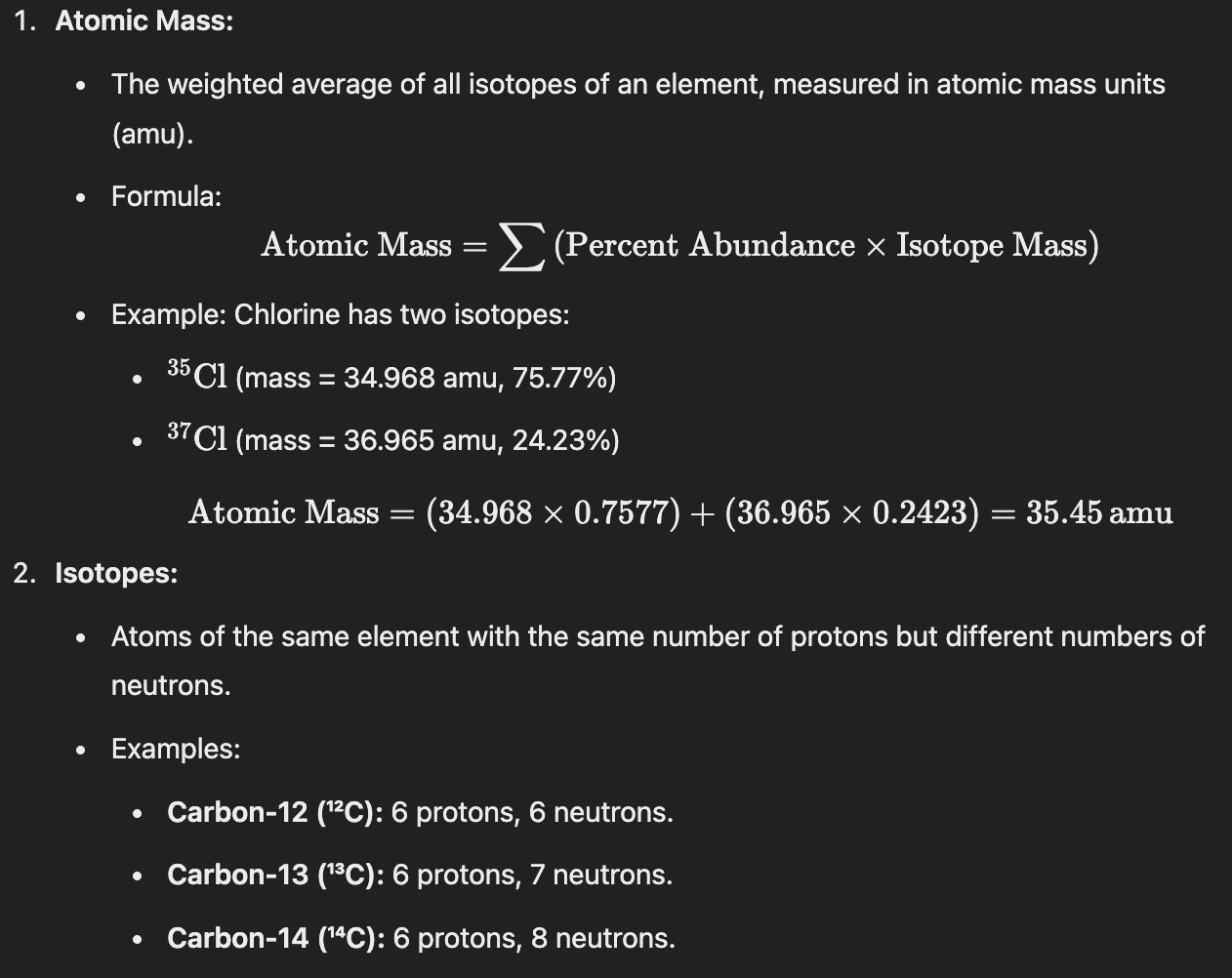
2. Atomic Mass and Isotopes
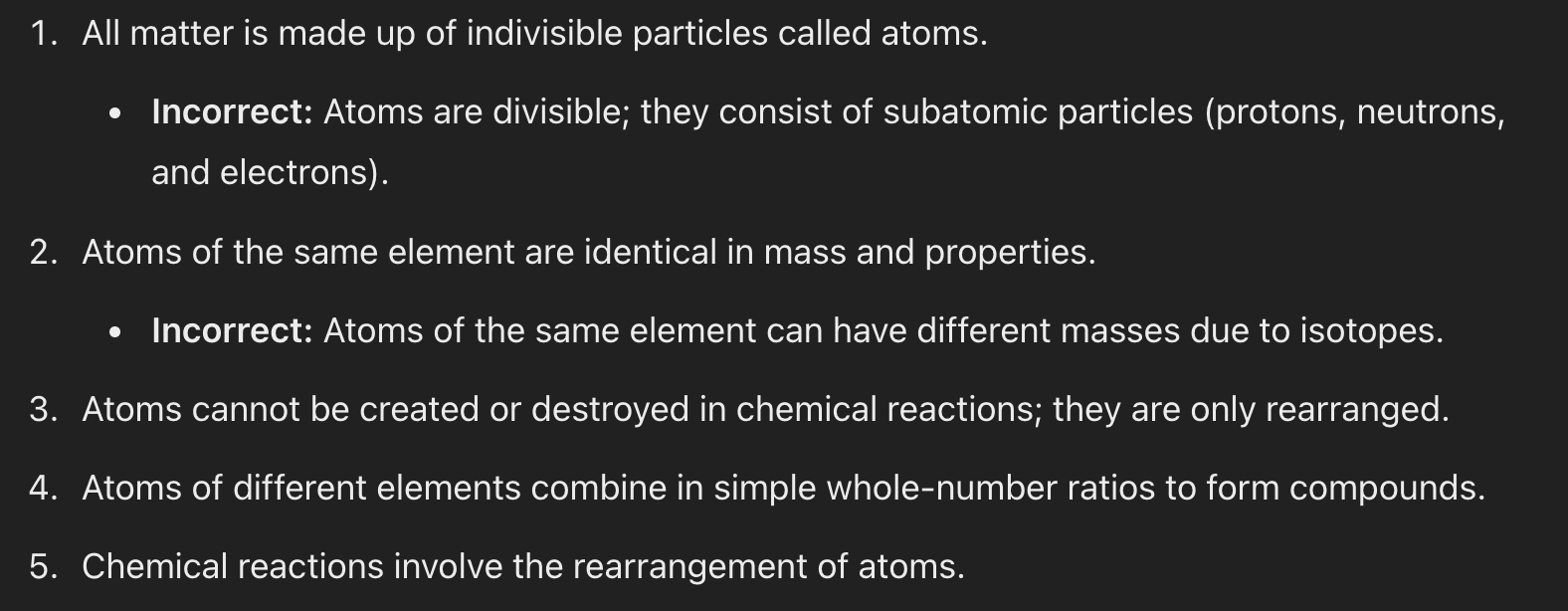
3. Dalton’s Atomic Theory (1808)
4. Key Experiments in Atomic Theory
Thomson’s Cathode Ray Tube Experiment (1897):
Discovery of the electron.
Demonstrating that cathode rays are composed of negatively charged particles embedded in a positively charged sphere
Proposed the "Plum Pudding Model," where electrons were embedded in a positive sphere.
Rutherford’s Gold Foil Experiment (1911):
Discovery of the nucleus.
Most of the atom is empty space; the nucleus is small, dense, and positively charged.
Led to the Nuclear Model.
Bohr’s Model of the Atom (1913):
Electrons move in fixed orbits around the nucleus.
Each orbit corresponds to a specific energy level.
Explained the emission spectra of hydrogen.
5. Electron Configuration
Energy Levels, Sublevels, and Orbitals:
Principal Energy Level (n): Determines the size and energy of orbitals.
Sublevels: s, p, d, f.
s = 1 orbital (2 electrons max).
p = 3 orbitals (6 electrons max).
d = 5 orbitals (10 electrons max).
f = 7 orbitals (14 electrons max).
Aufbau Principle: Electrons fill orbitals from the lowest to the highest energy.
Order: 1s, 2s, 2p, 3s, 3p, 4s, 3d, 4p, etc.
Pauli Exclusion Principle: No two electrons in the same atom can have the same set of quantum numbers.
Hund’s Rule: Electrons fill orbitals of the same energy singly before pairing up.
Example:
Oxygen (O): Atomic number = 8
Electron configuration: 1s²2s²2p4
6. How We See Colors (Emission Spectra)
Excitation and Emission:
When an electron absorbs energy, it moves to a higher energy level (excited state).
When the electron falls back to its ground state, it releases energy in the form of light.
Line Spectra:
Each element has a unique line spectrum (e.g., hydrogen’s Balmer series).
7. Frequency, Wavelength, and Energy of Light
Key Equations:
Speed of light (c):
c = 𝜆𝜈
Where: 𝜆 = wavelength (m), 𝜈 = frequency (Hz), c = 3.00 * 108 m/s
Energy of a photon (E): E = ℎ𝜈
Where: E = energy (J),
h=6.63×10 −34 J/s
𝜈 = frequency (Hz).
Key Equations:
Speed of light (ccc):
c=λνc = \lambda \nuc=λν
Where:
λ\lambdaλ = wavelength (m), ν\nuν = frequency (Hz), c=3.00×10⁸ m/sc = 3.00 \times 10^8 \, \text{m/s}c=3.00×108m/s.Energy of a photon (EEE):
E=hνE = h \nuE=hν
Where:
EEE = energy (J), h=6.63×10⁻³⁴ J\cdotpsh = 6.63 \times 10^{-34} \, \text{J·s}h=6.63×10⁻³⁴J\cdotps, ν\nuν = frequency (Hz).
Relationships:
Wavelength and frequency are inversely proportional.
Energy and frequency are directly proportional.
Example:
If ν=5.00×10¹⁴ Hz\nu = 5.00 \times 10^{14} \, \text{Hz}ν=5.00×10¹⁴Hz, calculate λ\lambdaλ: λ=cν=3.00×1085.00×1014=6.00×10⁻⁷ m\lambda = \frac{c}{\nu} = \frac{3.00 \times 10^8}{5.00 \times 10^{14}} = 6.00 \times 10^{-7} \, \text{m}λ=νc=5.00×10143.00×108=6.00×10⁻⁷m
8. Percent Abundance and Atomic Mass
Percent Abundance:
The relative percentage of each isotope in nature.
Example Problem:
Element X has two isotopes:
Isotope 1: 50% at 10.00 amu.
Isotope 2: 50% at 11.00 amu.
9. Summary of Key Scientists
Scientist | Key Contribution |
Dalton | First atomic theory (5 postulates). |
Thomson | Discovery of the electron. |
Rutherford | Discovery of the nucleus. |
Bohr | Energy levels in atoms. |