6.9 experimental design🧡
Repeated measures
the same participants complete both the conditions of the independent variable
Produces related data
Evaluation
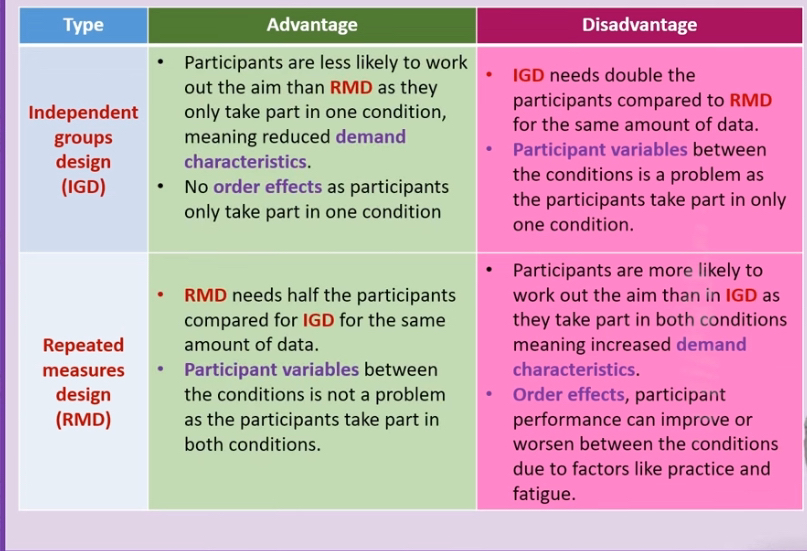
order effects, may influence performance in the second condition. And may alter behaviour (demand characteristics
This is controlled by ‘counter balancing’. One group does A then B. Other group does B then A
Independent groups design
different participants complete a condition of the independent variable
Randomly allocated to each condition (To avoid bias)
Produces unrelated data
Evaluation
participant variables - characteristics can influence the DV, extraneous variables which reduce validity
Matched pairs design
Participants are assessed and ranked on a characteristic. Then the top two are randomly assigned to separated conditions, same for the next two etc…
Produces related data. Scores in one condition can be paired with a data point in another condition
Evaluation
reduced participant variables as they are matched on characteristics
No order effects as they only take part in one condition
Takes longer
Needs twice as many participants
There are still some participant variables that influence the DV