States of Consciousness
States of consciousness refers to the various levels of attention an individual can experience.
tell us a lot about consciousness. Patients with split brains have their corpus callosum split which makes the two hemispheres unable to interact. Hemispheric specialization describes how the different sides of the brain have different functions. This is demonstrated why showing a person with a split-brain a word in either their left or right visual field. If the word is in their right visual field, they can say the word. If it is in their left visual field, they can draw the word. 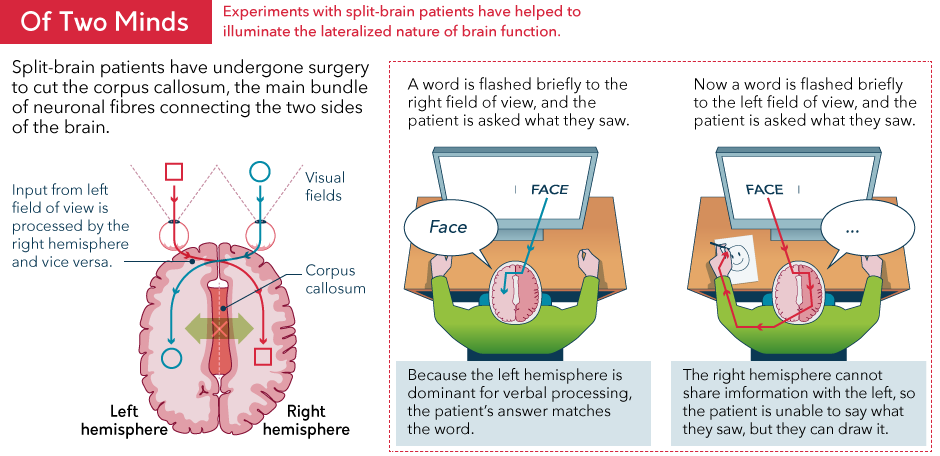
Daniel Dennett (1942-present)
Dennett demonstrates that conscious awareness functions like perception where we understand the world in a way that is useful to us. He says consciousness is the result of various processes in the brain working independently and interacting with each other. Daniel used the flicker test in his research.
Attention
is the process of selecting information from the internal and external environment to process. processes the external environment using bottom-up processing while uses top-down processing and is goal oriented. Selective attention occurs when a person is processing some information while ignoring other information. The refers to the bottom-up qualities around you and how easily the grasp your attention due to their physical properties. occurs when attention is diverted due to a stimulus salience. is the process of reducing processing of certain information while the brain attends to a specific task.
A is processed but does not reach the threshold of consciousness and cannot be detected when searched for. are shown too quickly for the visual system to process and are quiet in comparison to other audible stimuli in the environment. Subliminal messages are processed but are not salient enough to be consciously processed. refers to information from the environment that influences our behaviour without our knowledge. We are aware these stimuli are being processed by not that they influence behaviour.
The describes an event of selective attention where a person can be engaged in a conversation while ignoring all the stimuli around them to remain engaged.
The requires participants to wear headphones where different audio is fed into each ear. The participant is told to repeat the information from one ear out loud. This experiment demonstrates dichotic listening as when the unattended ear plays a stimulus such as the participants name. A measurement can be taken during this task which measures arousal levels when something startling or emotionally engaging is heard.
is when we attend to two or more tasks at the same time. Automaticity is effortless processing that can be done without thinking of the task too deeply and is the only reason we believe we can multitask. , missing changes in information, can occur when engaging in multiple tasks.
The shows participants a flash of two versions of the same photo and are asked to find the difference between the images. The images were shown for only 250 milliseconds. Participants have a hard time detecting the changes. studies use the flicker test. These studies require participants to actively search for the change made to the stimulus.
Attention Disorders
occurs when there is a lesion on the right parietal lobe which results in the lose of awareness of stimulus from the left visual field. Partients do not know that anything is wrong with their attention.
has nine measurements of attention and nine hyperactivity behaviours used for diagnosis where individuals need to have minimum of six in each category to receive a diagnosis. People with ADHD generally have a hard time concentrating on specific tasks.
Sleep
is a hereditary disease affecting the thalamus that causes death due to lack of sleep.
(EEGs) measure activity across the surface of the brain. measure movement of the eyes. measure tension in the jaw.
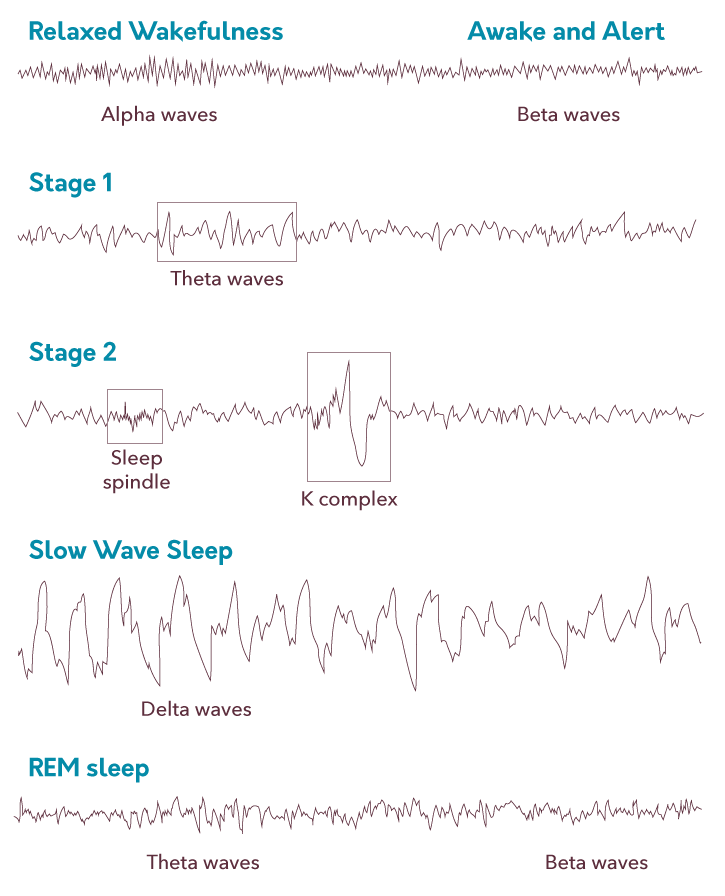
are observed when you’re relaxed and resting but not asleep. are erratic and desynchronized. This desynchrony shows that many neural circuits in your brain are being used. occur when you are deeply asleep where each oscillation has a period of neural inhibition and a period of neural excitation. occur when you are deeply relaxed or falling asleep.
Stage 1 sleep is the transition from alpha waves to theta waves referred to as . When transitioning from stage 1 to stage 2 sleep, (burst off activity 2-5 times per minute) and (neural excitation then inhibition once per minute) occur. After 15-20 minutes we enter , which is stages 3 and 4. SWS is the deepest stage of sleep and when awoken from SWS we fell groggy. 45 minutes after SWS, the brain enters sleep. Beta waves appear on the EEG and your eyes move side to side. REM is characterized by vivid plot-driven dreams which is due to the larhe proportion of oxygenated blood in te visual cortex. is the paralysis that occurs during REM sleep that keeps us from moving when brain activity is high during sleep. After REM sleep, you return to stage 1 and the sleep cycle repeats.
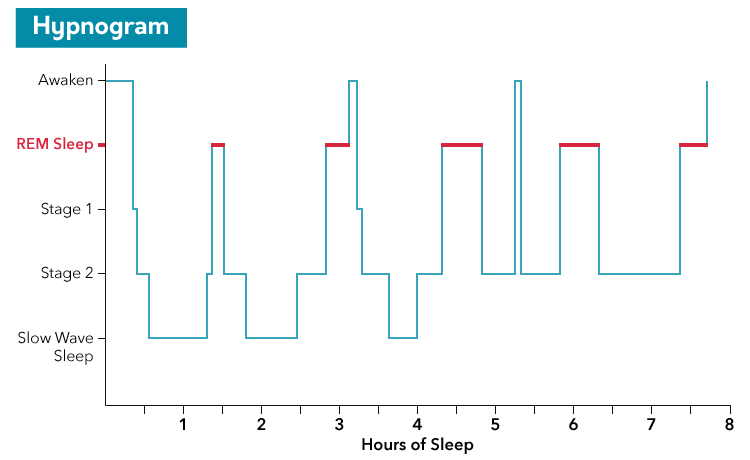
All warm blooded animals have REM sleep and experience muscular paralysis and rapid eye movement. One hypothesis of sleep suggests it has a role in rest and recovery for the body after physical excretion, though experimental evidence do not show a distinction between sleep patterns and amount of physical labour.
Short-wave sleep is shown to restore the brain, as seen in Horne’s experiment where he purposely sleep deprived participants and notices cognitive difference between the test and control group. SWS is also important for explicit memories. REM sleep allows the brain to integrate information. The rebound phenomenon describes how being deprived of REM sleep will make the body enter REM more quickly and for longer.
Dreams
Nightmares often occur during shortwave sleep. When awoken, the person will say they had a dream but they cannot remember it.
The theorizes that dreams are a consequence of brain processes that occur during sleep and have no meaning. The of dreams suggests that we dream about things directly related to survival and life threatening circumstances which make us more prepared for real life.
Sleep Disorders
refer to problems quality of sleep and parasomnias refer to disturbances during sleep. is the inability to fall asleep often due to stress or environmental factors such as napping during the day or drinking caffeine before bed. Sometimes insomnia due to underlying medial conditions or substance abuse. occurs when cues that would typically help a person fall asleep give the person anxiety. Trying to sleep is associated with the inability to sleep which makes it difficult to fall asleep. is the result of a neurophysical abnormality. is excessive sleepiness during the day that is often caused by poor sleep at night. is a conditioned when oxygen intake is reduced when asleep which causes the person to wake up throughout the night. is a rare neurodegerative disorder that causes a sudden and extreme need to sleep. is a second symptom of narcolepsy where an individual experiences muscle paralysis during waking hours occur when falling asleep and occur before waking up.
is a neurodegenerative disorder where the body is not paralyzed during REM sleep and the individual acts out their dreams. occur during SWS and consist of panicked screaming with no memory of what occurs when awoken. , commonly known as sleep walking, is an SWS disorder where individuals act out complex behaviours in their dreams.
Biological Clock
The internal clock that prepares you for daily, seasonal and annual rhythms are called biological clocks. The daily clock that tells us when to be awake and when to sleep is referred to as circadian rhythms which are set by zeitgebers. are time cues based primarily on the presence of light. occurs when you change time zones and your internal clock is out of sync with the time cues around you. The located next to the optic chiasma sets circadian rhythm because it receives light signal from the eye and signals to the pineal gland when to release melatonin, the sleeping hormone.
Altered States of Consciousness
influence mood, thoughts, and behaviour which results in an altered state of consciousness. Drug tolerance occurs when a large dose of a drug is required to obtain the desired affect. Dependence occurs when an individual needs a drug to function normally. Without taking the drug, they will experience withdrawal, which is characterized by distress, restlessness and irritability.
is apart of the brains reward system and is often targeted by drugs which makes them addictive.
slow the central nervous system. is a depressant that inhibits the affect of glutamate, an excitatory neurotransmitter, and increases the affect of GABA, an inhibitory neurotransmitter. induce sleep and are often prescribed to anxiety disorders. are fast acting highly addictive medication given to people with anxiety.
Stimulants increase activity in the nervous system. stimulates the release of acetylcholine, an excitatory neurotransmitter, and dopamine. Cocaine and amphetamines enhances the effects of dopamine. deactivates the proteins responsible for dopamine reuptake. stimulate the release of dopamine as well as inhibit its reuptake.
are psychedelic drugs that influence our sensory systems and perception of reality. Synesthesia, the merging of the sense, if often reported by those who take psychedelic drugs. LSD causes vivid sensory hallucinations and altered perceptions of time and space. This occurs because LSD is an agonist of serotonin, a neurotransmitter responsible for mood as well as organizing sensory information in the thalamus. , derived from peyote cacti, enhances colour perception as well as cause numbness, tension, anxiety, and intense nausea. is the most commonly used hallucinogen which influences how other neurotransmitters are released.