3.3.1 Biological molecules
Monomers and polymers
Monomers - smaller units from which larger molecules are made e.g. monosaccharides (glucose etc.), amino acids, nucleotides
Polymers - molecules made from many monomers joined together
Condensation reaction - joins 2 molecules together with the formation of chemical bond and involves the elimination of a molecule of water
Hydrolysis reaction - breaks a chemical bond between 2 molecules and involves use of a water molecule
Carbohydrates
Carbohydrates are used as a source of energy as well as used as structural materials in cells. All carbohydrates are soluble and contain carbon, hydrogen and oxygen
Monosaccharides
All monosaccharides have the formula C6H12O6
Glucose (2 isomers = alpha and beta)
Galactose
Fructose
Disaccharides
2 monosaccharides joined together in a condensation reaction by a GLYCOSIDIC bond (water removed)
Maltose = glucose + glucose
reducing sugar
Sucrose = glucose + fructose
NON REDUCING SUGAR
Lactose = glucose + galactose
reducing sugar
Polysaccharides
Many monomers joined together via condensation reaction
Starch = alpha glucose
storage molecule in plants
insoluble - doesn’t change water potential of cells so no uptake of water via osmosis
compact and dense - coils into helix so large amounts can be stored in small spaces
branched - large surface area so can be acted on simultaneously by enzymes
hydrolysed by amylase to use glucose for respiration
Glycogen = alpha glucose
animal storage and short term energy store
insoluble - doesn’t change water potential of cells so no uptake of water via osmosis
compact - large amounts stored in small spaces
branched - can be acted on simultaneously - more rapidly broke down
hydrolysed by glucagon into glucose for respiration (insulin condenses glucose into glycogen)
Cellulose = beta glucose
used in cell walls in plants for structure
alternating inverted beta glucose molecules = rigid/inflexible, straight chain
chains linked together by hydrogen bonds to form microfibrils - which are very strong
bonds cannot be hydrolysed by amylase - requires specific enzyme
Biochemical tests (for sugars)
Test for reducing sugars:
add benedicts reagent and shake
place in hot water bath and heat mixture
negative = remains blue, positive = brick red
(Colour change due to presence of copper oxide as reducing sugar has donated electrons which reduce blue copper sulphate to red copper oxide)
all monosaccharides and disaccharides are reducing sugars with the only exception of sucrose
Test for non reducing sugars:
perform test for reducing sugar and observe negative result
boil with hydrochloric acid to hydrolyse glycosidic bond
neutralise the solution using alkaline
add benedicts and heat - positive = brick red
(unable to donate electrons and doesn’t reduce other chemicals)
Test for starch
add iodine solution to starch
negative = orange, positive = blue-black
Lipids
All lipids contain carbon, hydrogen and oxygen. They are insoluble.
Lipids are hydrolysed by lipase into fatty acids and glycerol
Triglycerides
triglycerides = 1 glycerol, 3x fatty acids joined by a condensation reaction to form an ester bond
Saturated lipids - no double carbon bonds
Monounsaturated lipids - 1 double carbon bond (weaker)
Polyunsaturated lipids - more than 1 double carbon bond
Double carbon bonds cause a change in shape so the lipids cannot fit together as closely (liquid)
Phospholipids
Hydrophobic tails, hydrophilic heads
Form phospholipid bilayer (cell membrane)
Biochemical test
crush food
add ethanol and SHAKE
add water
lipid = white emulsion formed
Proteins
Amino acids
20 different amino acids - only part that differs is the R group
Dipeptides are formed in a condensation reaction between amine group of 1 amino acid and carboxyl group of another - forming a peptide bond
Made up of carbon, hydrogen, oxygen and nitrogen
Protein structure
Primary structure - sequence of amino acids
Secondary structure - hydrogen bonds form between amine group of 1 amino acid and carboxyl group of another - folding the polypeptide chain into alpha helices and beta sheets. (R group not involved)
Tertiary structure - polypeptide is folded into unique 3D shape forming a globular structure. Forming hydrogen bonds, ionic bonds and disulphide bridges between the R groups
Quaternary structure - more than one polypeptide chain to form globular proteins (enzymes) or fibrous proteins (more structural e.g. keratin)
Enzymes
Enzymes are biological catalysts for anabolic and catabolic reactions by lowering activation energy. They form enzyme substrate complexes and are affected by pH and temperature
Induced fit model:
substrate binds to active site of the enzyme
enzyme brings substrate molecules close together and puts stress on the bonds and bends them
active site changes shape slightly by changing the tertiary structure making it complimentary to substrate
this lowers activation energy
Rate of reaction:
temperature:
increases kinetic energy - more frequent collisions so more enzyme substrate complexes = increased rate of reaction
however if temperature too high the bonds are disrupted - changing tertiary structure therefore changing active site shape so substrate no longer complimentary and enzyme is denatured
pH:
at extreme pH bonds are disrupted - changing tertiary structure therefore changing active site shape so substrate no longer complimentary and enzyme is denatured
amino acid charge is altered in active site, preventing formation of ESC
concentration
substrate concentration increases = rate of reaction increases
until saturation point reached then concentration has no effect as it has already reached maximum
Enzyme inhibition:
These reduce enzyme activity by directly or indirectly interfering with active site
Competitive inhibition - shape is similar to substrate so will fit into active site (direct) preventing substrate from binding - however does not permanently bind to active site. Effectiveness depends on how much inhibitor and substrate is present - adding more substrate overcomes inhibition
Non-competitive - attach to enzyme at a site away from the active site (allosteric site) (indirect) which permanently changes active site shape so substrate cannot bind. Effectiveness does not depend on how much substrate present
Biochemical test (proteins)
add biuret solution to a sample of crushed food
positive = purple, negative = blue
DNA
DNA structure
Monomer of DNA is a nucleotide - these join together in a condensation reaction between phosphate group of 1 amino acid and deoxyribose sugar of another forming a PHOSPHODIESTER bond
Nitrogenous bases: Adenine - Thymine, Cytosine - Guanine
Adenine and Guanine are purines which are slightly larger bases - Thymine and Cytosine are pyrimidines which are slightly smaller - small and large base are always paired to form an even structure (bases join together with hydrogen bonds)
RNA structure
RNA transfers genetic information from DNA to ribosomes
RNA has the same structure as DNA but with ribose sugar instead of deoxyribose sugar - also has a uracil base instead of thymine
RNA is a short and single stranded whereas DNA is long and double stranded
3 types of RNA:
messenger RNA (transfers DNA code from nucleus to cytoplasm to make proteins)
transfer RNA (used in making proteins and in translation)
ribosomal RNA (form ribosomes which are the site of protein synthesis)
Genetic code:
3 bases in a row = codon
genetic code is universal (4 bases are same in all organisms)
genetic code is degenerate (different codons specify same amino acids)
genetic code is non overlapping (each base is only part of 1 codon)
DNA replication
SEMI-CONSERVATIVE REPLICATION:
DNA helicase unwinds the double helix and breaks hydrogen bonds between strands (‘unzipping DNA’)
Strands act as a template
Pool of free nucleotides attracted to complimentary bases (AT, GC)
DNA polymerase reforms hydrogen bonds
This produces 2 new DNA strands - each contain half original and half new - therefore semi conservative
Meselson and Stahl ultracentrifuge:
centrifuge DNA - more dense DNA forms band at bottom of tube (15N)
Add 15N DNA into a 14N growth medium - semi conservative replication forms 14.5N DNA - band appears further up
2nd generation forms half 14N and half 14.5N DNA etc.
ATP
ATP = adenine triphosphate - provides energy to drive processes inside living cells
Synthesised during respiration and photosynthesis
ATP is a small soluble molecule that provides a short term store of chemical energy that cells can use in processes such as active transport, muscle contraction etc.
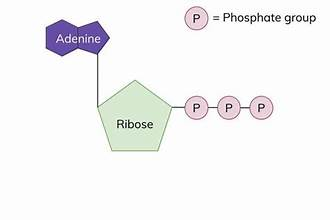
ATP is converted (hydrolysed) into ADP (adenine diphosphate) in a hydrolysis reaction using enzyme ATP hydrolase - also releasing an inorganic phosphate (Pi) and energy.
ADP is converted into ATP in a condensation reaction using enzyme ATP synthase
Why use ATP:
soluble
energy released in small, manageable amounts
broken down easily in a single step
energy available rapidly
can be reformed from ADP and Pi
It phosphorylates substances making them more reactive
Water
5 key properties of water:
it is a metabolite - involved in chemical reactions e.g. respiration, protein synthesis - any condensation/hydrolysis reaction
it is an important solvent - allows chemical reactions to occur faster and allows transport of substances
high specific heat capacity - can absorb large amounts of heat energy without changing temperature - maintains stable environment acting as a buffer to minimise fluctuations in temperature which is important for aquatic organisms
high latent heat of vaporisation - water evaporates heat energy away from body causing a cooling effect (sweat)
strong cohesion between water molecules - hydrogen bonds allow water to be held together so it can flow as a continuous column of water - allows it to be pulled up in xylem
Inorganic ions
Inorganic ions (without carbon) occur in solution in the cytoplasm and body fluids of organisms
Sodium ions:
involved in co transport of glucose and amino acids across membranes (large molecules)
Phosphate ions:
DNA and RNA contain phosphate groups which allow nucleotides to bond with phosphodiester bonds to form polynucleotides
ATP contains phosphate group which acts as energy source (phosphorolysis other substances)
Iron ions:
bind to oxygen in haemoglobin so it can be carried around body
Hydrogen ions:
pH level determined by concentration of hydrogen ions (more hydrogen ions present = lower pH)