W2/L2 Charismatic Leadership and Attribution
2. Understanding Charisma in Leadership
Historical Context:
Originally referred to as a divinely inspired gift (Weber, 1958).
Charismatic leaders influence followers through personal traits, vision, and communication styles.
Antonakis et al. (2016) identified three key ways charismatic leaders communicate:
Appealing to follower values.
Using clear and vivid symbolic communication.
Displaying emotional conviction and passion.
3. Charismatic Leadership in Practice
Characteristics:
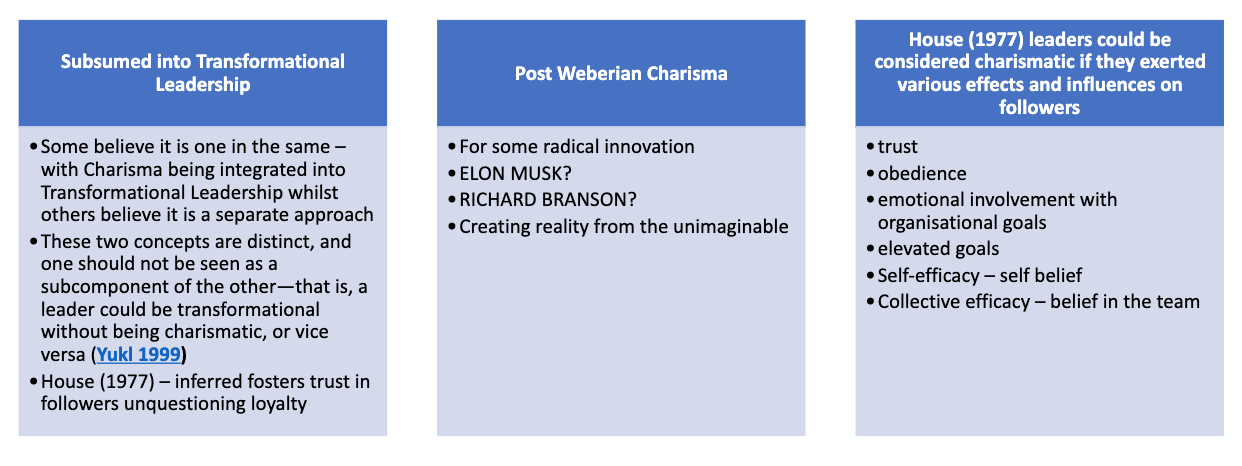
Leaders change followers' task perceptions, offering a vision that fosters collective identity and enhances self-worth (Roe, 2017).
Charisma can influence followers through:
Trust and loyalty.
Obedience and emotional involvement in organisational goals.
Self-efficacy (belief in one's abilities) and collective efficacy (belief in the team's abilities).
Transformational Leadership vs. Charismatic Leadership:
Charisma is often considered part of Transformational Leadership (Bass, 1985), but some view them as distinct approaches (Yukl, 1999).
House (1977) suggests charisma fosters loyalty and trust but can have limitations, as obedience is not always beneficial in all contexts (e.g., Milgram's experiments on obedience).
4. Charismatic Leadership and Attribution Theory
Attribution Theory:
Fiske and Taylor (1991) define it as how people use information to form causal explanations for events.
Leaders are often attributed with success or failure based on perception rather than reality.
Types of Attribution:
Dispositional Attribution: Explains behaviour through internal traits (e.g., personality, beliefs).
Situational Attribution: Attributes behaviour to external factors (e.g., environment, circumstances).
Fundamental Attribution Error: People often overemphasize personal characteristics when explaining others’ actions, ignoring situational factors.
5. The Role of Charisma in Attribution
Charisma can lead to over-attribution of qualities such as intelligence or success to leaders, which may not always be accurate (Fragouli, 2018).
Charisma may be used for both positive and negative outcomes, with the potential for manipulation.
Charismatic leaders often:
Present novel and compelling visions.
Make emotional appeals.
Demonstrate self-sacrifice and unconventional behaviours.
6. Bias in Attribution
Bias in Charismatic Leadership:
Charismatic qualities are often perceived differently depending on context (e.g., men as assertive, women as bossy).
This bias may be influenced by individualistic vs. collectivist cultures.
Individualistic cultures value self-autonomy and internal success attributions.
Collectivist cultures emphasize group success and external attributions.
7. Leader-Member Exchange (LMX) and Charisma
Leader-Member Exchange (LMX):
Focuses on the relational aspects of leadership, highlighting the importance of in-groups and out-groupswithin organizations.
Charismatic leaders build high-quality relationships, which fosters loyalty and trust.
Effective leaders manage both transactional and relational aspects of leadership to sustain engagement and well-being among followers.
8. Self-Concept and Charisma
Self-Concept in Leadership:
Defined by Carl Rogers (1959) as comprising three components:
Self-image: How one views themselves.
Self-esteem: The value one places on themselves.
Ideal self: What one aspires to be.
Leaders with high self-esteem focus on growth and improvement, while those with low self-esteem tend to avoid mistakes.
Implications in Organisations:
Charisma may be linked to leaders’ self-concept, influencing how they interact with followers and how they are perceived.
In individualistic cultures, leaders focus on individual achievements, whereas in collectivist cultures, the group’s success takes precedence.
9. Charismatic Leadership in Times of Crisis
Charismatic leaders often emerge during times of crisis due to their ability to:
Communicate a clear and compelling vision.
Foster loyalty and commitment in uncertain environments.
Examples of modern charismatic leaders in crisis include Elon Musk and Richard Branson, who are known for their risk-taking and visionary leadership.
10. Linking Theories for Critical Analysis
When analyzing leadership challenges, it is crucial to combine different theories such as Transformational Leadership and LMX for a well-rounded discussion.
Transformational Leadership: Considers how leaders inspire and motivate followers through the 4 I’s(Idealized Influence, Inspirational Motivation, Intellectual Stimulation, Individualized Consideration).
LMX: Focuses on the quality of relationships and negotiation within the leader-follower dynamic.
Critical analysis should evaluate the limitations of these theories and provide evidence-based conclusions.
11. Key References:
Antonakis et al. (2016). Charisma: An ill-defined and ill-measured gift. Annual Review of Organisational Psychology.
Northouse P. (2009). Leadership Theory and Practice. Sage.
Roe K. (2017). Leadership. Oxford University Press.
Bass B. (2008). Handbook of Leadership Theory. Free Press.
Fragouli, E. (2018). The dark side of charisma and charismatic leadership. Business and Management Review.