Vitamin K Antagonists
Anticoagulants
Use anticoagulants that inhibit the action of vitamin K to prevent venous thrombosis with secondary pulmonary emboli, ischemic cerebrovascular accidents secondary to atrial fibrillation, and thromboembolism in clients who have prosthetic heart valves. Also, use anticoagulants to prevent the recurrence of myocardial infarction and treat transient ischemic attacks, also known as mini-strokes.
Prototype and Other Medications
Classification: Anticoagulants
Warfarin is the only medication in this category.
Expected Pharmacologic Action
Anticoagulants that are vitamin K inhibitors block the activation of vitamin K, as illustrated in the diagram on this page. This decreases the production of vitamin K-dependent clotting factors VIII, IX, and X, and prothrombin.
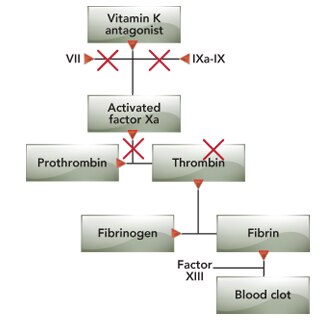
Vitamin K antagonists combine with VII and IXa-IX and connect to activated factor Xa. Activated factor Xa and prothrombin connect to thrombin. Fibrinogen and thrombin connect to fibrin, which combine with factor XIII to create a blood clot. If VII and IXa-IX are blocked, activated factor X-a does not combine with prothrombin, and thrombin is not created, preventing the formation of a blood clot.
Adverse Drug Reactions
Similar to heparins, warfarin’s primary adverse effect is bleeding. Toxicity or overdose, as evidenced by a prothrombin time (PT) and international normalized ratio (INR) above the expected therapeutic range, potentiates the risk for hemorrhage.
Interventions
For clients taking warfarin, monitor vital signs, and check for hypotension and tachycardia that may indicate hemorrhage. Also, check clients’ hematocrit and blood counts for indications of blood loss. In contrast to heparin, which requires protamine to treat an overdose, treat warfarin overdose by stopping the medication, and administering vitamin K, usually intravenously. Administration of vitamin K promotes the synthesis of coagulation factors VIII, IX, X, and prothrombin, reversing the anticoagulant effects of warfarin. Administer intravenous vitamin K slowly and in a diluted solution to minimize the risk of anaphylactic reactions. Give vitamin K in small doses of 2.5 mg by mouth or 0.5 to 1 mg intravenously to prevent future resistance to warfarin. If vitamin K is unable to control the bleeding, administer fresh frozen plasma or whole blood to replace needed clotting factors.
Administration
Administer warfarin orally. It is appropriate for clients in the home setting on a long-term basis. When preparing to administer warfarin, measure the client’s baseline vital signs and PT and INR. Determine the INR ratio by dividing the client’s PT with the control PT and then multiplying that by a correction factor. This provides a standard value regardless of the method in use to measure the PT. Check the INR prior to each dose. Report an INR above 2 or 3 or an INR below this range to the provider for a change in dosage. For clients taking warfarin on a long-term basis, monitor PT and INR daily until determining the correct dosage. Once determining that dosage, monitor the PT and INR every 2 to 4 weeks throughout the duration of therapy. Expect anticoagulant effects to take 8 to 12 hr to establish, with the full therapeutic effect in 3 to 5 days. IV heparin (enoxaparin) can be given during the initial treatment stage with warfarin, while full effects are achieved for up to 5 days. If clients are taking a medication that interacts with warfarin, monitor PT and INR more frequently. Tell clients to record the dosage, route, and time of warfarin administration daily. Also, tell clients to report manifestations of bleeding, such as bruising, bleeding gums, abdominal pain, nosebleeds, coffee-ground emesis, and tarry stools. Instruct clients to avoid taking over-the-counter NSAIDs, especially aspirin, or medications containing salicylates. Advise clients to use an electric razor and soft toothbrush.
Safety Alert
The same precautions taken for a client taking heparin apply to the care of a client on warfarin therapy. When caring for a client receiving warfarin therapy, there are measures taken to make sure it is administered safely. When preparing to administer the first and subsequent doses of warfarin, check the dosage with the medication record and check the client's PT/INR. In many institutions, each daily dose is prescribed after the provider reviews the PT/INR laboratory value so an appropriate dose is administered. Observe the client closely and/or use a dipstick to check for blood in the urine and a guaiac kit for blood in the stools. Monitor vital signs for an increase in pulse or decrease in blood pressure that could indicate internal bleeding. Check the client’s neurological status for changes that could indicate intracranial bleeding. Be sure to have vitamin K available to reverse the anticoagulant effects of warfarin should bleeding occur or laboratory values indicate a high risk for bleeding.
Client Instructions
Because clients may continue taking vitamin K inhibitor anticoagulants after discharge, instruct clients on all aspects of therapy. Tell clients to stop taking the medication at the first manifestation of hemorrhage and to report bruising, petechiae, hematomas, or black tarry stools immediately to the provider. Also, instruct clients to wear medical identification, such as a necklace or bracelet, indicating they are on warfarin therapy.
Contraindications and Precautions
Do not give warfarin during pregnancy because it’s a teratogenic medication and because of the threat of a spontaneous abortion. Also, do not give warfarin to clients who have a vitamin K deficiency, thrombocytopenia, liver disease, alcoholism, uncontrollable bleeding, or are preparing to undergo a lumbar puncture, regional anesthesia, or surgery that involves the brain, eyes, or spinal cord. Use warfarin with caution in clients who have hemophilia, increased capillary permeability, a dissecting aneurysm, peptic ulcer disease, severe hypertension, or hepatic or renal disease.
Interactions
Warfarin interacts with many different medications. Giving warfarin with heparin, aspirin, acetaminophen, glucocorticoids, sulfonamides, and parenteral cephalosporins increases its anticoagulation effects. Giving warfarin with phenobarbital, carbamazepine, phenytoin, oral contraceptives, and vitamin K decreases anticoagulation effects. Excessive intake of foods high in vitamin K, such as dark green leafy vegetables, including cabbage, broccoli, and brussels sprouts, as well as mayonnaise, canola, and soybean oils, decreases the anticoagulation effects. Because warfarin interacts with many other prescription and over-the-counter medications, foods, and herbal supplements, tell clients to check with the provider and pharmacist regarding possible interactions.