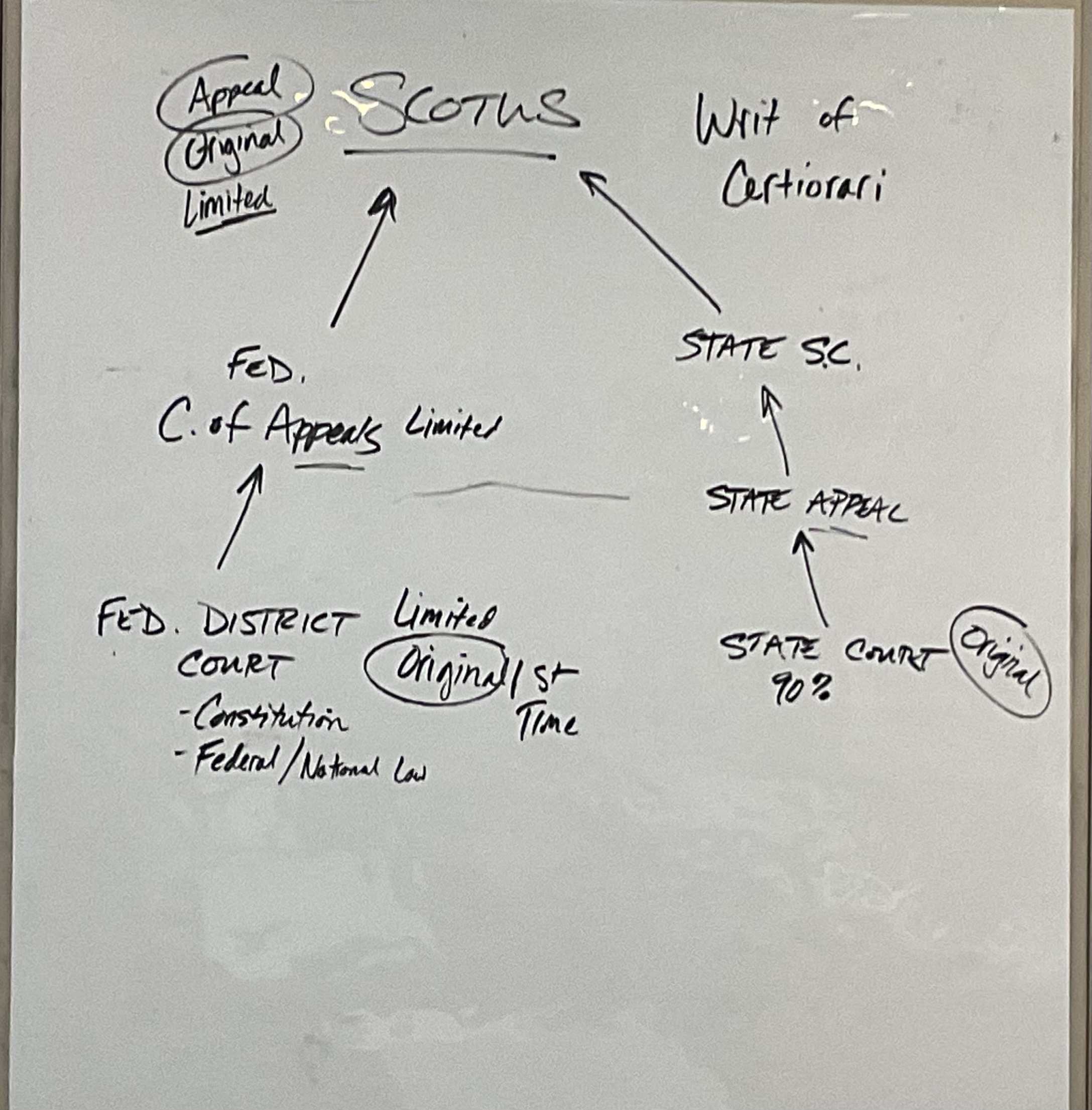
Court Organization
State Courts vs. Federal Courts
- Federal courts defend our basic rights, such as freedom of speech and equal protection under the law.
- Federalism: a government in which power is divided between one national government and other, smaller state or regional governments.
- State Courts:
- courts of “general jurisdiction.”
- They hear all the cases not specifically selected for federal courts.
- State courts interpret state laws.
- Each state gets to. make and interpret its own laws.
- Federal Courts:
- courts of “limited jurisdiction.”
- Can hear only 2 types of cases:
- Those that raise a “federal question”
- involve the U.S. government, the U.S. Constitution, or other federal laws.
- Those involving “diversity of citizenship”
- involve disputes between two parties not from the same state or country
Levels of the Federal Courts
- District Courts
- the trial courts of the federal court system.
- Where federal cases are tried, where witnesses testify, and federal juries serve.
- U.S. Magistrate Judge: federal judges of the district courts who serve 8 year terms
- Bankruptcy courts are separate units of the district courts.
- Bankruptcy judges serve 14 year terms.
- The U.S. Court of International Trade has nationwide jurisdiction over cases involving international trade and customs.
- The U.S. Court of Federal Claims has nationwide jurisdiction over cases over most claims for money damages, disputes over federal contracts, unlawful “takings” or private property by the federal gov, and a variety of other claims against the US.
- Court of Appeals
- Circuit Courts: established by Congress to relieve some of the caseload of the Supreme Court, and to hear cases that are appeal from the district courts.
- Appellate jurisdiction: review the decisions of the district courts, and determine whether they were correct.
- The Court of Appeals for the Federal Circuit: has nationwide jurisdiction to hear appeals in specialized cases.
- The U.S. Supreme Court: the highest court in the nation.
- Executive Branch Courts: several federal courts that are not actually part of the judicial branch of government.
SCOTUS
- The Constitution gives no qualifications for holding seats on the court, nor how many justices.
- The Judiciary Act of 1789 set the size of the court at six.
- The Judiciary Act of 1869, Congress decreased the number to nine.
- “Rule of Four”
- used to decide if they will take the case
- If four of the nine Justices feel the case has value, they will issue a writ of certiorari.
- A legal order from the high court for the lower court to send the rea cord of the case to them for review.
- By taking a case that involve an issue that has led to differing opinions in the lower courts, the Supreme Court creates a precedent that every court in the country has to follow.
- only takes cases from state courts when the appeal involves the U.S. Constitution.
Federal Judges:
- Chief Justice of the United States:
- serves as the head of the judicial branch of the federal government, and acts as the judge in impeachment cases involving the president and vice president.
- Magistrate Judges: issue search warrants, set bail, and do other preliminary things in criminal cases.
- Bankruptcy Judges: appointed by a majority of judges on the U.S. Court of Appeals for each circuit; preside over the bankruptcy cases that are filed in their respective districts.
- NO specific qualifications listed for federal judges in Article III.
- Senate Judiciary Committee:
- Has the job of investigating judicial nominations, and making recommendations about whether to confirm these nominees or not.
Judicial Independence
- Allows judges to make decisions based on what is right under the law, without facing political or personal consequences for the decisions they make.
- Maintained by:
- Federal Judges are Appointed: instead of being elected
- Federal Judges Serve a Life Term: provides job security, and allows appointed judges to do what is right under the law.
- Federal Judges Can’t Have Their Salary Reduced: allows judges to decide each case strictly in terms of the legal issues in front to them.
- Checks and Balances
- Impeachment: the process of charging a federal official with committing a “high crime or misdemeanor.”
- Judicial Code of Conduct: when judges take office, they agree to abide by a set of ethical principles established by the Judicial Conference of the United States.
- Recuse: judges step down from the case and allow another judge to take it in the case of bias.
- Oath of Judges and Justices