Chap 14, Monopolistic Competition
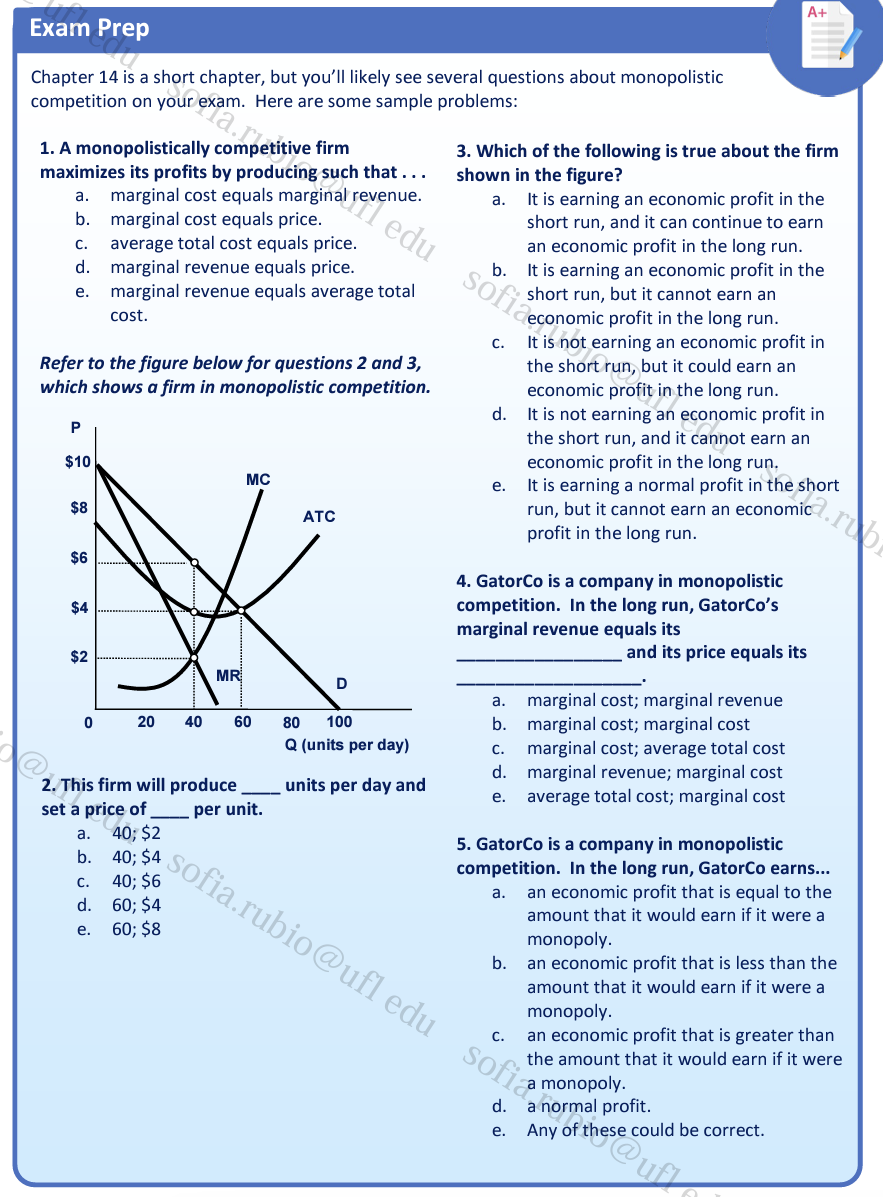
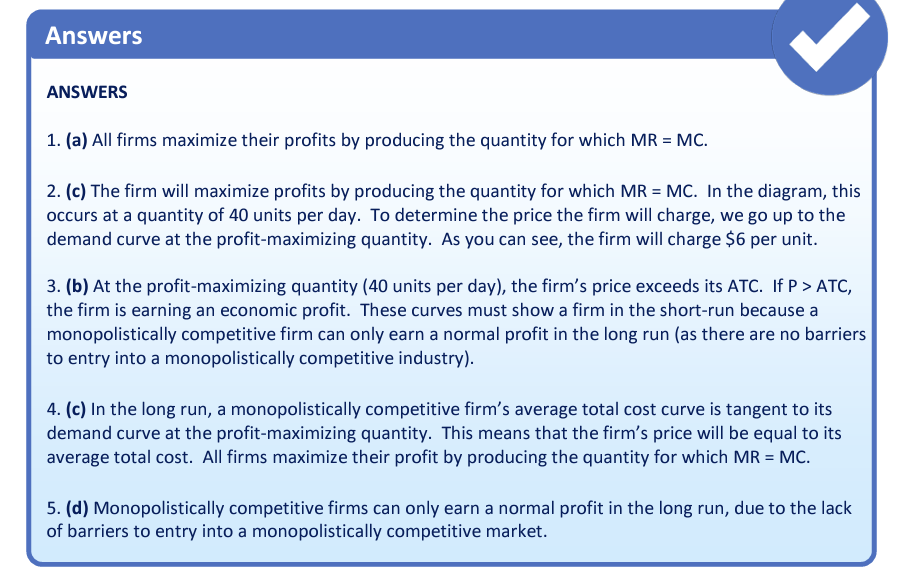
Monopolistically competitive Industries combine elements from perfect competition and monopolies. A monopolistically competitive industry is characterized by the following:
Lots of firms
No barriers to entry
A “DIFFERENTIATED” product (i.e a unique version of a product)
The graph of MC, MR, ATC, and D for a monopolistically competitive firm looks just like the graph for a monopoly in the SHORT RUN.
The firm will produce Q* and set the price at P*.
If P > ATC, then the firm can earn an economic profit.
If p = ATC, then the firm earns a normal profit.
If P < ATC, then the firm incurs an economic loss
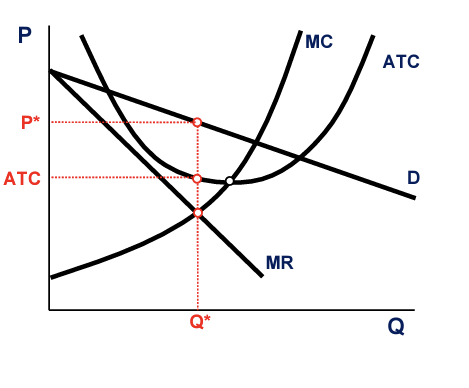
In the SHORT RUN, a monopolistically competitive firm CAN earn an economic profit. We will see that, in the long run, the firm cannot earn an economic progit bec there are no barriers to entry.
The difference between a monopoly and a monopolistically competitive firm is that there are barriers to entry for a monopoly, while there are no barriers to entry for a monopolistic competition. So, if firms are making an economic profit, more firms will enter, and we will eventually reach the following long-run equilibrium state.
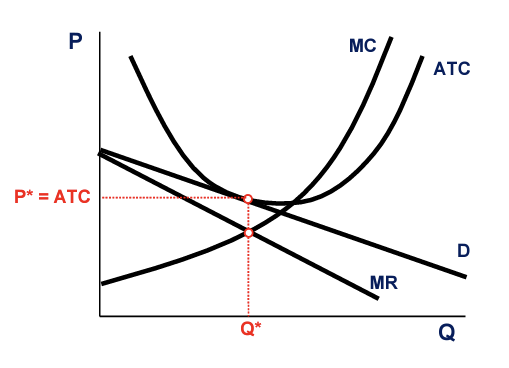
notice that, at this equilibrium point, the average total cost curve, is tangent to the demand curve. Also, note that, in the LONG RUN, the demand curve is closer to the origin than in the short run. Thus, in the long run, the price is equal to the ATC. For a monopolistically competitive firm, only a normal profit is possible in the long run.
Monopolies are defeinelty NOT preferred from a social porin of view because they produce a deadweight loss. They charge a higher price and produce smaller quantities than a perfectly competitive firm. There is no clear winner between perfect competition and monopolistic competition however.
Perfect competition is the most “efficient” in that it produces at capacity. However, in perfect competition, there is no variety. The firms produce just one product. Monopolistic competition produces with excess capacity, but it offers variety. So, its really a tradeoff between operating at capacity and added variety.
In monopolistic competition, firms invest a lot in advertising and product differentiation/innocation, which increases costs. For ex, taco bell spends a lot of money coming up with new ways to combine the small number of ingredients it uses, and it spends even more money on advertising. This does not occur in perfect competition bec the products are exactly the same. In the long run, there is a tradeoff between operating at capacity and having more variety in products. There is no unambiguous winner between perfect competition and monopolistic competition.