orgo ch. 4
•Be able to determine the IUPAC name of various alkanes.
identify and name parent chain: longest continuous chain of carbons; if more than one is possible, choose the one with the most substituents attached
name: use prefix that corresponds to the number of carbons
if ring structure, add prefix “cyclo-” to parent name (if ring has attachments, they do not count for the parent chain)

identify and name substituents: groups attached to parent chain
alkyl groups: substituents that are alkanes; named with same prefix system as parent chain, but with suffix “-yl”

if an alkyl group is attached to a ring that has fewer atoms than the rest of the structure, the ring is also a substituent (cycloalkyl group) and is named with same terminology (ex: cyclopropyl)
branched substituents: number the longest carbon chain within the substituent, name the substituent, name and number the substituent’s side group (ex: substituent = butyl, side group = 2-methyl, name = 2-methylbutyl)
common names that are accepted:
isopropyl = 1-methylethyl
sec-butyl = 1-methylpropyl
isobutyl = 2-methylpropyl
tert-butyl = 1,1-dimethylethyl
isopentyl/isoamyl = 3-methylbutyl
neopentyl = 2,2-dimethylpropyl
assign a locant to each substituent: number the parent chain
if one substituent, number the parent chain so the substituent has the lowest number possible
if multiple substituents, number the parent chain so that the first substituent has the lowest number possible
if there is a tie, number the parent chain so that the second substituent gets the lowest number possible
if there is no other tie-breaker, assign the lowest number alphabetically
cycloalkanes: same rules, except if there is only one substituent you don’t have to label it 1
assemble the name: number and name of each substituent before the parent chain name in alphabetical order
use prefixes (di, tri, tetra, penta, etc.) if multiple substituents are identical, and include locant multiple times
special case: naming bicyclic compounds
identify and name parent chain: count all carbon atoms in the two rings, add prefix ‘bicyclo-’
identify bridgeheads and the 3 paths that connect them; count carbons in each path, then place the 3 numbers from largest to smallest between brackets
identify and name substituents: same rules
assign a locant to each substituent: number bicyclic system
start at a bridgehead and continue along the longest path, then the second longest path, then the shortest (substituent may not get smallest number)
to start, choose the bridgehead that will give the lowest number for the substituent
•Be able to draw the structure of alkanes based on the IUPAC name.
•Be able to determine all constitutional isomers for a given molecular formula.
constitutional isomers: same molecular formula, differ in connectivity
can be determined by mentally rotating the structure, or determining the IUPAC name to see if they are the same
general molecular formula of alkanes: CnH(2n+2)
general molecular formula of cycloalkanes: CnH(2n)
•Be able to use of heat of combustion and other enthalpy measures to determine the stability of compounds.
smaller heat of combustion = more stable compound
branched alkanes are slightly more stable than straight chains
•Understand conformations (eclipsed, staggered,…), be able to determine the most stable conformation.
Newman projection: depicts a molecule as if it is viewed directly from a particular C-C bond
convert bond-line structure to a structure with wedges and dashes, then rotate the molecule 90 degrees in your head until you are looking down at a bond
back carbon is drawn as a circle around the front carbon
dihedral/torsional angle: angle between atoms on adjacent carbons, changes as the C-C bond rotates to create different conformations
staggered conformation: bonds between atoms on adjacent carbons are equally spaced, minimizing steric strain and torsional strain; lowest in energy, most stable
anti-conformation (butane): dihedral angle is 180 degrees, CH3 groups pointing away, lowest energy
gauche conformation (butane): CH3 groups are closer to each other, more steric hindrance/repulsion between electron clouds, higher energy

eclipsed conformation: when atoms on adjacent carbons are aligned with each other, resulting in increased steric and torsional strain; this conformation is higher in energy and less stable compared to the staggered conformation.
butane example: highest energy conformation when methyl groups eclipse one another; each CH3—-CH3 eclipsing interaction accounts for 11 kJ/mol of energy (torsional and steric strain)

other eclipsed conformations only show the torsional strain destabilization of 4 kJ/mol and 6 kJ/mol


predict relative energy for the different conformations of various alkanes:

cycloalkanes:
cyclopropane: only planar cycloalkane (triangle), bond angles 60 degrees and exhibit significant angle strain, least stable cycloalkane, significant torsional strain (always eclipsed)
cyclobutane: bond angles 88 degrees and exhibit significant angle strain, most stable as a ‘puckered’ conformation (no eclipsed hydrogens)
cyclopentane: bond angles almost 109.5 degrees, very little angle strain, envelope conformation, almost as stable as cyclohexane
cyclohexane: many conformations that quickly interconvert (ring flip)
chair conformation is most stable —> bond angles closest to 109.5 degrees, almost no torsional strain (all H staggered)
boat conformation: bond angles 109.5, but less stable bc H atoms are eclipsed and there is steric hindrance through flagpole interactions
twist-boat conformation: twisted boat conformation, relieves some torsional strain and steric hindrance, more stable than boat
half-chair conformation: highest energy conformation, basically planar with one C lifted out of the plane, bond angles close to 120 degrees, considerable angle strain and torsional strain (mostly eclipsed H)
•Be able to draw Newman and Haworth projections, as well as good cyclohexane chair conformations
chair conformation substituents:
axial: parallel to a vertical axis passing through the center of the ring, point straight up and down, alternate around the ring
equatorial: extended outward from the ring, run parallel to the lines in the chair
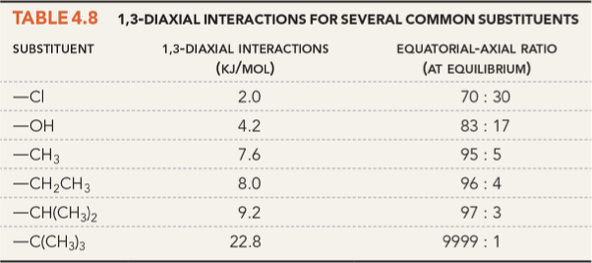
monosubstituted cyclohexane (one substituent): the most stable form is one where the substituent occupies an equatorial position, minimizing steric interaction with other hydrogen atoms on the ring. This is due to the reduced 1,3-diaxial interactions that occur when substituents are in the axial position, which can cause increased steric strain and destabilization of the molecule; larger substituents have larger 1,3-diaxial interactions, so equilibrium will be shifted more towards the equatorial conformation
disubstituted cyclohexane (multiple substituents): solid or dashed wedges are used to show positioning of the groups on the ring
solid wedge: pointing up
dashed wedge: pointing down
if all substituents can be equatorial at the same time, then that conformation is the most stable
if not, calculate which conformation has the biggest 1,3-diaxial interaction penalty:
•Understand cis-trans isomerism
cis: both substituents are on the same side of the ring
trans: substituents are on opposite sides of the ring
Haworth projection: represents cis and trans configurations

•Understand all terminology in this chapter (torsional strain, angle strain, steric hindrance, ring flip,…)
torsional strain: eclipsed conformations; atoms or groups on adjacent carbons are forced to align leading to increased repulsion and destabilization of the molecule
angle strain: the increase in energy that arises when bond angles deviate from their ideal values, more angle strain = less stable; often occurring in cyclic compounds where the bond angles are forced to be less than or greater than the optimal angles
steric hindrance: atoms or groups on adjacent carbons get too close to each other, electron clouds repel each other, resulting in an increase in energy and a destabilization of the molecule, which can affect the reactivity and stability of the compound.
ring flip: a conformational change in cyclohexane and other cyclic compounds, where the axial positions of the substituents are inverted to equatorial positions and vice versa, resulting in a relief of some strain and alterations to the steric interactions among groups on the ring.