Waves
Longitudinal and transverse waves
Waves transfer energy from one place to another but don’t transfer any matter
They vibrate/ oscillate to do this

Amplitude is the max displacement from equilibrium
A time period is the time it takes for one complete oscillation
F=1/t
Frequency(Hz) equals the number of complete oscillations per second
V=f
Wave speed (m/s) = frequency (Hz) x wavelength (m)
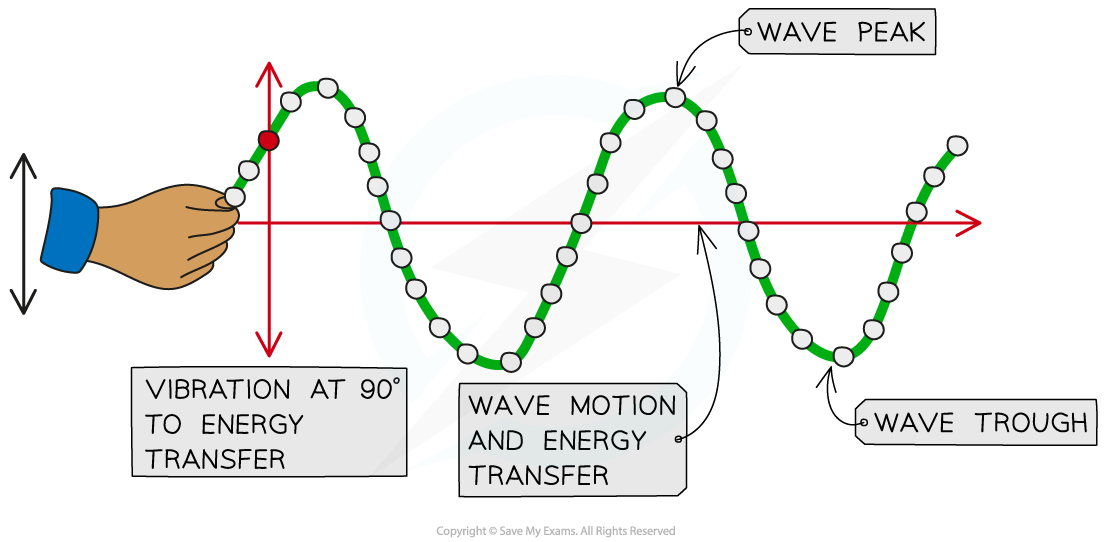
Transverse waves
Oscillations are perpendicular to the direction of energy transfer
Energy moves right by the wave moving up and down
For example, all electromagnetic waves, ripples and guitar strings
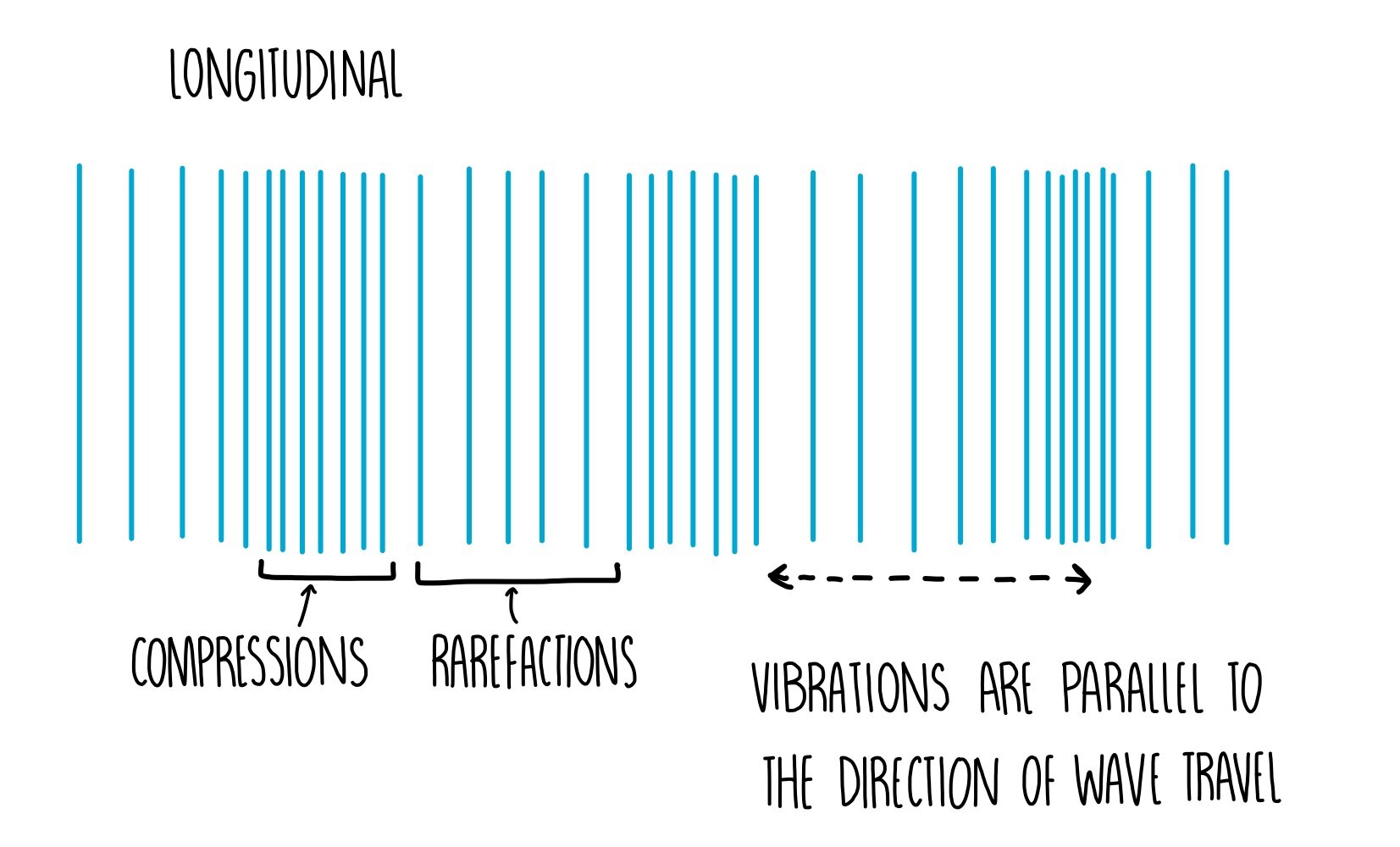
Longitudinal waves
Oscillations are parallel to the direction of energy transfer
Energy moves right though the wave compressing left and right
For example, sound waves
Reflection
When a wave arrives at a boundary, it is either:
Absorbed (energy transfers to the surface)
Transmitted (energy passes through - can be refracted)
Reflected
This depends on the wave length and properties of materials
Ray diagrams show how waves act at boundaries
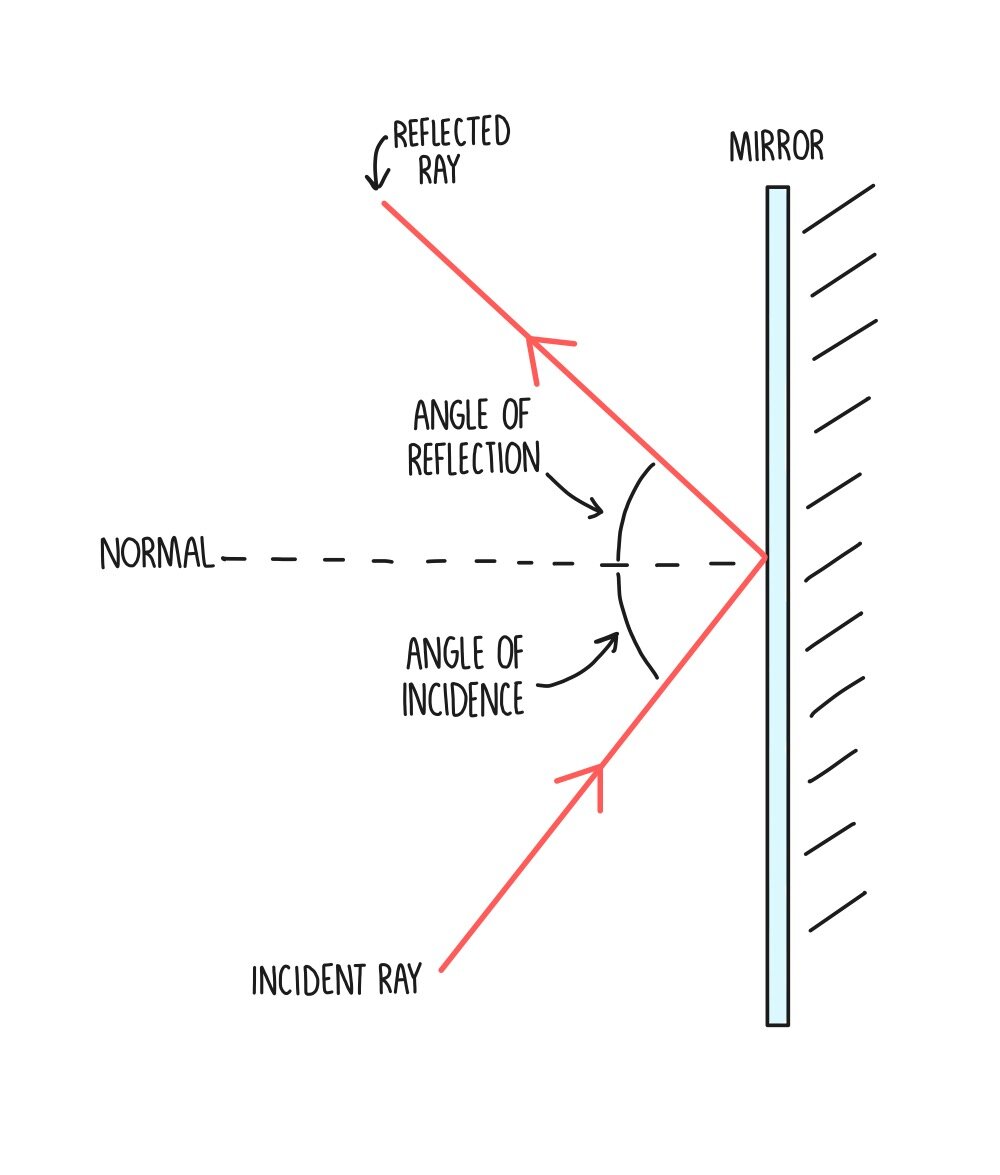
When boundaries are flat, all the normals are in the same direction
This is called specular reflection, where a clear image is formed
When boundaries are rough, like paper, the normals are all in different directions
They are perpendicular to where they hit the surface
This is called diffuse/scattered reflection, where light is reflected in different directions with no image being formed
Refraction
Refraction is when waves change direction as they pass from one medium to another
Waves travel at different speeds in different materials
This is due to different densities
For electromagnetic waves, the higher the density, the slower the wave travels
If it travels from air into glass, it will slow down
If the wave travels perpendicularly to the surface, it continues straight
It can still change speed depending on density
If the wave travels at an angle, it refracts (changes direction)

If it is travelling into a denser material, it refracts towards the normal
If it travels from a denser material to a less dense one, the emergent ray is faster and at a larger angle from the normal than from when it enters
Throughout, the wave speed changes but frequency stays the same
This keeps the wavelength constant
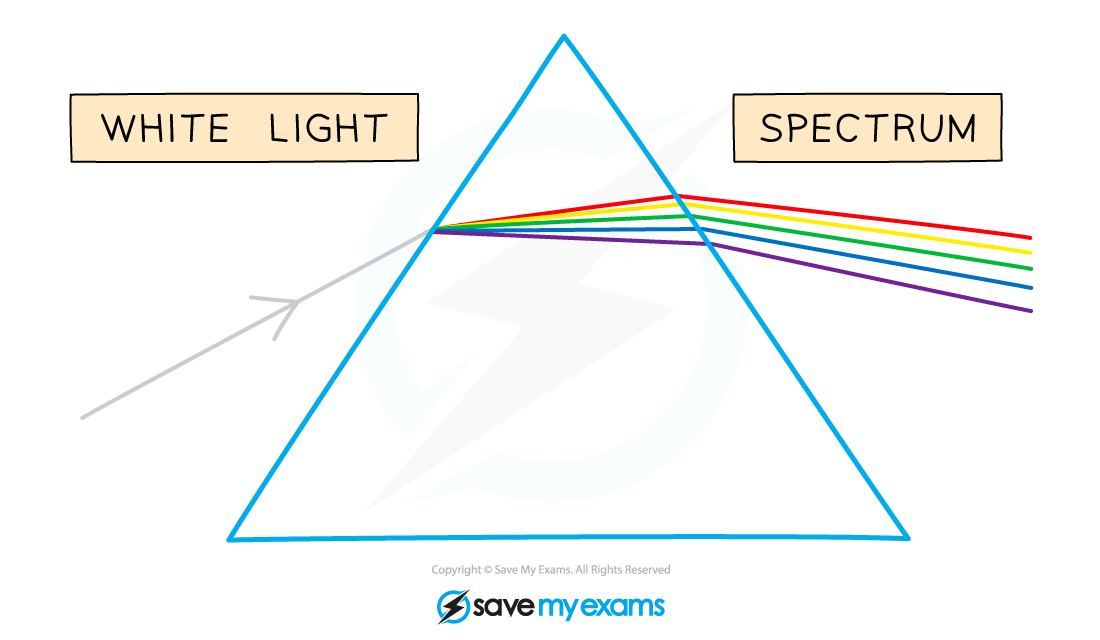
Different wavelengths refract different amounts
If we put white light (all the colours combined) through a triangular prism, they would all spread out at different colours
Electromagnetic waves
The electromagnetic spectrum contains only transverse waves, which can travel in a vacuum
All of these waves travel at the speed of light - 300000000m/s (x108)
They refract through different mediums at different speeds
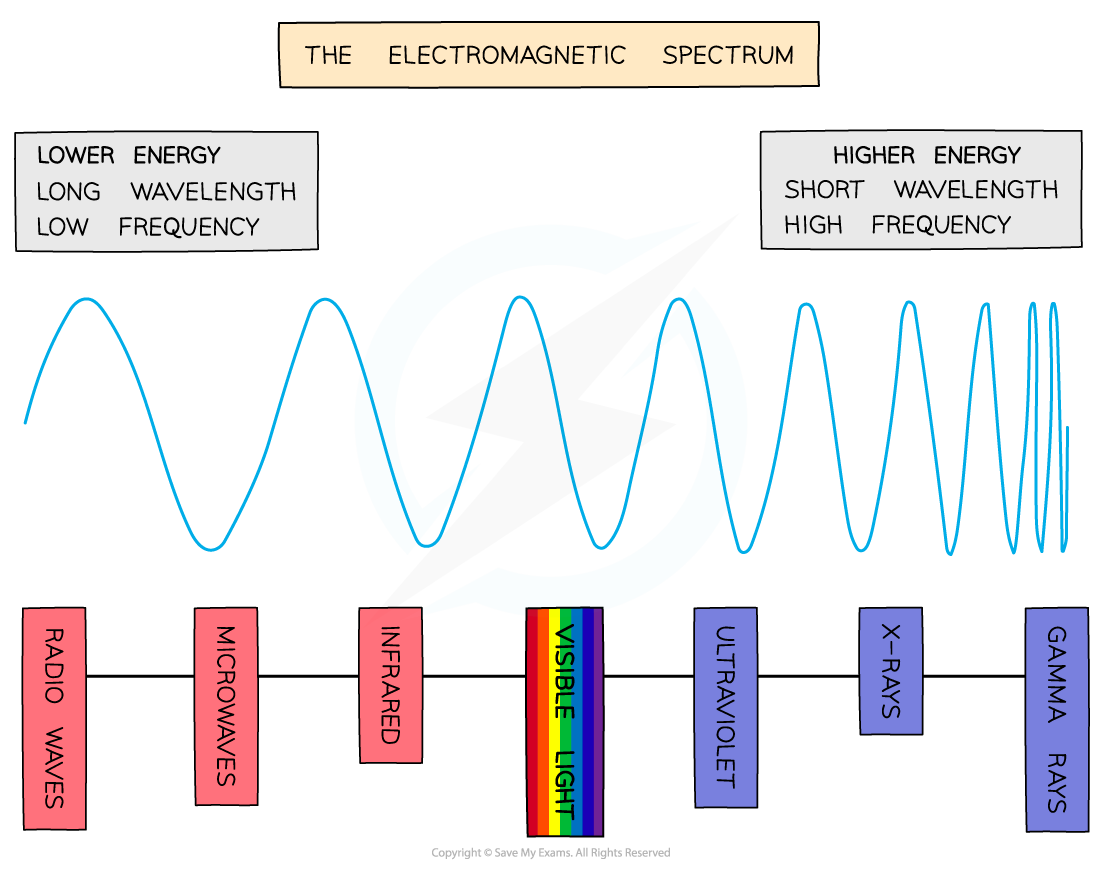
V=f
Speed is constant, so as wavelength decreases, frequency increases
Humans can only detect a small part of the spectrum
Ultraviolet, x-rays and gamma rays are all ionising, so can damage cells and cause cancers
Radio and microwaves and infrared are all used for communication as they can travel long distances
All of these waves can travel through empty space
When in contact with a surface, they reflect, refract/transmit or are absorbed
Microwaves and infrared
Microwaves and infrared have long wavelengths, and low frequencies
Microwaves are either absorbed by water molecules, or not
If they are not, they are used for communications using satellites
They have to pass through the earth’s atmosphere, so can’t be transported by water
They are received and transmitted by satellite dishes
If they are absorbed by water molecules, they are used for heating food in microwaves
Energy is absorbed from the waves into the water molecules, which causes vibrations that spread through the food and heat it
Infrared (IR) is emitted by all objects that have thermal energy, and the amount depends on the object’s temperature
Infrared is used for:
Infrared cameras - they allow objects to be seen in the dark and can spot living organisms due to a change in temperature (animals have higher temperature, so appear bright)
Cooking - we can heat metal, which emits IR and heats food by transferring energy
Electrical heaters - they use electrical energy to heat heat metal and emit IR to the surroundings
It doesn’t penetrate surfaces
Why toast is crispy and not just warm throughout 🥖🥖
Infrared and microwaves are only harmful in large quantities (if IN a microwave)
Radiowaves
Radiowaves have the longest wavelengths and lowest frequency in the electromagnetic spectrum
Oscilloscopes allow us to see the frequency of an alternating current, which determines the wave that is produced
These can be connected to a transmitter, which generates the wave
This wave can be detected by a receiver, which absorbs energy and generates another alternating current, displayed on another oscilloscope

This can be used to transfer information through frequencies
The main uses of radiowaves are for communications
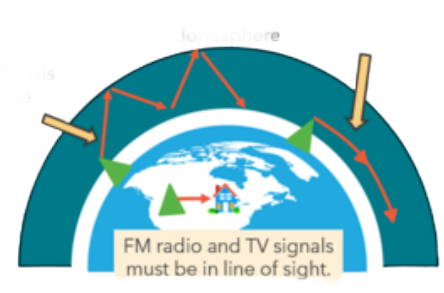
Long wavelengths - can be transmitted huge distances
Diffract/bend around the curved surface of earth between receivers
Short wavelengths can travel long distances
They can’t curve, but are instead reflected from the ionosphere (electrically charged layer of the atmosphere)
Can also send data short distances
Very short wavelengths - travel directly from transmitter to receiver
TV remotes, FM radio
They are affected by obstacles
Visible light and ultraviolet
Visible light is visible to humans
Different colours appear depending on wave lengths
Are viewed from red to violet
Can be used for communications
Optic fibres - thin glass/plastic that transmits pulses of light through reflections
With coded information, messages can be sent with fat transmission and without absorption
They can also transmit more information and are less likely to be disrupted than wires
Ultraviolet is emitted from the sun, and can be generated on earth 🙂
Fluorescence is a property of some chemicals where UV is absorbed and re-emitted as visible
Fluorescent lights generate UV radiation, which is absorbed by a layer of phosphorous in a bulb and then is re-emitted as visible light
They are really energy efficient, cheaper and have lower CO2 emissions
They can be used for security
Passports, bank notes, security pens
Invisible images can be printed, which are only visible when UV is shone on them, which makes forgeries more difficult
They can sterilize water as UV destroys microorganisms, so sanitizes
X-rays and gamma rays
Shortest wave length and highest frequency waves
X-rays are mainly used to view internal structure of objects
Some waves are absorbed by denser materials, like bone, so a detector plate registers only which pass through to create an image
Most pass through air, partially pass through middle density objects (flesh)
In X-rays, the white image shows where wave radiation didn’t reach/affect
They are used to detect broken bones
Small amounts of radiation, but usually worth the risk
Quick and cheap
Gamma rays
Used for medical imaging, to treat cancer (radiotherapy) and sterilisation (medical and food)
Sterilisation - can kill microorganisms without causing other damage
No risk to equipment/food as it only kills harmful organisms within and makes no alterations
Makes food fresher for longer, and makes it safer
X-rays and gamma rays are ionising radiation
They can be dangerous medically, so needs to be worth the risks
Lenses
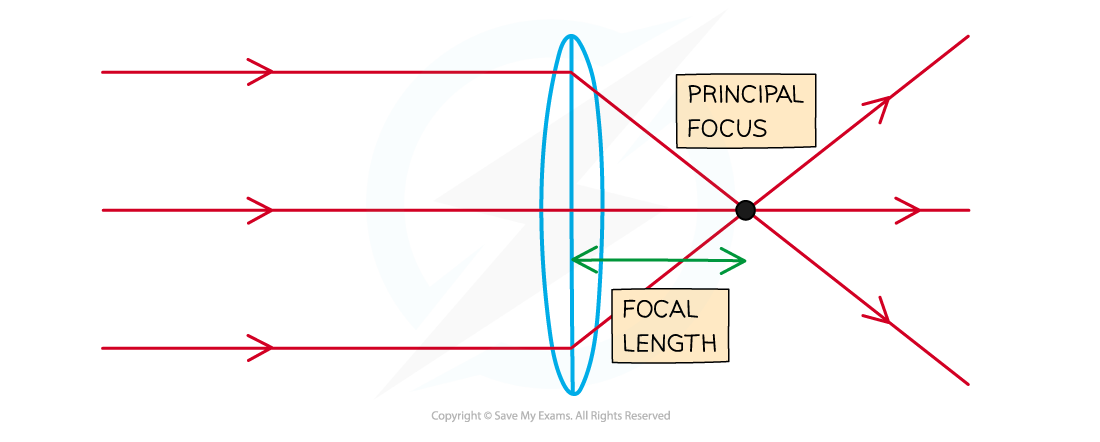
Conex lenses refract parallel rays of light inwards to a single point - converging
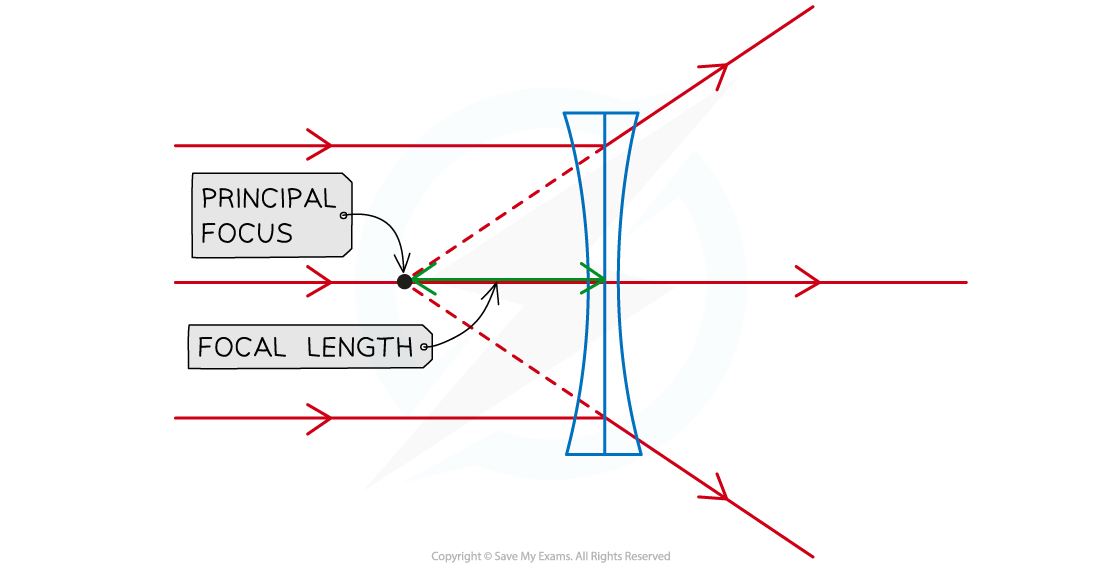
Concave lenses refract parallel rays of light outwards - disperse light
Lenses are usually symmetrical, so light can go both ways
The principle focus is always on an axis
The distance between the focal point and centre is the focal length
Shorter focal length = more powerful lens (stronger refraction)
The strength of lenses can be changed by changing the material or changing the amount the lens is curved
Images are formed at points where all light rays from a particular point on an object appear to come together
Real images are formed where light rays come together to form an image, that will be inverted
It happens in our eyes, and the brain then flips the image
From convex lenses only
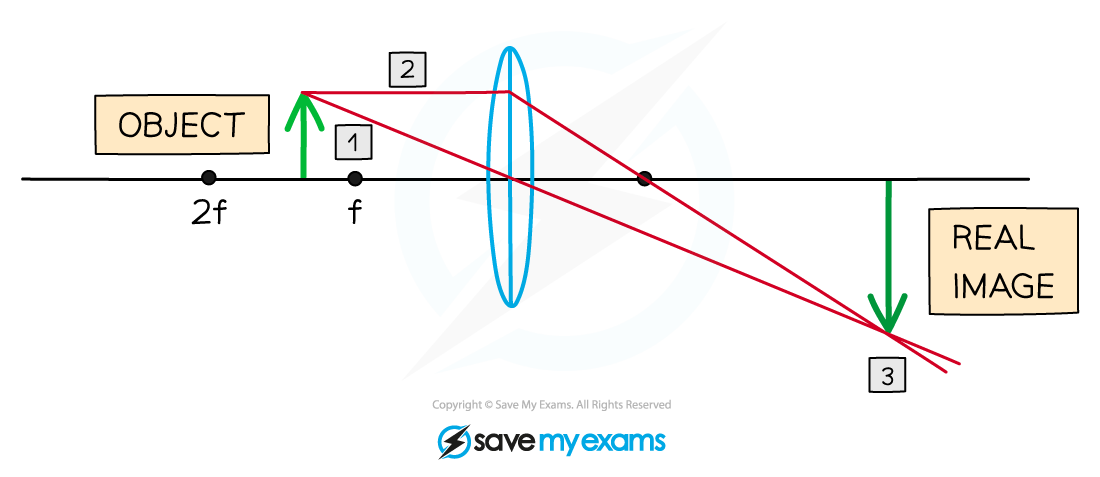
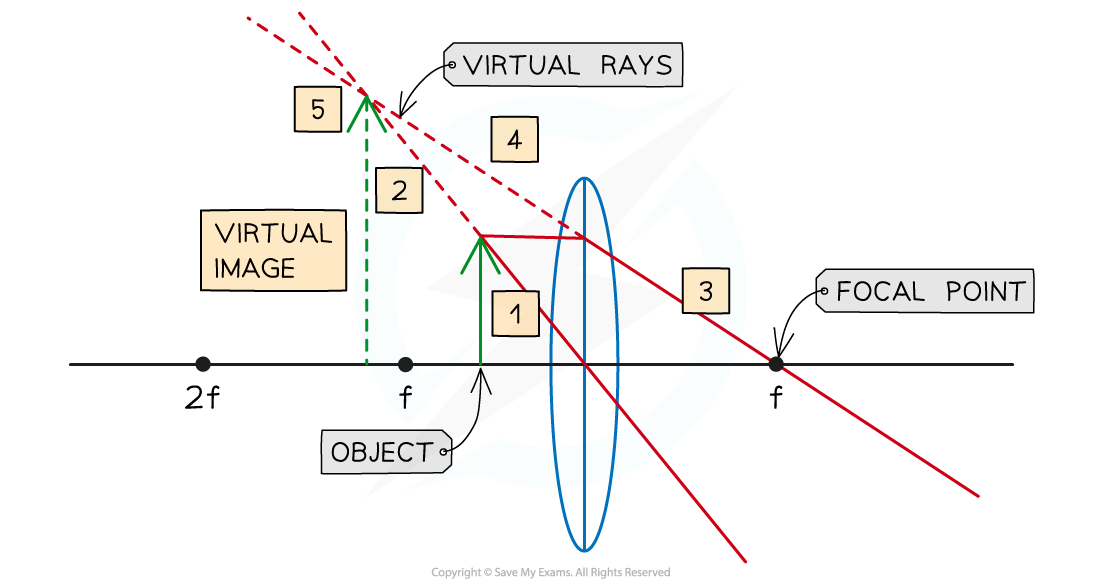
Virtual images are formed when light rays don’t actually come together where the image appears, but where the rays can be traced back to the focal point
This happens in mirrors - can’t actually be behind the mirror as rays don’t reach it but appears to be
Forms upright images
From concave lenses and sometimes convex lenses
Visible light and colour
Colours in visible light
The range of electromagnetic light waves our eyes can see - red → violet
Red has longer wavelengths, and violet has shorter wavelengths
Black is an absence of light - a perfect black body is theoretical and would be a material that absorbs all radiation and reflects/transmits none of it
Are good emitters
White is a mix of all visible light rays
The colour of an object depends on the wavelength of light hitting it and the properties of the object
This can determine absorption, reflection or transmission
Opaque objects don’t transmit any light
Wave lengths are either reflected or absorbed
Wave lengths that are reflected are the colour that the object appears
For example, an apple only reflects red wavelengths so appears red
Transparent objects transmit most light, but might absorb/reflect some light
Appears the colour that is transmitted
A bottle may appear green as wave lengths pass through or are reflected
Translucent objects transmit some light but scatter it (refract), so it appears fuzzy
Colour appears as the wavelengths that are transmitted and reflected
Colour filters are materials that only transmit certain wavelength of light and absorb/reflect the rest
Primary colour filters only transmit one of the primary colours - red, green or blue
Other colours transmit a range of wavelengths, that include primary colours that mix to certain colours
Absorbing radiation (temperature)
Absorbing radiation increases temperature
Emitting radiation decreases temperature
Radiation is pure energy
If more radiation is emitted than is being absorbed, the temperature will drop
Intensity is the power of the radiation per unit area
Energy transferred in a given area in a time period

As temperature increases, the intensity of every emitted wave length increases
Hotter = shorter wavelengths
Intensity of shorter wave lengths increase more (sun)
Balance of absorbing and emitting
The atmosphere absorbs radiation, reflects and emits it
Infrared is reemitted
In day, more energy is absorbed by the earth and atmosphere than is emitted, which increases local temperature
At night, more energy is emitted than absorbed, which decreases local temperature
It is always day somewhere, so it roughly balances out
Sound waves
Sound waves are vibrations that pass through the molecules of a medium
Through compressions and rarefactions
Longitudinal waves - need a medium to travel
Denser objects cause the wave to move faster as particles are closer together so transmit wave faster
Sound waves travel fastest through solids than gases
Sound can’t travel in a vacuum as there are no particles to vibrate
As mediums change, frequency doesn’t change but speed does due to density
v = f - frequency remains the same, but speed does so therefore wave length changes
Solids = faster → longer wavelengths
Gases = slower → shorter wavelengths
This means sound can be refracted (due to change in speed), absorbed and reflected
Human hearing
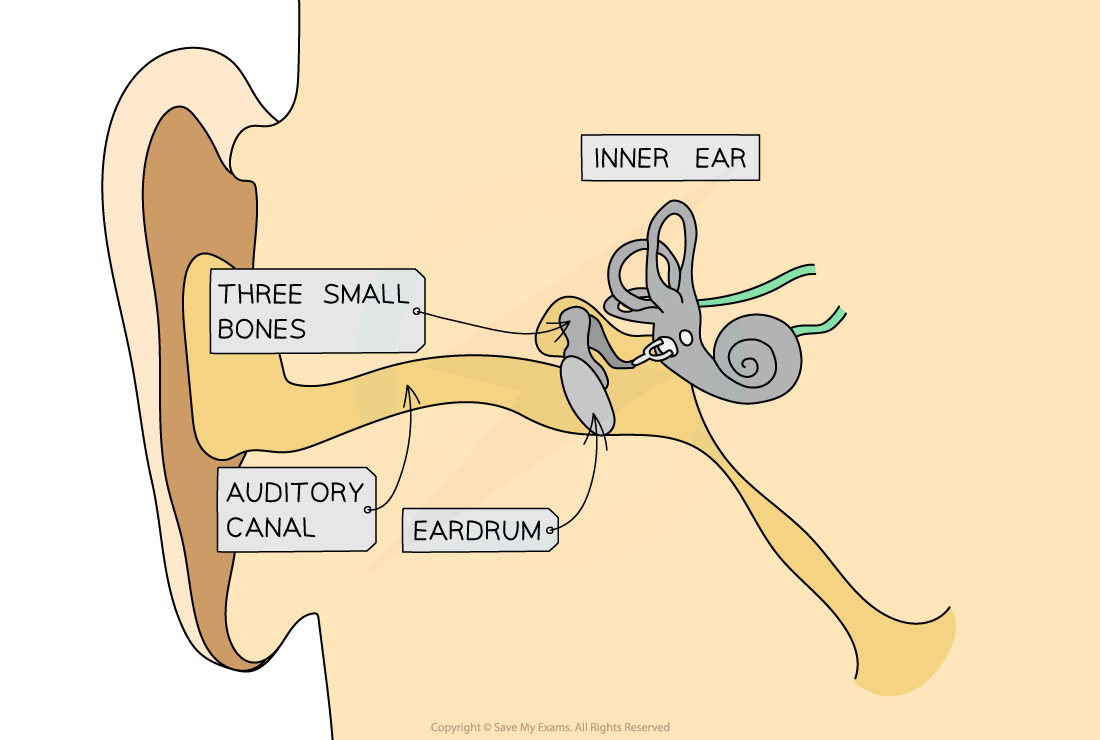
Sound waves cause the ear drum to vibrate, which is transmitted through the ossicles and ear canal and to the cochlea
This then converts vibrations into electrical signals, passed along auditory nerve to the brain
Higher frequencies = higher pitch
More intensive signal = louder
Humans can hear frequencies from around 20 Hz to 20000 Hz
Ultrasound
Ultrasounds are sounds that vibrate at frequencies above 20000Hz (human hearing)
Some animals use these for communications
They are produced by electrical oscillations converted into ultrasound waves
When passing through a boundary (between materials), only some waves are reflected and some are refracted
Partial reflection
If ultrasound waves are transmitted through an object, some are reflected back to us
If we know their speed and the time taken, we can calculate how far away the boundary is
If we repeat this with all reflections, we can find different boundaries within an object, which tells us about its internal structure
Can use to form images - s=d/t
Is completely safe 🙂
Ultrasound machines - scanning foetuses
Waves pass from one medium to another
Some waves are reflected back, and some are refracted through
Timings and distributions of echoes are processed by a computer
This produces a live image - used to check health
Ultrasound is also used to check product quality
Wave should pass straight through if the product is solid with only two reflections
If there are more than expected there is a crack or fault which is detected
Echo sounding/sonar
Boats and submarines fire ultrasounds at the sea floor/objects in the ocean to find out how far away they are
Seismic waves
Large scale events, like volcanoes and earthquakes, cause or produce waves that spread in all directions into the earth - seismic waves
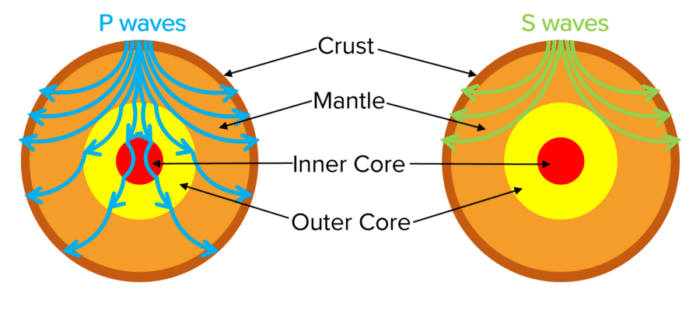
P-waves are longitudinal, travel through both solids and liquids and are faster
S-waves are transverse, only travel through solids and are slower
By studying how the waves pass through the earth, scientists can find the internal structure and their materials
They can detect waves with seismometers and compare results with others around the world to see how long it took for the waves to travel through the earth, after earthquakes for example
Boundaries
Seismic waves can be reflected, absorbed and transmitted
This usually causes refraction as waves change speed between different densities
P-waves can pass through both solids and liquids so refract between the mantle and outer core
As they pass through the outer core, the density varies so there are constant slight refractions (curves)
This happens again as the wave passes back through the mantle
S-waves can’t travel through liquids, so can’t pass through the outer core
This is how scientists discovered the outer core is liquid
DONE!!!