Week 1 First Law of Thermodynamics
2.1 Joules Experiment
The amount of work done on a fluid by a stirrer for example, can result in temperature changes for a fluid.
“For each fluid, a fixed amount of work per unit mass was required for each degree of temperature rise caused by the stirring.”
You must contact a colder object to return to the original temperature if there was heat transfer.
What is work?
The transfer of energy to or from an object by applying force.
2.2 Internal Energy
Internal energy does not include kinetic and potential energy but is associated with the motion and position of a molecule (In a microscopic view)
(also the total energy contained within a system)
Internal energy deals in the microscopic scale while external is macroscopic
It does not have a specific thermodynamic definition
Thought to be thermodynamic primitive
Cant be directly measured
absolute values are unknown
Usually, all molecules move endlessly, so there is bound to be kinetic energy (moving through space) unless monoatomic substances, then its also involve rotation and internal vibrations
With heat to a substance, it will increase molecular motion (increasing internal energy)
same with work
Changes in internal energy are important
relates to heat and workflows
Example: Temperature and phase of a substance
2.3 The First Law of Thermodynamics
First Law of Thermodynamics - Although energy assumes many forms, the total quantity of energy is constant, and when energy disappears in one form, it appears simultaneously in other forms.
In simple terms, energy cannot be made or destroyed
System- where the process occurs
It can be of any size
Surrounding- Everything the system interacts with
Boundaries may be real or imaginary, rigid or flexible.
▵(Energy of a System) + ▵(Energy of Surroundings) = 0
2.4 Energy Balance for Closed Systems
Closed system- The boundary of a system does not permit the transfer of matter between the system and its surroundings. (nothing goes out)
mass is constant
All energy is exchanged between a closed system and its surroundings in the form of heat and work.
Total energy change of surroundings = net energy transferred to or from it as heat and work.
▵energy surrounding = Qsurr + Wsurr = -Q - W
▵energy system = Q+W
Undergoes processes which only internal energy of the system changes which is reduced to:
▵Ut = Q + W
Ut - the total energy of the system
Processes with finite change in the internal energy system (for differential change in Ut :
dUt = dQ + dW
Q, W, and Ut pertain the the entire system.
Open system - Matter crosses the system boundary and the surroundings (streams enter and leave)
Total internal energy is an extensive property because… it depends on the quantity of material.
Temperature and pressure are independent of the quality of material so it is an intensive property. While total volume and total internal energy depend on the material so it is extensive.
2.5 Equilibrium and the Thermodynamic State
Equilibrium
Static Condition (no change)
absence of tendency towards change on a macroscopic scale (any tendency would mean it is caused by a driving force)
Forces are in exact balance
If a change happens in the system, not at equilibrium, it can depend on resistance as well as driving force.
Systems under appreciable driving forces may change at negligible rate if the resistance to change is very large.
Example: a mix of hydrogen and oxygen at ordinary conditions is not in chemical equilibrium because of the large driving force for the formation of water.
2.6 The Reversible Process
Reversible process
it is ideal and produces the best results
yields minimum work input required or maximum work output attained from a specific process. (helps to determine maximum performance of devices)
In the real world this can be impossible
easy to analyze
Work is calculated often times for hypothetical reversible processes.
The reversible work as a limiting value may be combined with an appropriate efficiency to yield a reasonable approximation to the work input required for or work output produced by an actual process.
efficiency * work
Example:
When swinging you cannot swing forever which has to do with many factors of friction. When a child swing there is friction between the child and air which is called drag. There is also friction with the gears and the metal chains that hold the swing in place.
There is a reversible processes as swinging you can go back and forth going back to the original position (without having any impact on the surroundings)
Example two:
Turbines in a steam plant that are continuous (reversible) allow for better power output compared to an irreversible turbine (which can be slower).
What is oscillation?
bring repeated or going back and forth.
What makes something irreversible?
Many factor such as heat to surroundings (like a cup of coffee heat transfer through a finite temperature difference), rapid compression and expansion (piston), mixing fluids, electrical resistance, deformation of solids (hammer and nails), chemical reactions.
2.7 Closed System Reversible Processes; Enthalpy
No highlighted notes in this section.
What is enthalpy?
The amount of heat energy in a system or change in heat energy during a reaction.
Equation:
H = U +PV
H - enthalpy
U - internal energy
P - Pressure
V - volume
2.8 Heat Capacity
Heat capacity with a constant volume equation:

Constant volume process in a closed system equation:
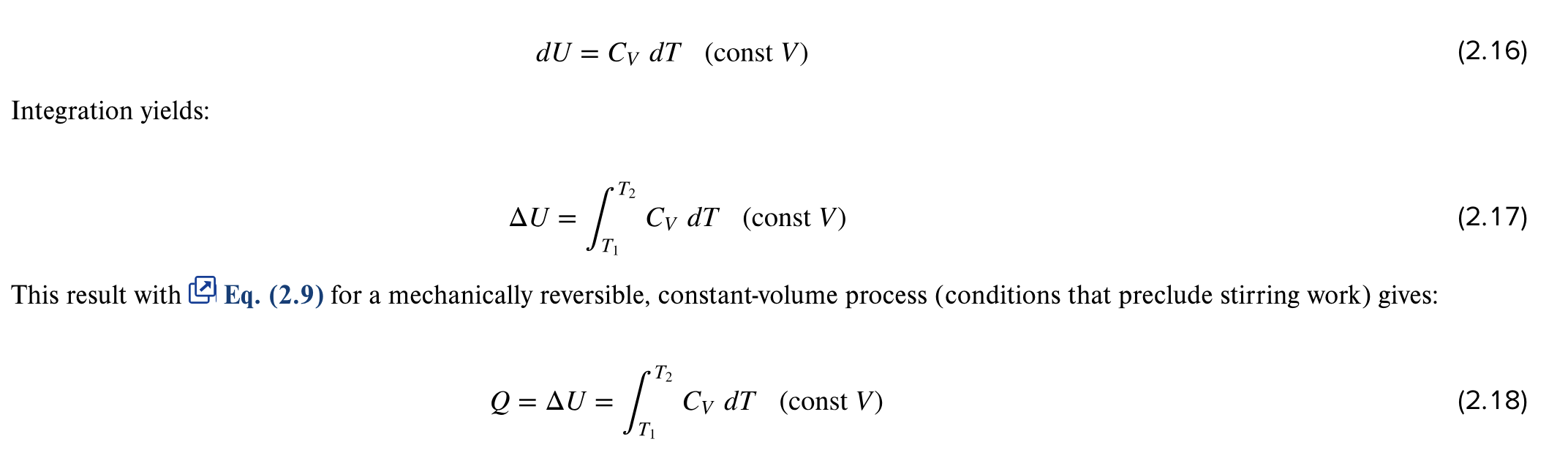
Heat capacity with a constant pressure equation:

Constant pressure in a closed system process equation:
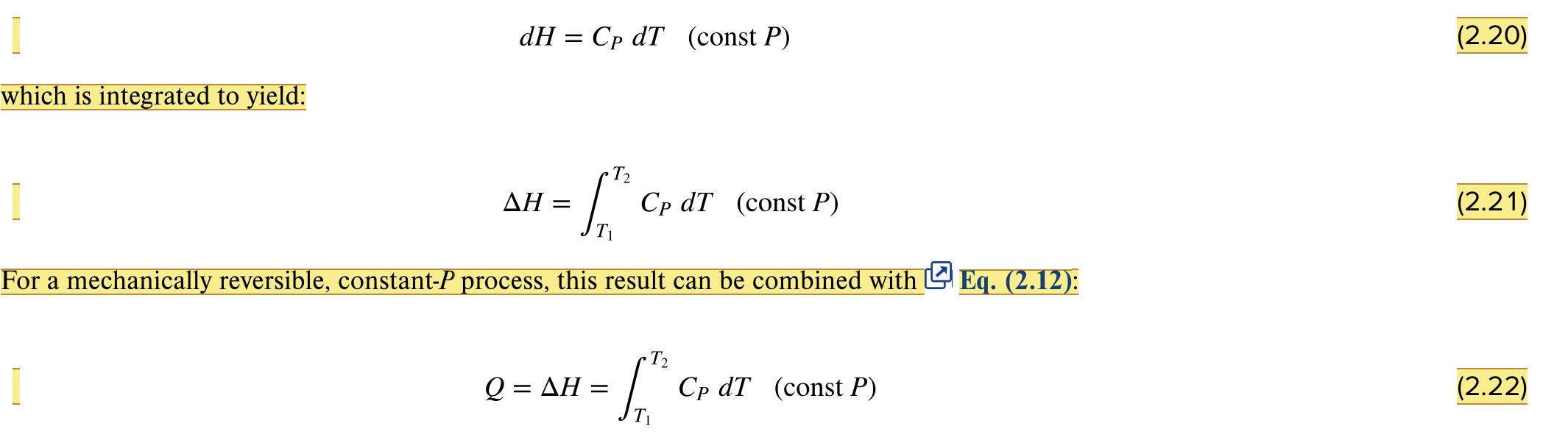
2.9 Mass and Energy Balances for open systems
Measure of Flow: open systems are characterized by flowing streams described with measures of flow:
Mass flow rate (m dot)
Molar flow rate (n dot)
Volumetric flowrate (q)
velocity (u)
The flows can relate to one another:
examples:

The big cursive M is the (molar mass) and A is the cross-sectional area

Energy Balance for Steady-State Flow Processes
The equation for the first law for a steady-state/flow process between one entrance and one exit:
![All terms represent energy per unit mass of fluid [J]](https://knowt-user-attachments.s3.amazonaws.com/cdf93636-ba69-4a89-b54f-f48908526eec.png)
When kinetic and potential energy are neglected then the equation would simplify to:

the first law of steady-state/flow is similar to a nonflow process.
Enthalpy can be measured using a flow calorimeter (which is a electric resistance heater immersed in a flowing fluid)