Hinduism and Buddhism
Hinduism:
5 notes:
Oldest living religion from 3000 years ago in Indus River Valley Civilization
Smriti: what is remembered
Bhagavad Gita: tales of gods/goddess on how to live with responsibilities
Karma: actions have effect on your soul, and can affect how you are reincarnated
Dharma: duties of your social place you are born in
Bhakti: rituals you show to the divine
Common Beliefs:
Deities (gods and goddesses)
Cycle of rebirth
Sacredness of life
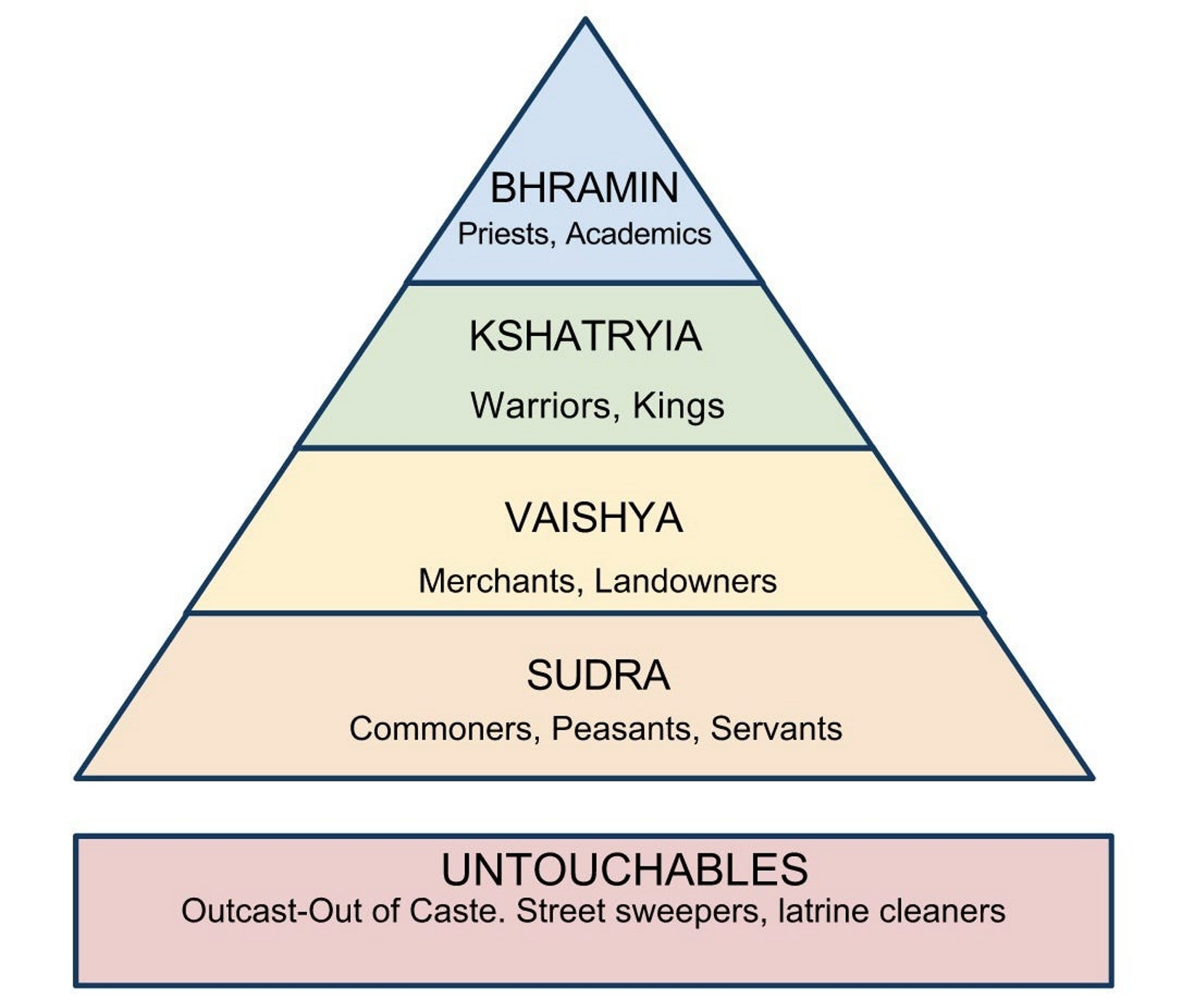
Caste system
Life pursuits
Deities:
Exact number of gods in Hinduism is unknown
Brahman is seen as the ultimate reality
The 3 primary forms or gods of Brahman symbolize the 3 stages of life
Brahma - creator
Vishnu - preserver
Shiva - destroyer
Avatars are forms of Brahman or incarnations of gods that come into the world
Cycle of Rebirth:
The ultimate goal of Hindus is to achieve Moksha, which is freedom from the cycle of reincarnation
Karma: the sum of a person's actions in this and previous states of existence which will decide their fate in future reincarnations
Samsara: endless cycle of rebirth
A result of one seeing himself as an individual rather than one with Brahman
Life Pursuits:
Dharma: pursuit of righteousness, one's duties in life
Artha: pursuit of both material and political life
Kama: pursuit of artistic, recreational, and sensual pleasure
Moksha: liberation
Sacredness of Life:
Hindus believe that Brahman, the ultimate reality, is in all living things, making all life sacred
Ahimsa: desire to do no harm to any form of life forming the basis for the practice of nonviolence as a solution to problems
For this reason, many Hindus are vegetarians
Caste System:
Sacred Scripture:
Shruti Scriptures
Includes the Vedas, originally orally transmitted praises from the Indo-Aryans of their gods
Written in Sanskrit
4 parts:
Rig Veda: oldest, over a thousand hymns to various gods and stories on them
Sama Veda: hymns for sacrifices
Yajur Veda: instructions on sacrifices
Atharva Veda: prayers for home prayer and worship
Smriti Scriptures
The Mahabharata: the story of a war between 2 families with the gods taking sides
Includes the Bhagavad Gita a side story with the greater story
Ramayana: story of a prince who is forced into exile and goes on a journey to rescue his wife
Puranas: story of 3 gods and the story of the creation and history of the world
Sacred Places:
Temples
Most towns and cities contain temples with images of various gods and goddesses but are dedicated to particular deity
A Brahmin (priest), performs pujas, practices of honoring a particular deity in a devotional ritual
These rituals include awakening bells, deity is washed, dressed, and offered incense, food, and flowers
Home Shrines
Most Hindu families have shrines in their homes to perform pujas
Often they are dedicated to a deity with which the family hold special devotion to
Simple ceremonies are done at home usually by women, which involves welcoming the deity into their house and asking it to dwell there. It is washed, dressed, and offered fruits, flowers, and incense.
Rivers (especially the Ganges) are considered to be the most sacred of places
Symbolic of life without end
The Ganges river is considered a primer place of healing and washing ritual are often conducted in its waters believing that it has the power to wash away bad karma
Many Hindus request to have their ashes sprinkled into the Ganges
Sacred Time:
Hindu calendar is a lunar calendar made up of 6 seasons
Spring, summer, rain, autumn, winter, cool season
Hindus celebrate several annual festivals that symbolize the various life cycle events and rites of passage
Diwali: festival of lights
This festival occurs during early autumn and last from one day to several days. It commemorates the return of Rama (Vishnu) to his kingdom
As part of the festival, oil lamps are lit to guide him home
Homes are often decorated with color and candles. Some will even light fireworks or have bonfires
Holi: spring festival of colors
Commemorates the love of the deities Krishna and Radha
Divisions between castes are suspended for the celebration
Part of the celebration includes squirting people with red liquid and throwing red powder at each other
Life Celebrations:
Birth: during pregnancy, prayers are said for health of the child and mother, as well as for a son, the husband will also brush his wife's hair for love and support
Childhood: namkaran giving is the name giving and welcoming into the community, ears are pierced, and first haircut is a ceremony for boys
Adulthood: fit season for girls a purification ceremony after their first period, boys have a home blessing ceremony for their first shave
Death: prep of the body by the oldest son, cremated and scattered in a river
Similarities between Hinduism and Catholicism:
Loving god
Community
Saints vs other gods
Catholic-Hindu dialogue
Brahman as the one ultimate being or reality that they desire to be with
Sacredness of life
Belief in one objective truth
If all truth statements were collected, the sum of these pieces would not equal the Truth (but the world would be closer to the Truth)
Hindus have a great tolerance for religious diversity without minimizing one's own religious tradition or denying universal Truth
Jesus in Hinduism:
Christianity has been present in parts of India since nearly the time of Jesus
Many Hindus today do hold some sort of belief on Jesus
Jesus is believed by some to be an avatar of Vishnu or Krishna
Others he is a great teacher who travelled to India as a child to learn from gurus
For others though he is a yogi or even a mere legend
Buddhism:
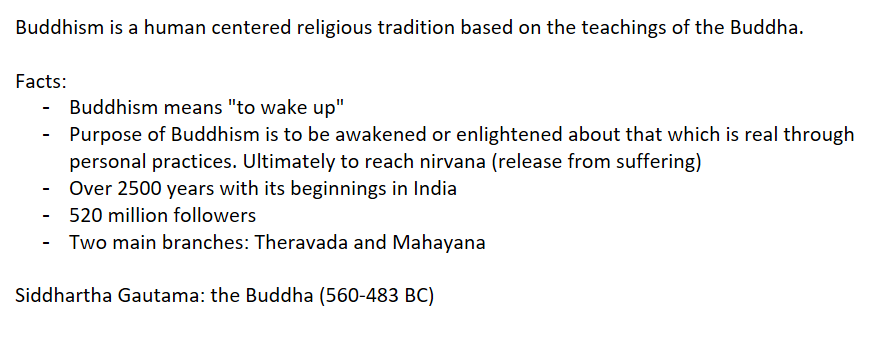
Buddhism is a human centered religious tradition based on the teachings of the Buddha.
Facts:
Buddhism means "to wake up"
Purpose of Buddhism is to be awakened or enlightened about that which is real through personal practices. Ultimately to reach nirvana (release from suffering)
Over 2500 years with its beginnings in India
520 million followers
Two main branches: Theravada and Mahayana
Siddhartha Gautama: the Buddha (560-483 BC)
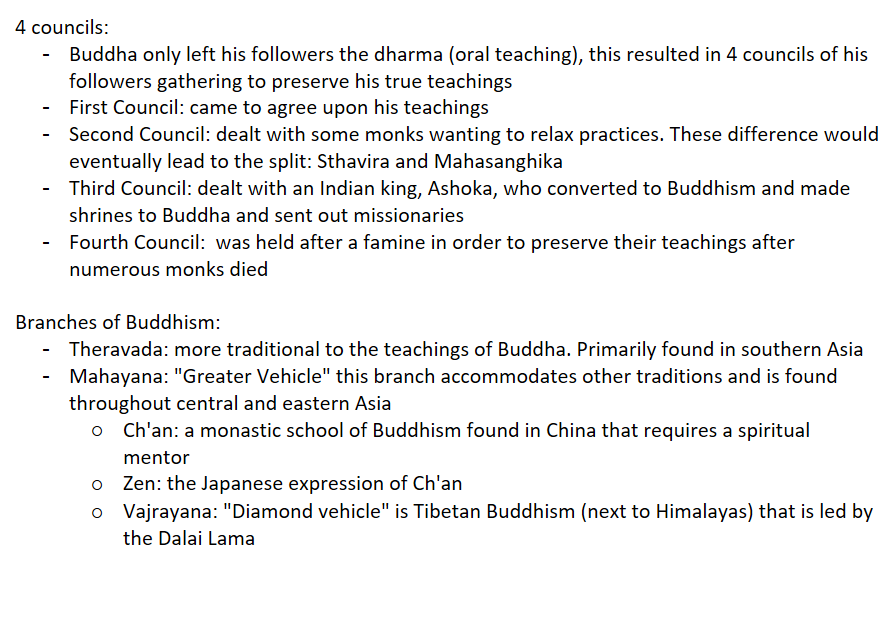
4 councils:
Buddha only left his followers the dharma (oral teaching), this resulted in 4 councils of his followers gathering to preserve his true teachings
First Council: came to agree upon his teachings
Second Council: dealt with some monks wanting to relax practices. These difference would eventually lead to the split: Sthavira and Mahasanghika
Third Council: dealt with an Indian king, Ashoka, who converted to Buddhism and made shrines to Buddha and sent out missionaries
Fourth Council: was held after a famine in order to preserve their teachings after numerous monks died
Branches of Buddhism:
Theravada: more traditional to the teachings of Buddha. Primarily found in southern Asia
Mahayana: "Greater Vehicle" this branch accommodates other traditions and is found throughout central and eastern Asia
Ch'an: a monastic school of Buddhism found in China that requires a spiritual mentor
Zen: the Japanese expression of Ch'an
Vajrayana: "Diamond vehicle" is Tibetan Buddhism (next to Himalayas) that is led by the Dalai Lama
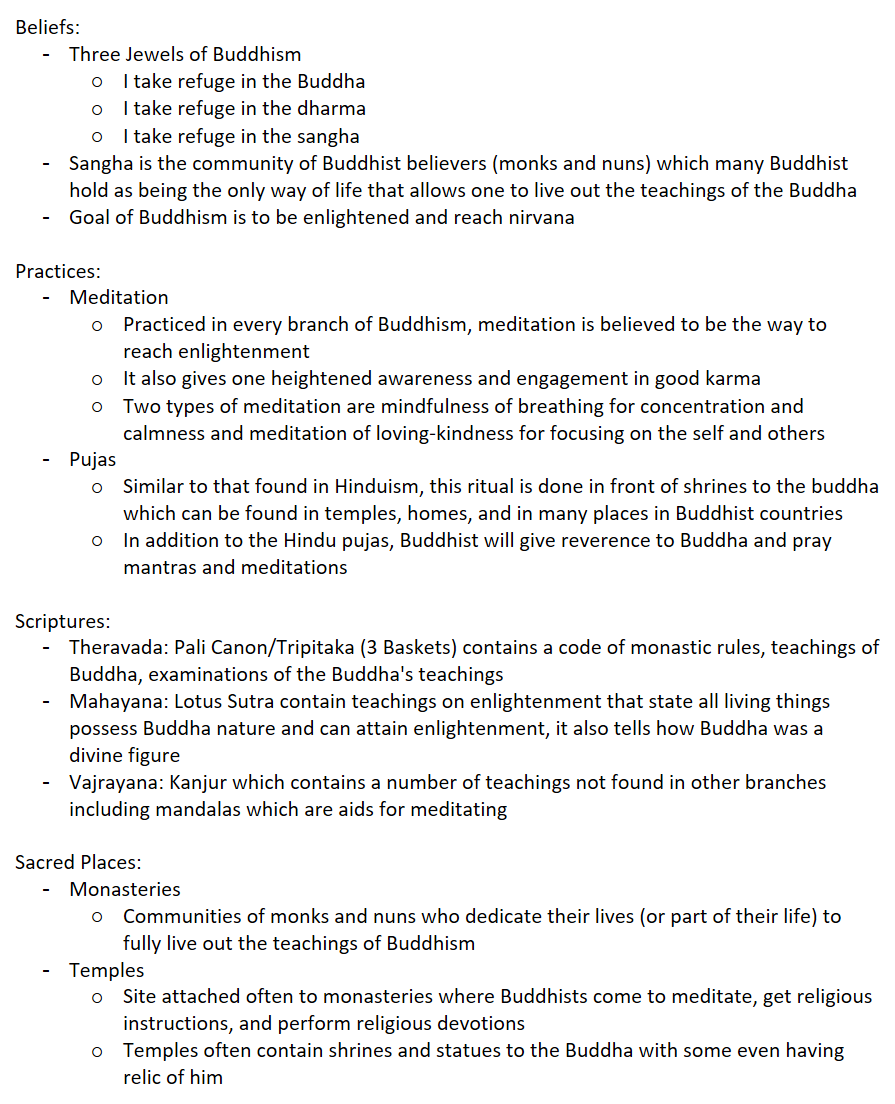
Beliefs:
Three Jewels of Buddhism
I take refuge in the Buddha
I take refuge in the dharma
I take refuge in the sangha
Sangha is the community of Buddhist believers (monks and nuns) which many Buddhist hold as being the only way of life that allows one to live out the teachings of the Buddha
Goal of Buddhism is to be enlightened and reach nirvana
Practices:
Meditation
Practiced in every branch of Buddhism, meditation is believed to be the way to reach enlightenment
It also gives one heightened awareness and engagement in good karma
Two types of meditation are mindfulness of breathing for concentration and calmness and meditation of loving-kindness for focusing on the self and others
Pujas
Similar to that found in Hinduism, this ritual is done in front of shrines to the buddha which can be found in temples, homes, and in many places in Buddhist countries
In addition to the Hindu pujas, Buddhist will give reverence to Buddha and pray mantras and meditations
Scriptures:
Theravada: Pali Canon/Tripitaka (3 Baskets) contains a code of monastic rules, teachings of Buddha, examinations of the Buddha's teachings
Mahayana: Lotus Sutra contain teachings on enlightenment that state all living things possess Buddha nature and can attain enlightenment, it also tells how Buddha was a divine figure
Vajrayana: Kanjur which contains a number of teachings not found in other branches including mandalas which are aids for meditating
Sacred Places:
Monasteries
Communities of monks and nuns who dedicate their lives (or part of their life) to fully live out the teachings of Buddhism
Temples
Site attached often to monasteries where Buddhists come to meditate, get religious instructions, and perform religious devotions
Temples often contain shrines and statues to the Buddha with some even having relic of him