unit 5 - molecular geometry and forces
day 1
lewis dot structures
electron dot notation
the first step of Lewis Dot Structure
Deals with elements valence electorns
electrons are placed around the element symbol in a specific order
must know how many valence electrons are in the main group elements !
steps of lewis structures!
find the sum of valence electrons of all atoms in the polyatomic ion or molecule.
if it is an anion, add one electron for each negative charge
if it is a cation, subtract one electron for each positive charge
the central atom is the least electronegative element that isn’t hydrogen
connect the outer atoms to it by single bonds
fill the octets of the outer atoms
go back and review and fill in the rest- missed a step
if you run out of electrons before the central atom has an octet… form multiple bonds until it does (so they share the electrons)g
add valence electrons (divide by 2)
find central atom (Written first)
make outside atoms happy with
Make central atom happy
Form double/triple bonds if we run out of electorns
(what the fu-)
multiple covalent bonds
double and triple bonds are referred to as multiple bonds, or multiple covalent bonds
in general, more bonds have greater bond energies and are shorter bonds
carbon, nitrogen, or oxygen can create multiple bonds something i could catch oops…
ammonium
NH4+1
expanded octet
some elements cna have expanded octets - allowing the central atom to have more than 8 elements around it. those elements are in period 3 and below - mainly in the p block
VSEPR - molecular geometry and polarity
VSEPR - valence-shell electron-pair repulsion
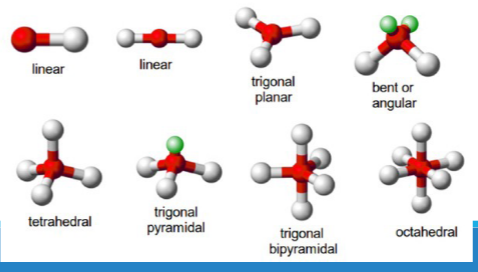
VSEPR theory is used to predict the shape of the molecule
VSEPR theory states that repulsion between the sets of valence-level electrons surrounding an atom causes these sets to be oriented as far apart as possible
shape | bonds | lone pairs |
see-saw | 4 | 1 |
t-shaped | 3 | 2 |
linear | 2 | 1 |
square pyramid | 5 | 1 |
square planar | 4 | 2 |
YOU MUST ALWAYS DRAW A LEWIS STRUCTURE BEFORE IDENTIFYING THE SHAPE
VSEPR theory also takes into account geometries of molecules with unshared electron pairs
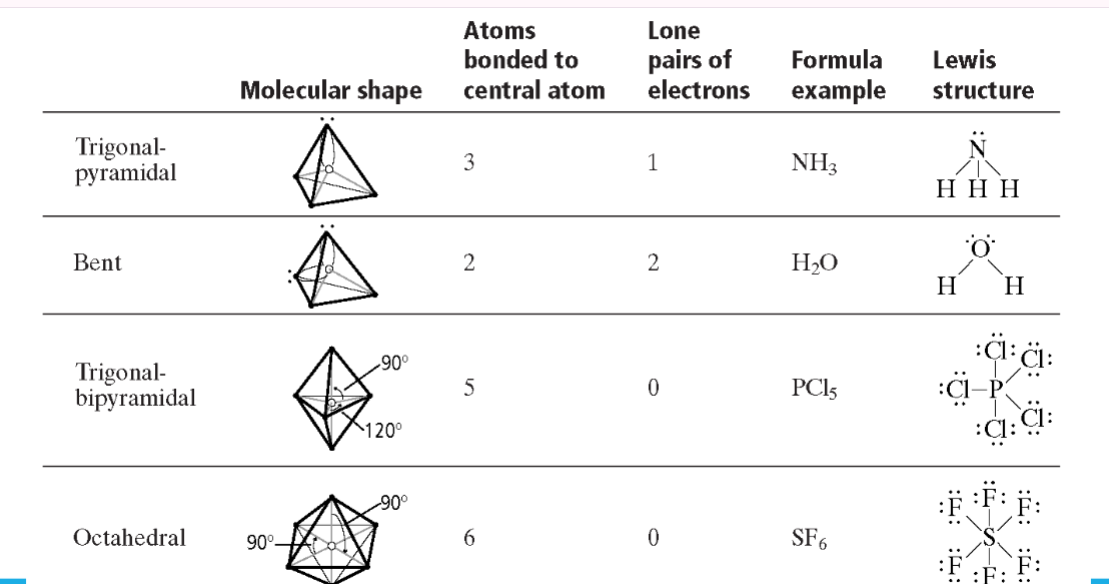
ex ammonia, NH3, and water H2O
VSEPR theory postulates that the lone pair occupies space around the nitrogen atom just as the bonding pairs do
Those lone pairs need more space than a bond does due to the concentration of negative charge in one place
You have to know that lone pairs are there, but ONLY THE BONDED ATOMS account for the shape of the molecule
unshared electron pairs repel other electron pairs more strongly than bonding pairs do
molecular geometry vs electron domain geometry
there are 2 types of geomtries; molecular and electron domain
molecular geometry: the true shape of a 3d model
electron domain geometry: the general shape based on the idea that lone pairs of electrons take up space
the arrangement of all the electrons in the 3D space
groups of electrons around the central atom
polarity
a polar bond is an unequal sharing of of electrons between two atoms
usually, one atom has a negative charge and the other has a positive charge
a nonpolar bond is an equal sharing of electrons between two atoms
classification of bonds
you can determine the type of bond between two atoms by calculating the difference in electronegativity values between the elements
the bigger the electronegativity difference the more polar the bond.
using molecular geometry to figure out polarity
lone pairs on central atom?
y → polar
no → keep going
atoms around central atom
same: nonpolar
diffferent : polar
lone pairs on the central atom will always make it polar except for the expanded octets linear
intermolecular forces
intermolecular forces (IMF) - the forces of attraction between molecules, known as intermolecular forces.
the boiling point of a liquid is a good measure of the IMF between its molecules: the higher the boiling point, the stronger the forces between the molecules
intermolecular forces vary in strength but are generally weaker than intramolecular forces (bonds)
London Dispersion/Van der Waals Forces
even noble gas atoms and nonpolar molecules can experience weak intermolecular attraction
in any atom/molecule, polar or nonpolar, the electrons are in continous motion
so, as a result, at any instant, the electron distribution may be uneven
a momentary uneven charge can create a positive pole at a one end of an atom of a molecule and a negative pole at the other
this temporary dipole can then induce a dipole in an adjacent atom or moelcule - the two are held together for an instant by the weak attraction between temporary dipoles
the intermolecular attractions resulting from the constant motion of electrons and the creation of instanteous dipoles are called London dispersion forces
a dipole is created by equal but opposite charges separated by a short distance
the direction of a dipole is from the dipole’s positive pole to its negative pole
the negative region in one polar molecule attracts the positive region in adjacent molecules, so the molecules all attract each other from opposite sides
such forces of attraction between polar molecules are known as dipole-dipole forces
dipole-dipole forces act at short range, only between nearby molecules
besides 2 polar molecules having dipoles, ions in a solution can also create a dipole moment
an ion-dipole is created when an ion is attracted to an oppositely charged polar molecule
some hydrogen compounds have unusually high boiling points
this is explained by a very strong type of dipole-dipole force
in compounds containing H-F, H-O, or H-N bonds, the large electronegativity differences between hydrogen atoms and the atoms they are bonded to make their bonds highly polar
this gives the hydrogen atom a positive charge that is almost as half as large as that of a bare proton
the small size of the hydrogen atom allows the atom to come very close to an unshared pair of electrons in an adjacent molecule
the intermolecular force in which a hydrogen atom that is bonded to a highly electronegative atom is attracted to an unshared pair of electrons of an electronegative atom in a nearby molecule is known as hydrogen bonding
only with H-F, H-O, HN → between atoms that also have hydrogen bonding
bonds ranked from strongest to weakest : ionic bond, covalent bond, hydrogen bonding, dipole dipole force, london forces
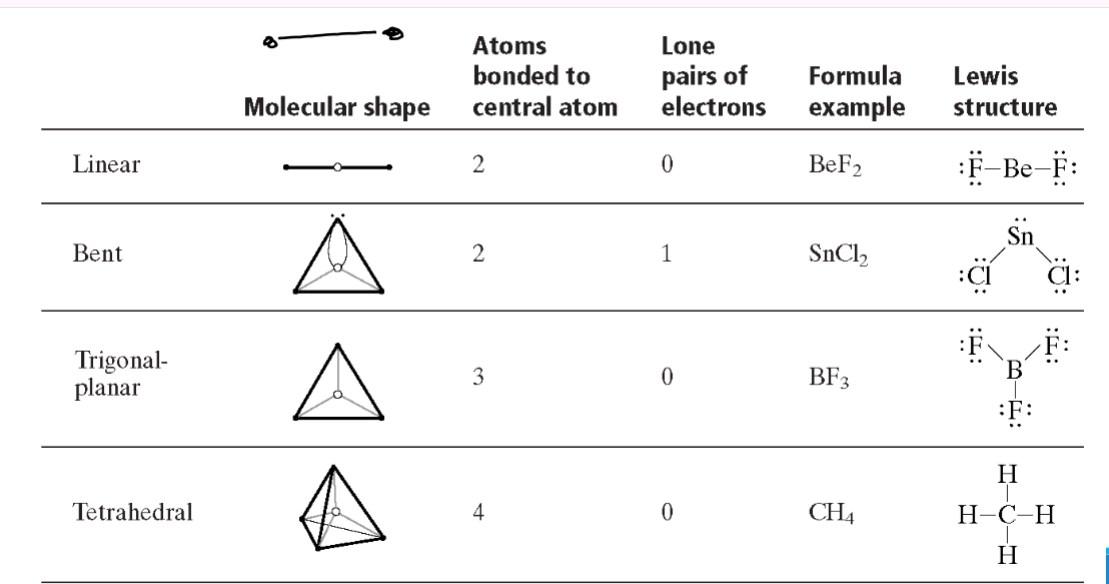
name | molecular shape | atoms bonded to central atom | lone pairs of electrons | formula ex |
linear | 2 | 0 | BeF2 | |
bent | 2 | 1 | SnCl2 | |
trigonal planar | 3 | 0 | BF3 | |
tetrahedral | 4 | 0 | CH4 |
WHAT THE HECK BRO