X-ray diffraction
Conditions of diffraction
Also known as x-ray crystallography.
For diffraction to occur there has to be:
- a slit proportional in size to the light wavelength. For X-rays the wavelength is about 10^-10m (1A).
- a grid with appropriate wavelength distance between the slits, we use crystals.
Generation of diffraction from crystals
An x-ray source with x-rays coming out and crystals at the end, the rays are diffracted on reaching the crystal to a film. At given direction the rays create intense spots on the film.
Interpretations
Bragg: In their research they discovered that if we assume that x-rays are falling on atoms then they will be reflected from planes of the crystal.
Laue: He suggested that diffraction pattern can be explained by considering x-rays as beams scattering on reaching the atoms.
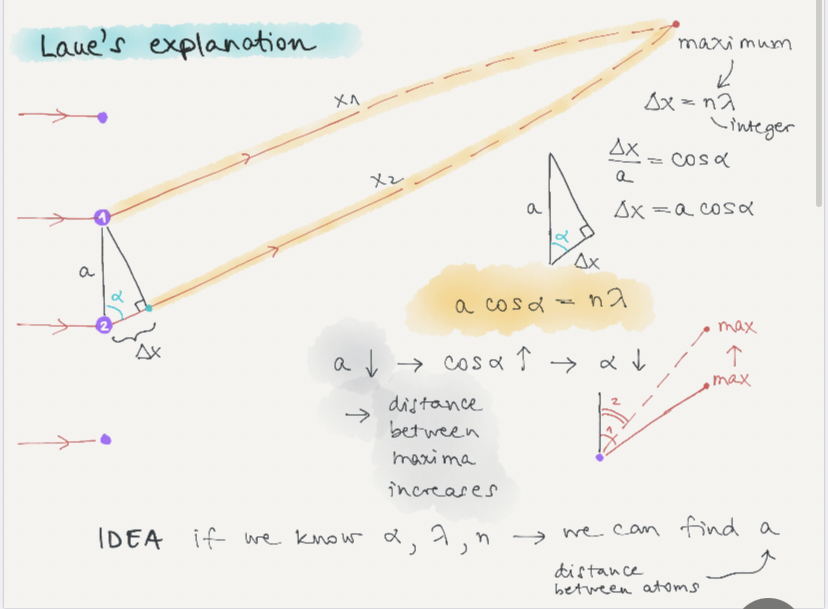
He explained the x-rays were hitting the atom perpendicularly, the atoms were then scattered to disk deferent angles but meet at a point. ==The distance between the atoms is a and the angle between them is alpha, if a decreases then the angle also decreases leading to increased distance between maxima.==
IDEA: if we know the alpha, wavelength and maxima then we can derive a.
Condition for formation of interference maxima
X-rays are hitting the atoms and we have a screen to detect which has maximum intensity points. The x-rays are then traveling from the atoms(1 & 2) to the maximum intensity point on the screen and interfere with each other at that point.
When the two atoms are at same distance from the screen they are in phase on arrival at the screen resulting in constructive interference, the maximum intensity is determined by the path difference but if the difference is 0 resulting in amplification .
When distance from second atom to screen is larger the wave shifts and it is in opposite phase from the first atom so no spot is created.
This all means when there is a difference maximum intensity.
Experimental procedure
- Create X-ray diffraction image .
- Determine scattering angles(3 dimensions).
- Calculate distance between the atoms.
Biological application
We apply it analysing proteins structures, by generating diffraction patterns and calculate distances between atoms. We crystallize the proteins then perform x-ray diffraction and we can find out the position of each atoms in the protein.