4e. Monopoly
Monopoly
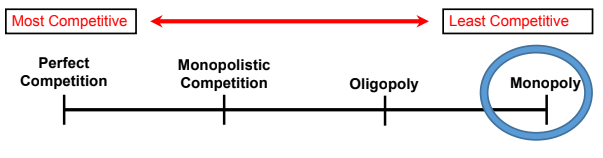
In a monopoly we generally assume that there is one firm in the market. They have 100% market share and are known as a pure monopoly
In the UK a more precise definition is that there is one firm in the market that has more than a 25% market share. At this level they have monopoly power. For example Google (there are other search engines)
Monopoly
There are many different definitions of what a monopoly is:
Pure Monopoly- there is only one firm in the market (this is what we will study)
Working Monopoly (CMA Definition)- when a firm has 25% market share
Legal Monopoly – this is protected by the law e.g. Systembolaget
Local Monopoly- where there is no viable alternative in the area e.g. School canteen
Note - a duopoly exists when two firms dominate the market
Characteristics
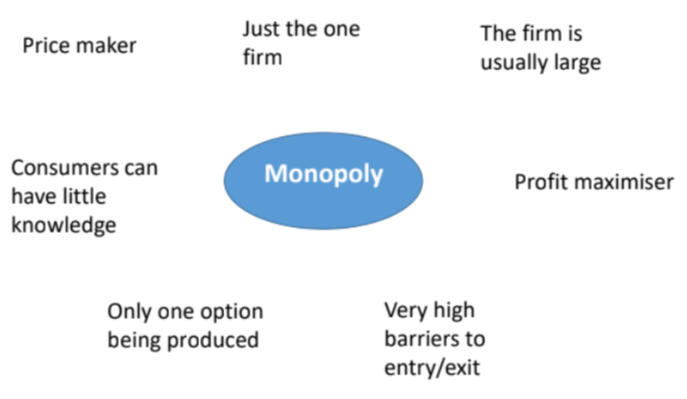
Monopoly short run loss
A monopoly can make a loss in the SR (as long as it covers its variable costs- see next diagram for a more complicated diagram)
Advantages of monopolies
Economies of scale If there are significant economies of scale, a monopoly can benefit from lower average costs. This can lead to lower prices for consumers.
Research & Development. Monopolies make supernormal profit which can be invested in Research & Development. This is important for industries like medical drugs.
they would be dynamically efficient
A Firm may gain monopoly power because it is the most efficient. Google gained monopoly power through offering innovative new products. It is hard to argue google has x-inefficiency because of its monopoly power.
Problems with monopolies
Higher Prices: Firms with monopoly power can set higher prices than in a competitive market.
Allocative Inefficiency: A monopoly is allocatively inefficient because in monopoly the price is greater than MC. (P > MC). In a competitive market the price would be lower and more consumers would benefit. A monopoly results in dead-weight welfare loss indicated by the red triangle.
Productive Inefficiency: A monopoly is productively inefficient because output does not occur at the lowest point on the AC curve.
X – Inefficiency: It is argued that a monopoly has less incentive to cut costs because it doesn’t face competition from other firms. Therefore the AC curve is higher than it should be.
Supernormal Profit: A Monopolist makes Supernormal Profit possibly leading to an unequal distribution of income.
Lower Prices to suppliers: A monopoly may use its market power and pay lower prices to its suppliers. E.g. Supermarkets have been criticised for paying low prices to farmers.
Diseconomies of scale: It is possible that if a monopoly gets too big it may experience diseconomies of scale. – higher average costs because it gets too big.
Lack of incentives: A monopoly faces a lack of competition and therefore, it may have less incentive to work at product innovation and develop better products.
Monopoly power
Monopoly power is derived from high barriers to entry (legal, sunk costs, anti competitive pricing, economies of scale etc.) The higher the barriers, the more power the monopolist has.
like a coffee shop in a train station that cost more as they have monopoly power in that circumstance
Product differentiation and number of near competitors are also a factor. Houses have to have electricity. What is the substitute? The Birmingham to London train is used by 1000s of commuter a day. What is their alternative?
you can get regional monopolies like Thames Water or local train routes
First Degree Price Discrimination
The firm is able to charge each consumer the price they are prepared to pay (perfect price discrimination will mean consumer surplus is equal to zero).
like an auction
Second Degree Price Discrimination
The firm tries to sell off any capacity it has remaining at a lower price than the normal published price.
like bulk buying
Third Degree Price Discrimination
The firm splits the market into different groups based on elasticity of demand and charges different prices to different groups. This could be based on segments such as:
Time e.g. peak/off-peak trains
Place e.g. cars in the EU cost different amounts in different places
Income e.g. discounts for those on benefits
Age / sex of the consumer e.g. student discount
Third Degree Price Discrimination
For third degree price discrimination to be effective, there needs to be certain conditions:
Monopoly power (price setters)
Otherwise they will be undercut by new rivals
Different demand curves must exist (elasticity must vary)
Otherwise there is no point in charging different prices
The buyers must be split into distinct groups
It must be easy to classify consumers by elasticity
The monopolist must be able to keep the markets separate at relatively low cost (no arbitrage)
Otherwise consumers with inelastic demand will be able to get back their consumer surplus
Third Degree Price Discrimination
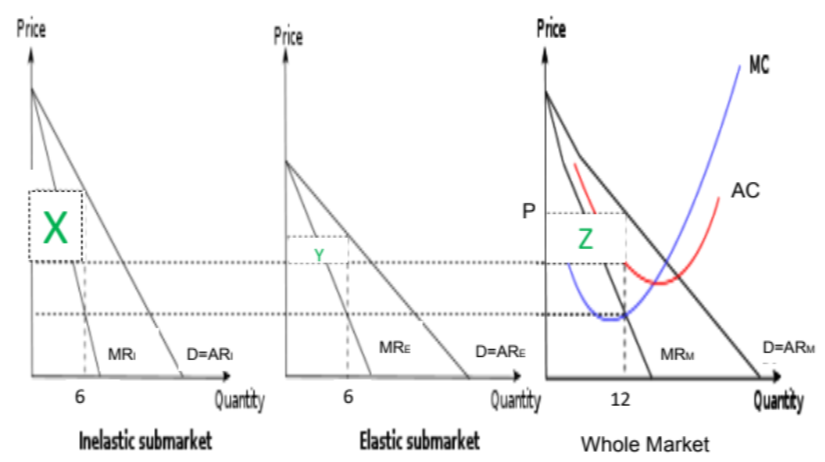
Originally the monopolist just charges one price to the whole market. They produce at the profit maximising output of 12 and therefore charge price P and making supernormal profits of area Z.
You will notice that the demand curve is splintered with those at the top showing highly inelastic demand and those at the bottom showing elastic demand.
The monopolist can split the market into two, charging different prices for the groups that have elastic or inelastic demand.
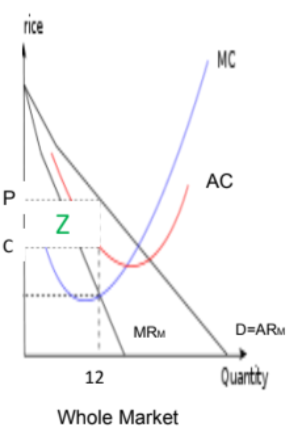
The total output does not change, the market is just divided into two parts, one elastic and the other inelastic, i.e. 6 + 6 = 12.
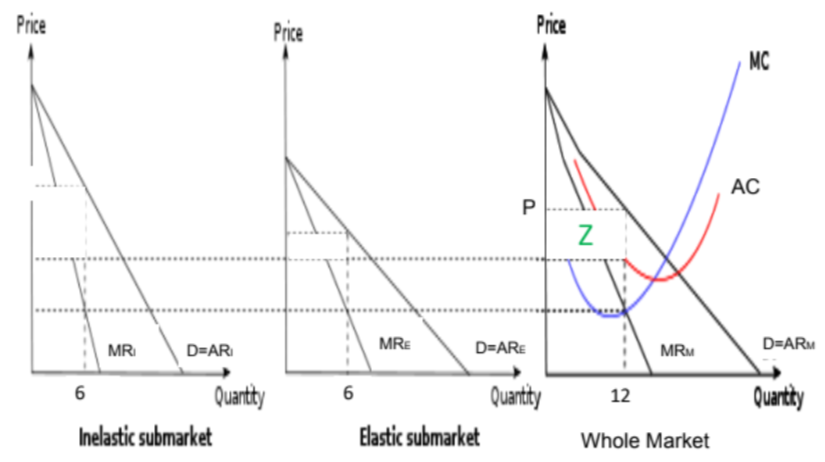
The costs have not changed so we can carry the MC and AC curves across using a dotted line. The cost of C will therefore be unchanged for all markets.
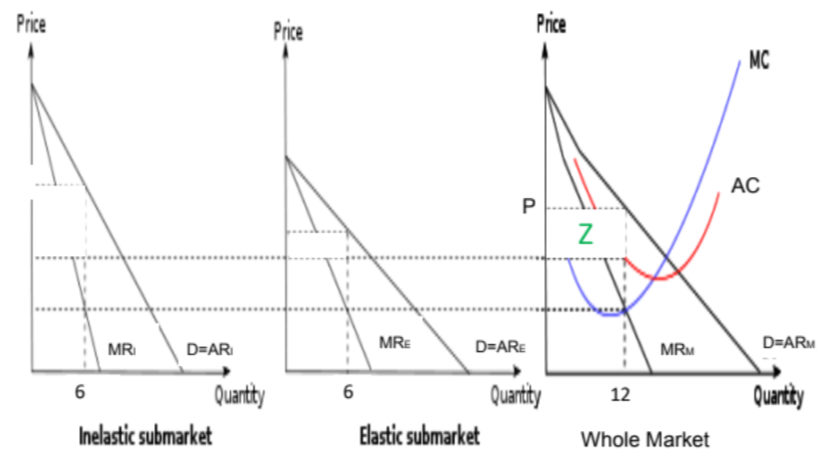
In the elastic submarket the MR curve hits the MC line at 6 leading to a price of P1 and a fairly small SNP box of area Y.
Third Degree Price Discrimination
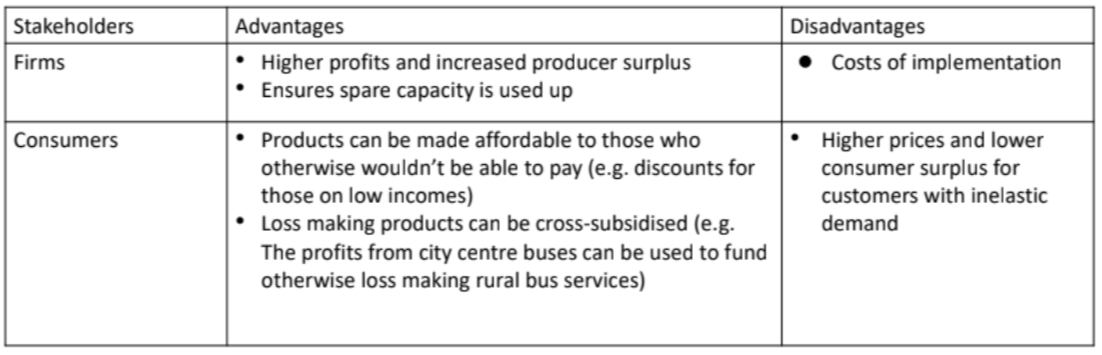 - firms can use profits to improve quality of peak services for consumers
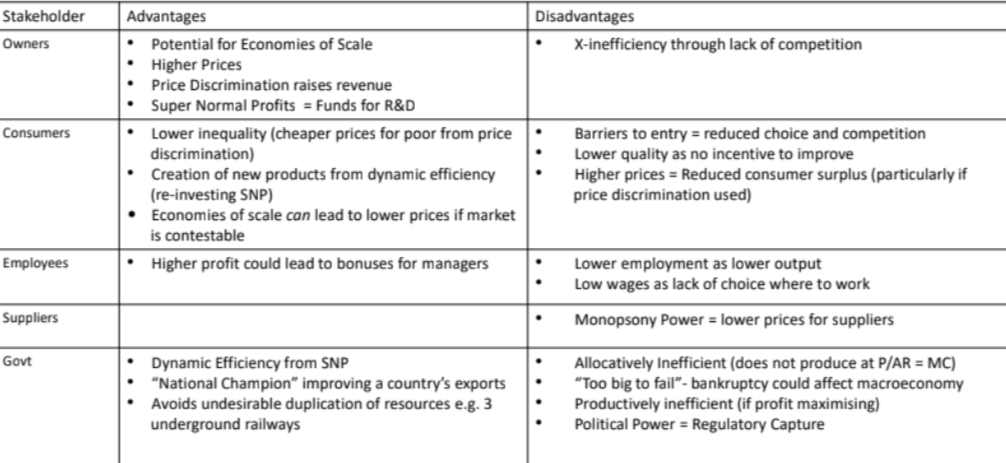
Natural monopolies
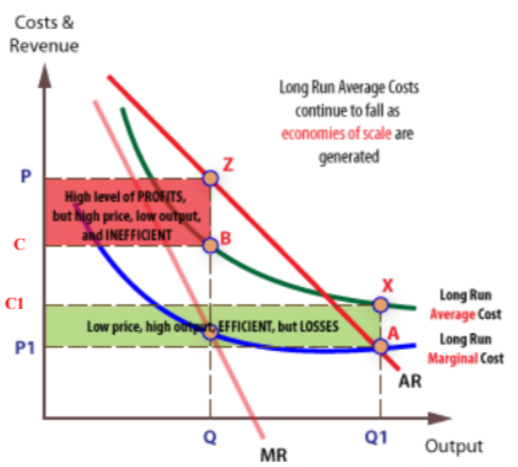
Natural monopolies exist when not even one producer can exploit the economies of scale available. This means that the dominant firm in the industry, i.e. that with the largest output and the lowest cost, is always able to undercut competitors in price and force them out of the industry if they choose. Therefore, the firm is the industry / the industry is the firm.
A natural monopoly is a distinct type of monopoly that may arise when there are extremely high fixed costs of distribution, such as exist when large-scale infrastructure is required to ensure supply. Examples of infrastructure include cables and grids for electricity supply, pipelines for gas and water supply, and networks for rail and underground. These costs are also sunk costs, and they deter entry and exit.
In the case of natural monopolies, trying to increase competition by encouraging new entrants into the market creates a potential loss of efficiency. The efficiency loss to society would exist if the new entrant had to duplicate all the fixed factors - that is, the infrastructure.
Natural monopolies tend to exist in industries where fixed costs are very large and marginal costs are very small e.g. railways, gas, electricity, water and telephones.
like railways or the TFL or the natural grid these would be considered natural monopolies
Natural monopoly
Firms would prefer to charge the profit maximising price of P at an output of Q. However, due to the nature of the good/service this is unlikely to be in the consumers interest. The government would prefer the firm to charge an allocatively efficient price of P1 at an output of Q1. However, at this point the firm would be making a loss.
Therefore to ensure a price of P1 the government would need to subsidise between XA in order to have an efficient market that won’t shut down.
Multi plan monopoly
A multi-plant monopoly is given in monopolistic firms that have their production divided into more than one production plant, each one having its own cost structure. Different cost structures give place to different marginal costs and hence each production plant will have to choose the individual production output level in order to profit maximise.
Duopoly
In its purest form two firms control all of the market, but in reality the term duopoly is used to describe any market where two firms dominate
Examples of duopolistic markets: There are many examples of duopoly including the following:
Coca-Cola and Pepsi (soft drinks), Unilever and Proctor & Gamble (detergents)
Bloomberg and Reuters (Financial information services), Sotheby's and Christie's (auctioneers of antiques/paintings)
Airbus and Boeing (aircraft manufacturers)
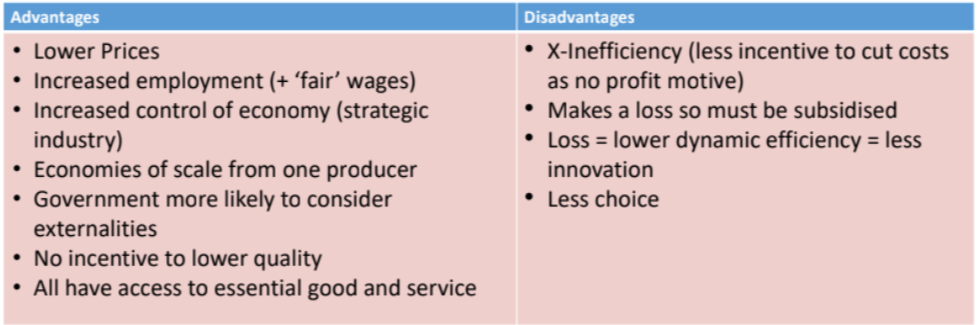
Nationalisation
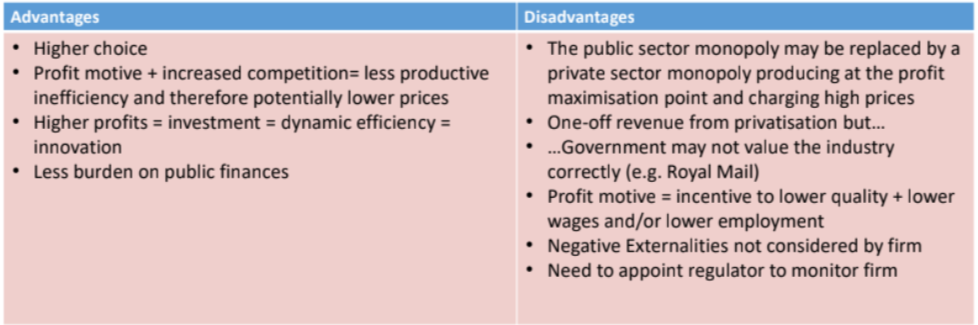
Privatisation
Competitive tendering
When an organisation decides to contract out, firms (and sometimes the government as well) bid for the right to run a service or gain a certain contract (paid for by the government)
The firm offering the lowest price, subject to quality guarantees, wins the contract
The contract is put up for tender again in a few years, in order to:
give the winning firm a continued incentive to perform well; and give other firms a chance to outcompete the incumbent
Used in army supplies, cleaning services in school, prisoner transfer etc
Competitive tendering - advantages
Brings competition into public services
Incentive for private firms to reduce costs (productive efficiency) and to be innovative (dynamic efficiency) Vs public sector being bureaucratic (x-inefficiency)
Leads to lower prices and higher quality products
Hence, the government saves money and taxpayers get better services
Competitive tendering - disadvantages
Private firms may cut corners on quality and staffing in order to keep costs down, and this may have serious consequences
Where only a few firms bid for a contract, competition is restricted and the lowest price won’t be attained
How many firms have the resources to bid for complex projects?
Risk of collusion from bidders
No real transfer of risk as government must still provide service if provider goes bankrupt
Monopoly regulation
Following the mass privatisation of the 1980s there was concern that these privatised monopolies could abuse their market power by lowering quality and setting high prices. A series of regulatory bodies were therefore set-up to monitor these monopolies and intervene if necessary
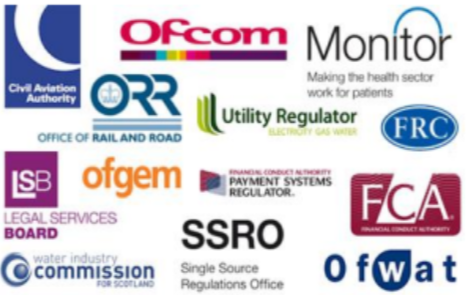
Regulations are a form of government intervention in markets
•The economy operates with a huge and growing amount of regulation.
The government appointed regulators who can impose price controls in most of the main utilities such as telecommunications, electricity, gas and rail transport.
° Free market economists criticise the scale of regulation in the economy arguing that it creates an unnecessary burden of costs for
"businesses - with a huge amount of "red tape" damaging the competitiveness of businesses.
* Regulation may be used to introduce fresh competition into a market - for example breaking up the existing monopoly power of a service provider. A good example of this is the attempt to introduce more compettion for British Telecom. This is known as market liberalisation.
Options available to regulate monopolies
Price controls or price regulation (P : MC=AR)
Profit controls or profit regulation (taxes)
Quality standards
Performance targets
Breaking up the monopolist
Lowering barriers to entry
Windfall taxes
Privatisation and nationalisation
Deregulation
Subsidies (for smaller firms)
Self regulation
Monopoly regulation
Effective government intervention can mean:
Lower prices to customers
Reduce abnormal profits
Increase in efficiencies
Increase quality of products
Increase consumer choice
Problems that regulators can face
Hard to find evidence of anti-competitive behaviour:
Lack of spoken or written evidence
Conflicting or asymmetric information
Complex information
Conflicting evidence – e.g. it might be markets forces or collusion in an oligopoly
Fear of fines or other control mean that there is strong incentive to conceal collusion
Lack of regulator power and lack of regulator resources
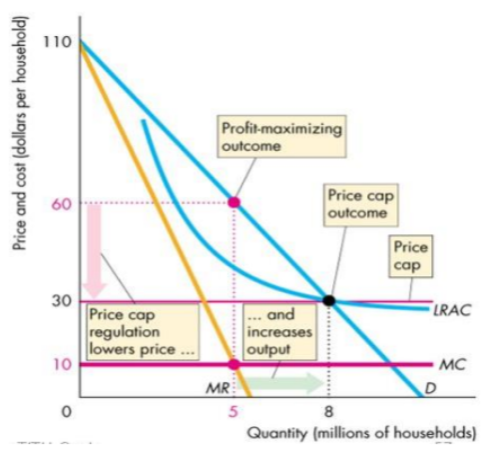
Price capping
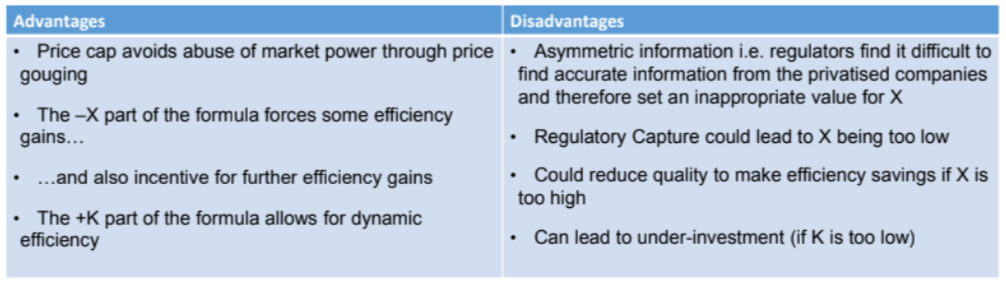
The main method available to a regulator is price capping.
In the UK this is normally done using the RPI- X+K formula
This allows regulators to increase the prices by the rate of inflation minus the expected efficiency gains they should make (due to the profit motive)
If the firms are undertaking major investment they are allowed to add on an amount to fund this
Price capping
Performance targets/Quality standards
Ensures that firms do not cut corners on quality to lower prices
However, firms can ‘game the system’ e.g. A train company might make the official journey time longer or miss out stops to improve their punctuality figures
It can be hard to judge performance effectively e.g. Train service could be late due to bad weather or actions by passengers
Profit capping
Profit capping stops firms from exploiting consumers
However, they provide little incentive to be efficient once the profit cap has been reached
Due to asymmetric information they may struggle to calculate how much profit is reasonable. If it is set too high, the firm can abuse its monopoly power
This is particularly problematic if an industry is prone to regulatory capture
Deregulation
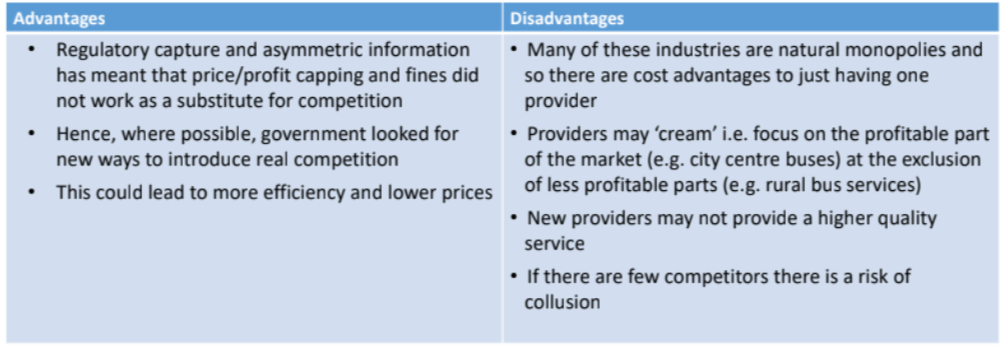
Deregulation involves removing government legislation and laws in a particular market.
By removing barriers to entry this may allow new firms to enter the market and create more competition
For example, in the UK, many industries used to be a state monopoly – BT, British Gas, British Rail, Buses, Royal Mail. However, deregulation allowed new firms to enter these markets
Deregulation
Monopoly power
Monopoly power is derived from high barriers to entry (legal, sunk costs, anti competitive pricing, economies of scale etc.) The higher the barriers, the more power the monopolist has
Product differentiation and number of near competitors are also a factor. Houses have to have electricity. What is the substitute? The Birmingham to London train is used by 1000s of commuter a day. What is their alternative?
One way in wich gov can intervene to reduce prices at mororaway service stations is through placing price gaps on certain staple goods.