L5- Avoiding Predation
Adaptation→
a heritable trait that enhances the person’s fitness through current benefits and also past benefits
→ not all behaviours are current adaptations
Why are some behaviours non-adaptive?
behaviour evolved to adapt to past conditions that no longer exist, has not been replaced, leaving a non-adaptive trait
arctic ground squirrels live where snakes don’t but when experimentally exposed to snakes, they behave like squirrels that like with snakes
arctic moth do not fly in bat areas but will stop moving when experimentally exposed to ultrasonic bat stimuli
behaviour evolved as a side effect of a good adaptation, is genetically linked to it
rodents feeding other offspring as well due to their strong parental drive
stepparents abusing their stepchildren
behaviour is mal-adaptive now that the environment has recently changed, person has not evolved to it yet
sea turtles eating plastic bags that resemble jellyfish
Example of an adaptive behaviour→ Mobbing:
anti-predator trait, group attacks an intruder to drive them off
e.g. gulls mob any individual near the nest
this causes injuries and deaths but it protects the nests
Q→ is mobbing a behavioural adaptation against predators?
Predict→ mobbing should reduce egg predation if it is a behaviour adaptation against egg predators
Method→ placed a hen egg every 10m along a line from the outside of the colony to the middle of the colony, measured the amount of mobbing by crows and amount of egg predation
Results→
mobbing was the highest inside the colony BUT
egg predation reduces as you get into the colony
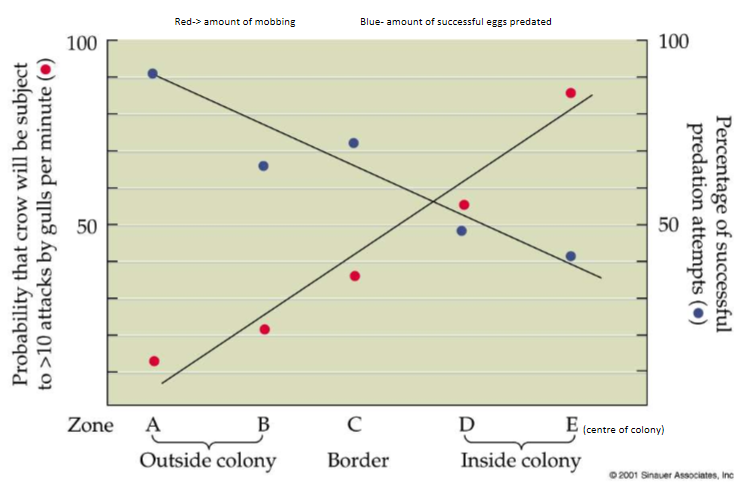 → predation lowers with mobbing and therefore increases reproductive success through egg survival
Comparative Method:
method to test evolutionary hypotheses if experiments are unavailable
compares different taxa to see if one factor causes another by determining if two factors are correlated
e.g. if mobbing is adaptive, it is only expected in species where it reduces predation and would not be needed in non-ground dwellers
kittiwakes are cliff-dwelling gulls→ have no ground predators
predict→ no mobbing occurs in kittiwakes
results→ there is no mobbing in kittiwakes, fits prediction
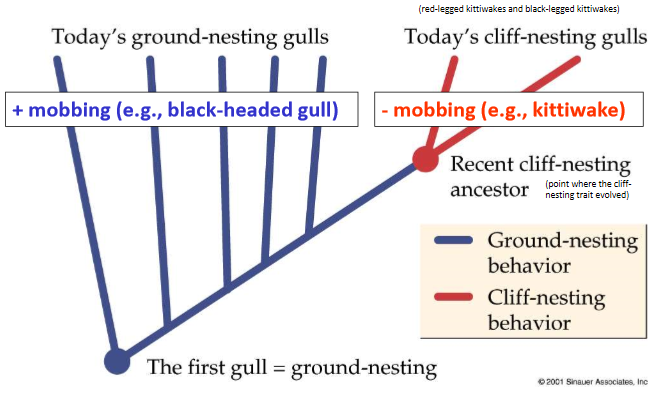
method requires an accurate phylogeny:
e.g. phylogeny shows gulls lost the risky behaviour of mobbing when the cliff-nesting trait evolved
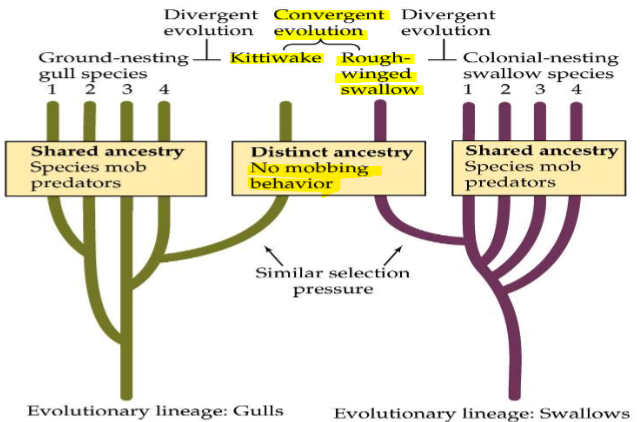
e.g. comparing phylogenies of gulls to swallows
are different taxonomic groups→ kittiwakes are cliff-nesting and rough-winged swallows are solitary
BUT there was convergent evolution to similar selection pressures that lead to the loss of mobbing
Types of Anti-predator Behaviours:
Anti-detection
crypsis→ camouflage, transparency, nocturnality, subterranean living (underground)
Anti-attack→
animal has already been detected
stotting (Springbok), selfish herding, mimicry, warning colouration
Anti-capture→
once the predator is about to catch the prey
vigilance, running, swimming, flying, jumping (grasshoppers), losing body parts (tail loss in lizards)
Anti-consumption→
once animal has been captured
fighting back, pretending to be dead, releasing chemicals, being hard to swallow (puffer fish)
Anti-Predation Techniques→
Camouflage:
camouflage can be of other senses e.g. squirrels eating rattlesnakes skin to smell like them
both the prey and the predator can camouflage
e.g. Peppered Moths-
carbonaria→ black moths, camouflage on black trees
typica→ white moths, camoflauge on white trees (lycan)
larvae→ camouflage by looking like a dead twig
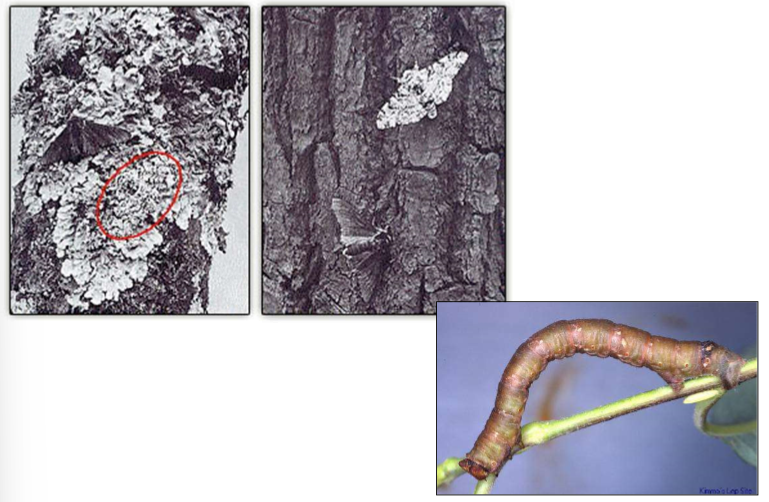
Q→ how effective is camouflage in the face of predation? (Pietrewicz and Kamil)
Method→ showed blue-jays photos of treebarks with moths on, operant conditioning→ rewarded for correct, did not reward for incorrect
Results→
jays detected fewer white underwing moths on white bark than on black bark
jays detected even fewer white head on moths (whose lines are in line with the bark)
→ both where and how the moths settle affected the ability of jays to detect them
e.g. Decorator Crabs:
pile coral/algae/anemone on their backs and let them grow
are choosy with they choose to grow→ prefer Dictyota menstrualis
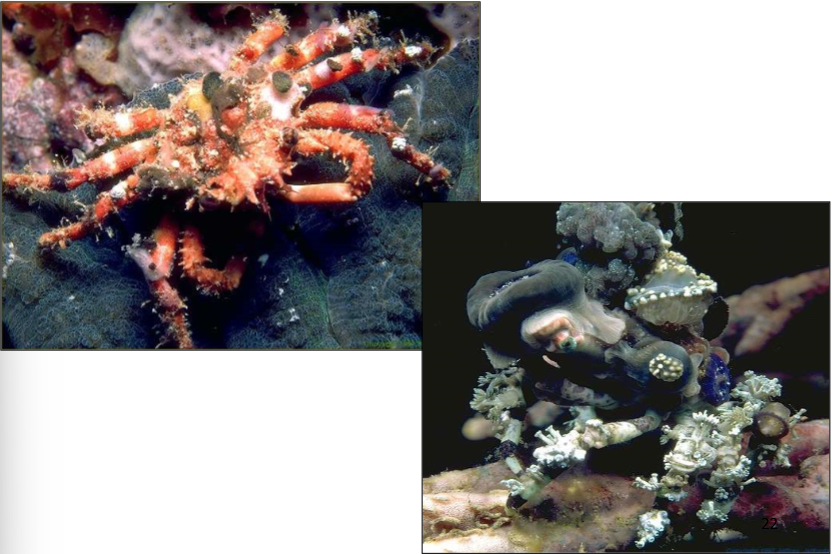
Q→ is the preference of Dictyota adaptive?
Predict→ crabs with Dictyota are less predated
Method→ had crabs with Dictyota and crabs without in an area with predatory fish
Results→ the crabs without Dictyota disappeard 5x faster than crabs with Dictyota
Q→ what is the mechanism of Dictyota?
Results→ Dictyota contains a chemical that repels omnivorous fish
Stotting:
Thomson’s Gazelles stot when they spot a predator→ jump and display white rump to predator
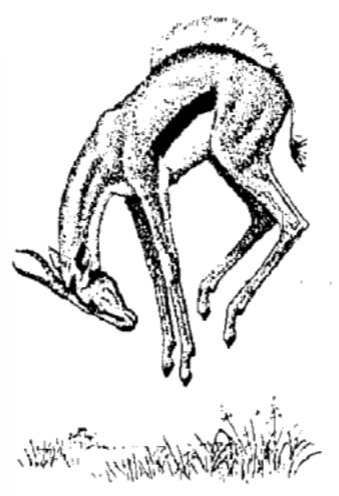
Q→ why do Thomson’s Gazelles advertise themselves to a predator?
Hypotheses:
anti-ambush:
lets gazelles see what is ahead and reduces chance of ambush
occurs in all habitats, not just long grass
→ NO
alarm signal:
warns others that a predator is near
even solitary gazelles stot, show rumps to predators
→ NO
social cohesion:
allows gazelles to form groups and flee together
even solitary gazelles stot, show rumps to predators
→ NO
confusion effect:
confuses and distracts the predator
even solitary gazelles stot
→ NO
unprofitability:
tells the predator that they have seen them and are ready to flee
is an honest signal of their health
→ MOST LIKELY
Method→ compared the results of predation between those that slot and those that don’t
Results→
30% of those that slot are chased vs 50% of those that don’t slot are chased
0% of stotters were eaten vs 20% of non-stotters were eaten
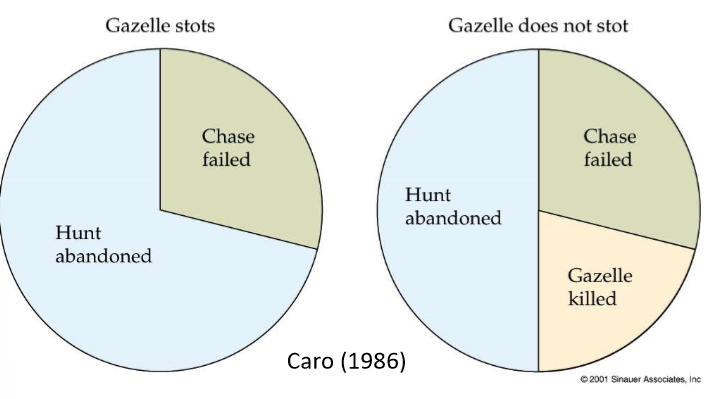 → stotting is an honest signal as predator runs out of energy, unprofitablity hypothesis is true
Selfish Herding:
moving together as a group to avoid predation
benefits the individual but may increase predation risk of group as they are more conspicous
individuals in a group still have a lower mortality than alone
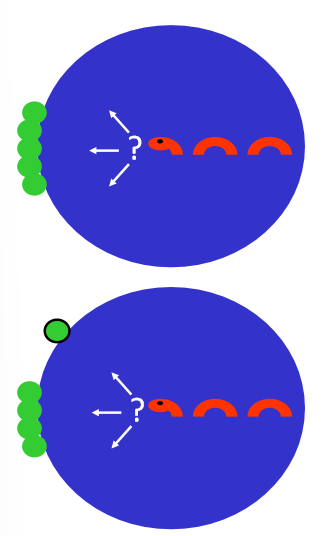
e.g. Bluegill sunfish
build nests on the sea floor
those in the center are less likely to be attacked than at the edges→ all fish try to get to the middle
→ where the fish affects fitness, which depends on the predation rate, which depends on the group size
Mechanism of selfish herding→ the Dilution Effect:
40 individuals with 5 predators, chances of eaten are 5/40= 0.125
400 individuals with 5 predators, chances of eaten are 5/400= 0.0125
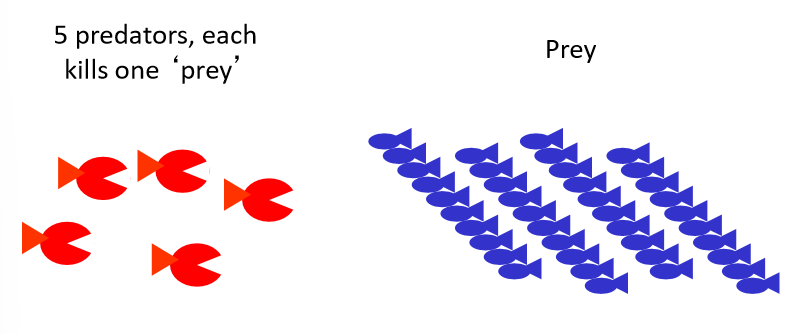 → the larger the group, the lower the individual chances of being eaten
e.g. Whirligig Beetles→
are aquatic, live on pond surfaces, are predated by fish below
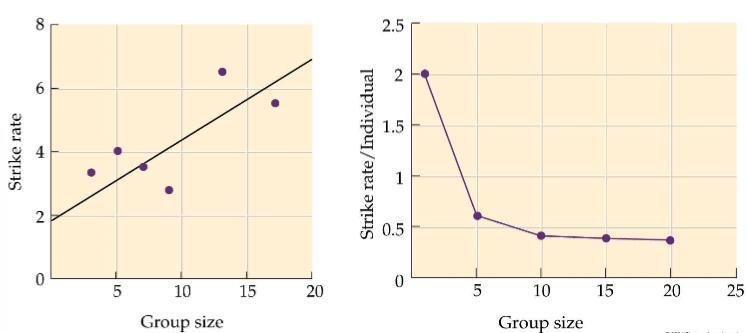
experiment looking at strike rate depending on group size
results→
larger groups are attacked more BUT
the likelihood of one individual being predated is less in larger groups
food is more abundant on the edge of a group but so is predation risk
experiment deprived beetles of food and looked at where they were
results→
food-deprived beetles tended to be on the edges more where there is more food
well-fed beetles tended to be in the center more where there is a lower predation risk
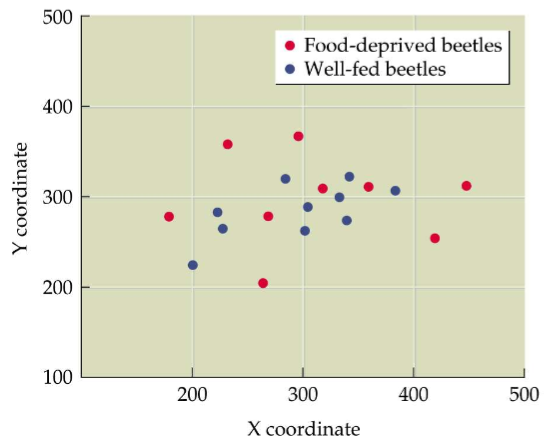
→ there is a trade off between obtaining food and predation risk
→ the dilution effect affects the spacing of individuals
e.g. Mayflies→
live in freshwater, adults emerge and are predated by fish
measured the number of adults emerging that were predated
results→
the days where more mayflies emerged were when there was less predation risk, as the fish became full faster
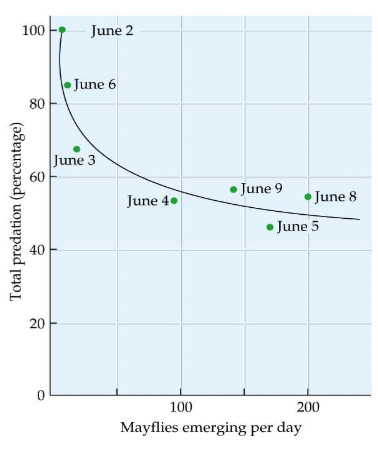 → the dilution effect is causing selection for synchronised emergence
e.g. seabirds lay eggs at the same time to satiate the gulls preying on the chicks
e.g. coral spawn at the same time to satiation the animals preying on the gametes
Group Formation and Vigilance:
being in a group reduces the chance of one individual being predated
one can warn the others or can escape and the others will see this
being in a group increases the level of vigilance
Q→ is group formation better for vigilance and then survival? (Kenward, 1978)
Predict→ individuals in a group react more quickly to threats than solitary individuals
Method→ released a hawk on groups of different sizes of woodpigeon flocks
Results→ as the number of individuals in a flock increases, the reaction to the hawk increases
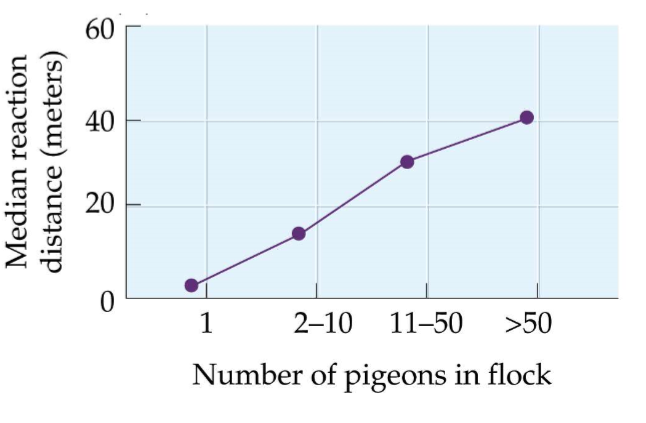 → detection range increases as flock size increases
Method→ looked at the percentage of successful attacks in each flock
Results→ there are less successful attacks in larger flocks
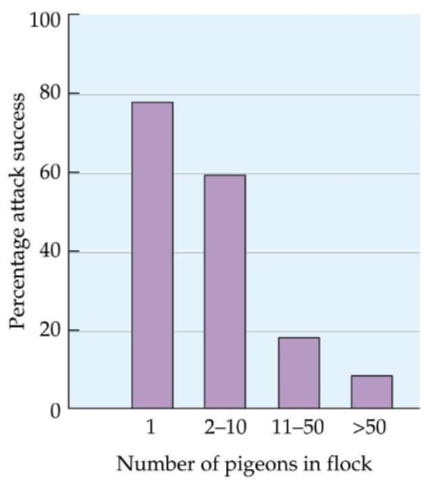 → total attack success declines in larger flocks
→ group living has benefits→ lower predation risks
Group living is also costly→ increases competition for food
e.g. Sparrows→
feed alone or in groups
to form a group, they chirrup to attract the others
Q→ is it better to be in a group or solitary at different predation risks?
Predict→ solitary when predation risk is low, group when risk is high
Method→ manipulated the risk of predation:
distance from predator→ was 25m or 15m away from bird
distance from cover→ near (adjacent) or 2m away from bird
recorded the number of chirrups→ indicates if they are trying to attract the group
Results→
fewer chirrups when foraging closer to cover and further from predator
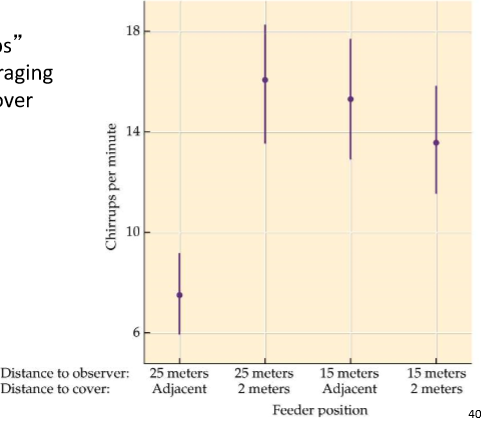 → prefer to forage alone when predation risks are low
→ prefer to forage together when predation risks are high
→ have altered their short-term behaviour to avoid the costs of group foraging