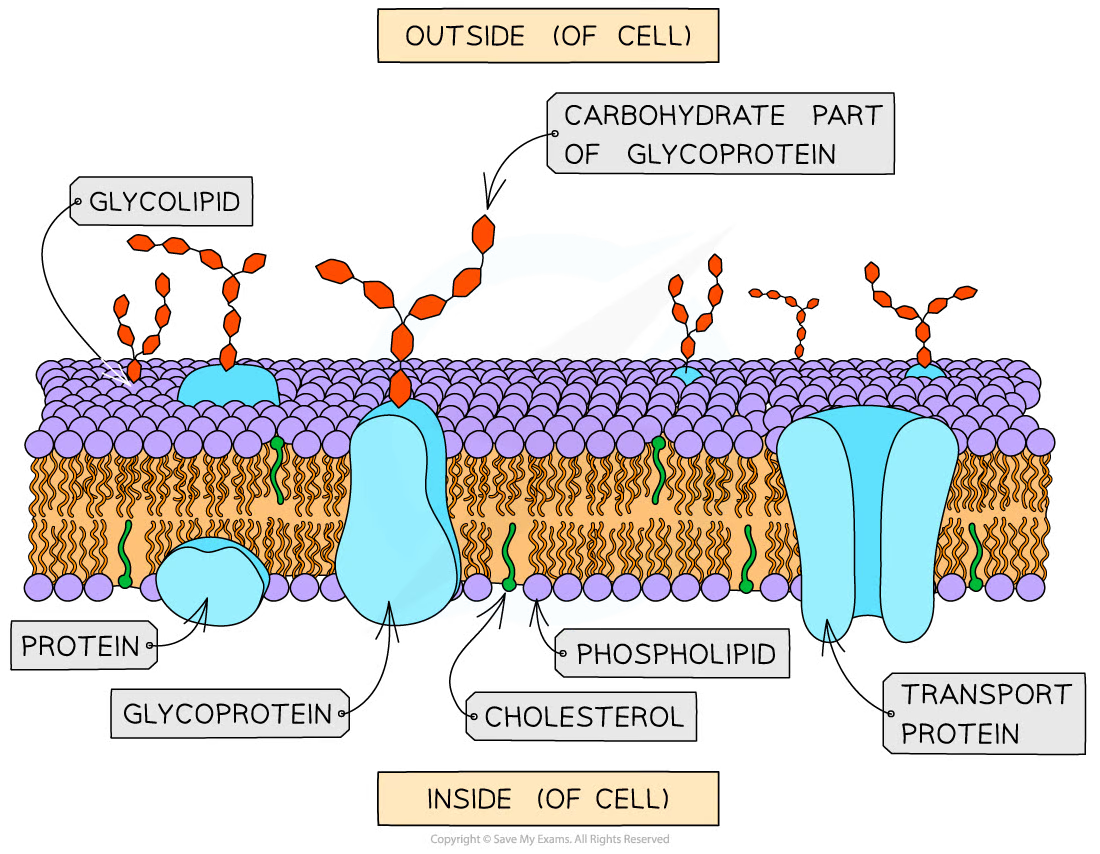
4.1 Structure of Cell Surface Membranes
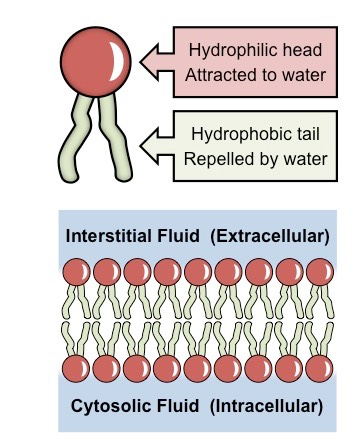
Phospholipids
- %%Hydrophilic head%%, attracted to water, %%point to outside of cell surface membrane%%
- %%Hydrophobic tail%%, repelled by water, %%on inside of cell surface membrane%%
- %%Lipid soluble substances are able to pass through the membrane%% i.e. enter and leave the cell
- %%Water soluble substances are not able to enter or exit the cell%%
- Phospholipids make the membrane %%flexible and self-sealed%%
Proteins
- Proteins are interspersed in the phospholipid bilayer
- Some proteins occur on the surface of the cell membrane and do not extend the full length, used for %%mechanical support or in conjunction with glycolipids, as receptors for hormones%%
- Other proteins span the full membrane, such as %%carrier of channel proteins which allow certain molecules to pass through%%
- Function of proteins in membrane is to…
- Provide %%structural support%%
- Act as %%channel transporting water soluble substances%% through the membrane
- Allow %%active transport across membrane through carrier proteins%%
- Form %%cell surface receptors%% for identifying cells
- %%Help cells adhere together%%
- Act as %%receptors%% e.g. for hormones
Cholesterol
- Add %%strength%% to membranes
- %%Very hydrophobic so prevent loss of water%% and dissolved ions by the cell
- %%Pull together fatty acid tails to prevent movemen%%t and other molecules so membrane is the correct rigidity
- Make membrane %%less fluid at high temps%%
Glycolipids
- Carbohydrate covalently bonded to a lipid
- Carbohydrate portion sticks out end of membrane and act as a %%receptor for specific chemicals%%
- Help %%maintain stability%% of membrane
- Help %%cells attach to 1 another and form tissues%%
Glycoproteins
- Act as %%cell surface receptors%%, specifically for hormones and neurotransmitters
- Help %%cells attach to 1 another and form tissues%%
- %%Allow cells to recognise one another%%
Permeability of Cell Surface Membranes
- In general most molecules do not diffuse through the membrane as they are…
- %%Not soluble in lipids%% and therefore cannot pass through the phospholipid layer
- %%Too large%% to pass through the channels in the membrane
- Of the %%same charge as the charge of the protein channels%% so they are repelled
- %%Polar%% so have difficultly passing through the non-polar hydrophobic tails
Fluid Mosaic Model
- Fluid: individual phospholipid molecules %%can move relative to each other, fluid as membrane is constantly changing in shape%%
- Mosaic: %%proteins embedded%% vary in shape, size and function