BIO 120 FINAL EXAM
Proximate questions - immediate causation, development
How?
Ultimate questions - evolution, adaptive function
Why?
Physiological systems require integration of multiple levels of organization
Atomic and molecular level
cellular level
tissue level
organ level
organ system level
organism level
All levels need to intergrate to function
Organismal structure is fundamentally related to function
cellular level
tissue level
organismal level
Feedback mechanisms drives physiology
Homeostasis
Sensor - detects stimulus
Integrator - translation of signal in body
Effectors - effect change in body
Negative feedback - response opposes stimulus that triggered response
Positive feedback - response enhances or amplifies the stimulus, leading to an even greater response.
Homeostasis - balance-stability in chemical and physical conditions (regulated by negative feedback)
Gradients - super important!
Concentration gardients: things move from high → low concentration
Proteins are critically important mediators of physiology
Evolution by natural selection
Variation
Heritability
Differential survival
Natural selection hypotheses
Species comes from other, pre-existing species
Species change through time
Dawrin and Wallace proposed one mechanism for evolution: natural selection
Four Postulates:
There must be variation among individuals in a population
At least some variation must be heritable
Survival and reporductive success are highly variable. Some individuals proce more offspring that survive to reproduce than others do
Survival and reproductive success are not random: individuals with certain heritable traits are more likely to survive and reproduce in a given environment
Adaptation and acclimation are both important, but they’re not the same
Adaptation - evolutionary process
By evolution by natural selection
Occurs in population (individuals do not change)
Acclimation - in response to current conditions
Reversible changes in physiology
Occurs at individual level
Trade-offs are everywhere
“Cave fish” and “surface fish” are not seperate species
Why have these fish lost their eyes? - Ultimate
How have these fish lost their eyes? - Proximate
How vertebrate animals see:
Light is focused on retina
Light sensitive photoreceptors in retina are “excited” by light
Neurons from retina are “excited” - send signals to brain
Neurons in brain process info recieved from neurons at retina
Fertilization - egg and sperm produce zygote
Egg and sperm are “germ cells”
Zygote is diploid
Egg: maternal DNA, mitochondria, proteins and RNA, nutrition
Sperm: paternal DNA, centrosome structure - intiate mitosis
Cleavage - rapid cell division, end product: blastula, hollow fluid-filled ball of cells
Size of embryo doesn’t change much
Gastrulation - process of cell movements that give rise to the 3 germ layers
Ectoderm - outer (skin, CNS)
Mesoderm - middle (bones, muscle, blood vessels)
Endoderm - inner (digestive organ lining, lungs)
Body plan and axes also begin to develop during gastrulation
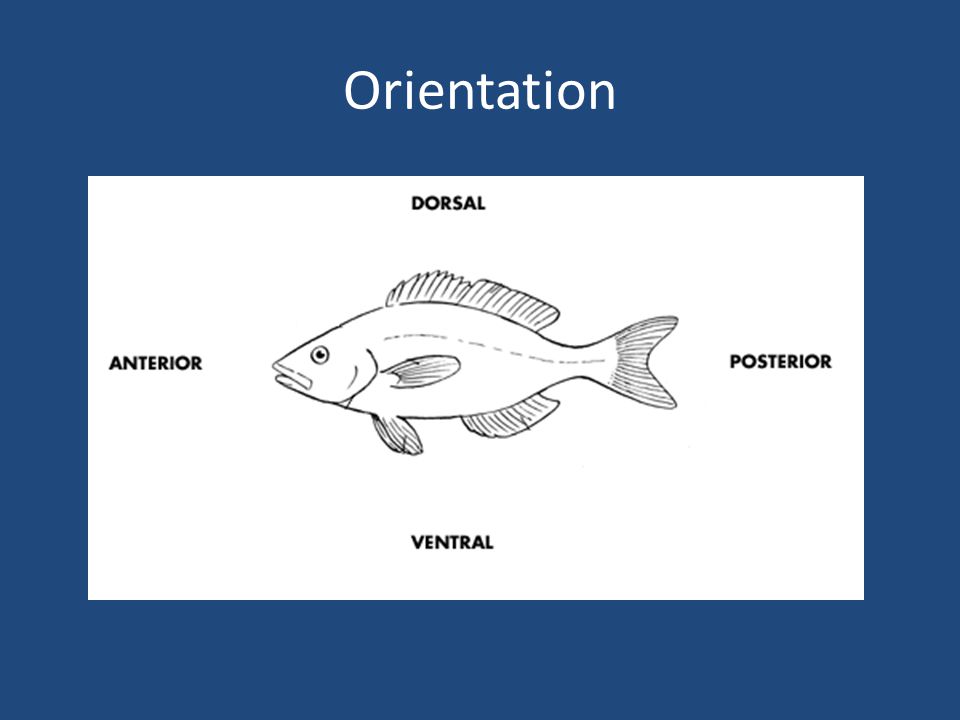
Organogenesis - specific tissues and organs arise
Can occur because gastrulation has formed and positioned germ layers such that cells can signal to one another
4 stages of eye development
Neurulation - formation of CNS, occurs during organogenesis
Formation of neural tube at end
Hollow tube formed from ectoderm becomes CNS (brain, spinal cord)
Part 1: regions of neural tube bein to become specialized
Part 2: optic vesicles form from the neural tube
Part 3: optic cup and lens pit forms
O.V. contacts with surface ectoderm
Part 4: lens vesicle forms
neural tube → optic vesicle → optic cup → RETINA
surface ectoderm → lens pit → lens vesicle → LENS
Every cell in an organism contains the same DNA sequences
Cell type - a group of cells that exhibit a similar function (Neuron, muscle cell)
Cell lineage - developmental history of a cell or group of cells (ecto-, endo-, mesoderm)
Cell commitment
Uncommited state
cell can become essentially any cell in adult organism
possibilities are endless
Commited state
cell is now specialized
cell may not look like a specific cell type yet, but it’s commited to a very limited set of potential cell types
Differentiated state
cell looks like a specific cell type, has associated functions
unsually irreversible
All possible because of differences in gene expression over time
Gene expression: production of different proteins
Chromosomes and genes
Genes: segements of DNA that are expressed to form a functional product → RNA → proteins
mRNA hypothesis - stand of DNA is used as a template to make a complementary strand of RNA
Eukaryots HAVE a nucleus
Prokaryots do NOT HAVE a nucleus
Regulation of transcription and translation
“Gene expression”
Transcribed region - DNA sequence that is transcribed to producce RNA
Regulatory region - DNA sequences that allow bonding of proteins that control initiation of transcription
Has to come before transcribed region
Proteins that bind at regulatory regions
RNA polymerase - produces an RNA strand whose sequence is complementary to the DNA strand
Transcription factors - proteins that bind to regulatory region and allow trasncription to occur (can turn genes on or off)
*Need both for bind to occur
Binding of transcription factors can be affected by:
Concentration - how much is present?
Affinity - high tightly does transcription factor bind to DNA?
Pax6 - an important transcription factor that is required for eye development
Transcription factors: are proteins, are also regulated by gene expression
Shh - sonic hedgehog
protein that controls abundance of pax6
chemical messenger
“local” secretion (nearby cells)
binds recpetors - produces an effects (different effects on pax6 depends on Shh concetration)
High concentration Shh → Less Pax6, more Vax1 (negative transcription factor)
Low concentration Shh → More Pax6
Proximate approach
Shh expression in blind cavefish is higher than in surface fish
What does this mean for pax6 levels in the region where eye structures would normally form? Vax 1 levels? → There would be less pax6 and more vax1 (negative transcription factor)
What does this mean for eye development in cavefish? → Eye development is essentially not occurring because of high levels of vax1
Energy use in animals
generation of physical work (movement)
maintenence (nervous system regulation, circulation, respiration, digestive system)
biosynthesis (tissue growth)
Energy molecules
carbohydrates (sugars)
fats
proteins
Carbohydrates - monosaccharides, disaccharides, polysaccharides
Monosaccharides - glucose, fructose
Disaccharides - sucrose
Polysaccharides - Often long chains of monosaccharides
Glycogen - string of glucose molecules
Glycogen → storage form of glucose → stored in muscles and liver
Fats/lipids - trigylcerol/triglyceride
fat soluble vitamins
insulation
long-term energy storage (2x as much energy per weights as carbs
Fat is stored in adipose tissue
Body fat
Bone marrow
Lipid droplets in muscles
Proteins - numerous diverse functions
can be used directly for energy
used only when carbs, fats, not available
Sugars, fats, and proteins provide sources of energy for organisms: cells use these to produce ATP
ATP - the “energy currency” of the cell
adenosine triphosphate
energy is released following hydrolysis of a phosphate bond
ATP → ADP
Hydrolysis - breaking and reforming of bonds
Energy metabolism in animals
Antoine Lavoisier - heat produce dby an animal is proportional to O2 consumed and and CO2 produced
Energy → maintenence, growth, activity
Food/fuel is oxidized to form ATP
Metabolism - sum of all biological transformations of energy and matter
Metabolic rate - energy metabolism per unit time
Aerobic metabolism
fuel + O2 → CO2 + H2O + ATP + heat
Fuel, O2, CO2, and H2O are INDIRECT measures of metabolic rate
Indirect measures of metabolic rate - O2 consumption or CO2 production
Respirometry - used to measure O2 consumption or CO2 production
Can be open (open container, uses sensors) or closed (closed container)
Heat is a DIRECT measure of heat production
Direct measure of heat production - “direct calorimetry”
335 Joules melts 1g ice
Endothermy - birds and mammals
relatively high metabolic rate
body temperature is elevated by metabolically produced heat
thermoregulate by physiological means
Ectothermy - everything but birds and mammals
relatively low metabolic rate (not producing enough heat to elevate body temp)
depend on conditions of environment to elevate or decrease body temp
thermoregulate behaviorally
Thermoneutralzone - range of temperatures over which MR does not change
Endotherms - basal metabolic rate
not active
haven’t just eaten
know reproductive success
not thermoregulating (in thermoneutralzone)
Ectotherms - standard metabolic rate
not active
haven’t just eaten
know reproductive success
report temperature (standard)
Aerobic respiration - series of reactions that harness energy from food and transfer it to ATP
Glucose - the most common form of chemical energy used by organism
stored in the bonds
In cellular respiration, glucose is oxidized (“burned”) in cells through a series of carefully controlled redox reactions
Oxidation - loss of electrons
Reduction - gain of electrons
Redox reactions - energy transfer via transfer of electrons
Important electron carriers
FAD → FADH2 → electron carrier
NAD+ → NADH → electron carrier
Cellular respiration - 4 phases
glycolisis - takes place in the cytoplasm
“splitting glucose”
pyruvate processing - takes place in the mitochondria
citric acid cycle - takes place in the mitochondria
also called the krebs cycle
electron transport chain - takes place in the mitochondria
oxidative phosphorylation
Stage 1: glycolysis
glucose is split into 2 3-c pyruvates
energy transferred to NADH, ATP
Stage 2: pyruvate processing
those 2 3-c pyruvates → produce 2 2-c acetyl CoA and 2 CO2
energy transfers: NADH is formed
Stage 3: citric acid cycle
the 2- 2c acetyl CoA molecules form 4 CO2 molecules
energy transfer: 6 NADH, 2 FADH2, 2 ATP
Stage 4: electron transport chain
oxygen is the final electron acceptor → H2O formed
H+ gradient (proton gradient)
H+ move from inner membrane back out through ATP synthase range → 25-29 (driven by H+ gradient)
ADP + P → ATP
Anaerobic ATP production - fermentation
lactic acid fermentation occurs in humans
some ATP produced
byproducts produced: lactate
occurs only in the cytoplasm
Overview of cellular respiration: glucose is not the only possible input!
Rely on fats and carbohydrates during exercise
carbohydrate metabolism is more efficient during high intensity exercise → human body favors carbohydrate metabolism during high intensity exercise
Maximal oxygen uptake (VO2 max) - maximum rate of O2 uptake/use during activity
measured in mLO2/kg/min
an activity’s intensity is often determined by what % of VO2 max it demands
As intensity of an aerobic activity increases, reliance on glucose for cellular respiration increase
There are glycogen stores in liver and muscle
you can also ingest carbohydrates
Sled dogs have a VERY high VO2 max
more muscle than humans
with training and high fat diet, they have increased numbers of mitochondria
Sled dog diet - 50% fat, 35% protein, 15% carbohydrates
If sled dogs are fed higher carbohydrates:
Intense muscle cramping
blood sugar drops
muscle glycogen is depleted
If sled dogs are fed higher protein and fat:
lower injury incidence
How do sled dogs fuel their activity on such a low carb diet?
their muscle glycogen increases over course of race (when on a low carbohydrate diet)
shift towards carbohydrate metabolism
change in hormonal profiles that allows for glucose production by liver
increase in glycogen breakdown in liver → elevates blood glucose
increase gluconeogenesis in liver
gluconeogenesis - make glucose from non-carb molecules (fats, proteins)
How do they stay in the thermoneutralzone?
Challenge #1: not losing heat to the cold environment
Solutions: highly insulative fur coat
Why don’t they lose heat from legs/feet? → special arrangement of blood vessels that keeps feet cold
lose less heat to the environment (keep core warm)
Challenge #2: not overheating during activity
Solutions: low body fat, insulative fur coat
What is mad honey and why is it dangerous?
2 systems of chemical regulators used for communication within the body:
Endocrine system
secretes hormones
signals can be “broadcast” to all cells via blood supply
chemical communication
Nervous system
“point to point” communication
chemical, electrical signals
Organization of the nervous system
cephalization
segmental organization
centralization
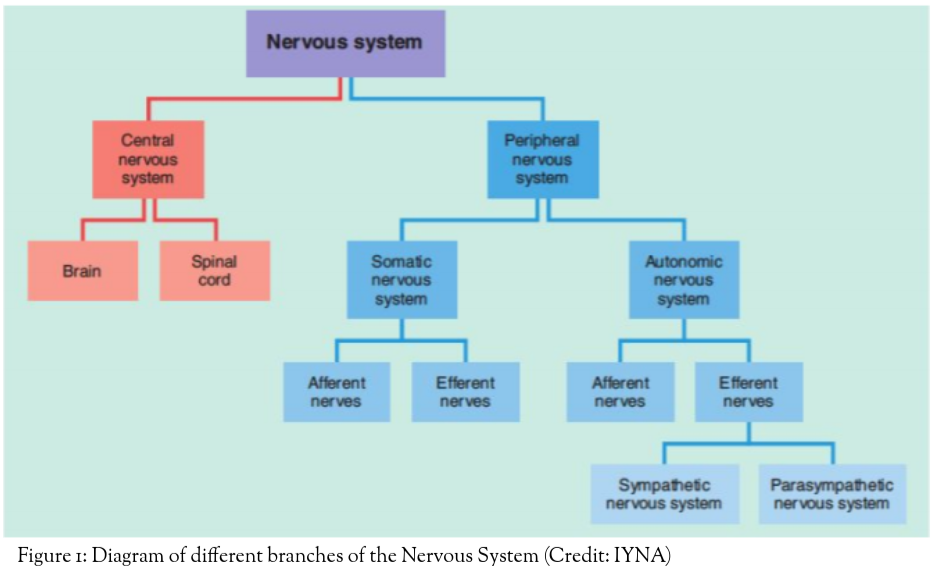
Central nervous system (CNS) - brain and spinal cord
Peripheral nervous system (PNS) - everything else
Neural tissue: 2 cell types
Neurons
structural, functional units of the nervous system
transmit electrochemical signals
Neuroglia (glial cells)
support: insulate, nourish, etc.
Anatomy of a neuron
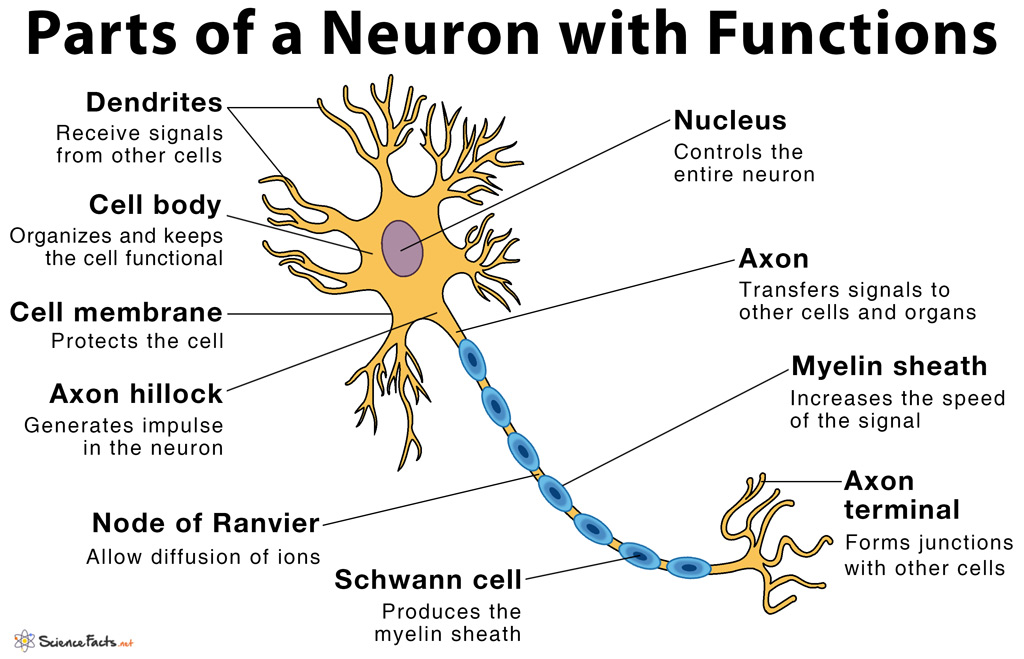
Many neurons also have dendritic spines - increase surface area of dendrites
Neurons send signals across synapses
Synapses - gap between one neuron and another neuron/cell
Communication across synapses
chemical
electrical
Classifying by structure
Total number of neurites (axons and dendrites) that extend from cell body
lots of neurites → multipolar
2 neurites → bipolar
1 neurite → unipolar
Anatomy of dendrites
spiny vs not spiny
Axon length
Classifying by gene expression
neurotransmitter type
chemical released into synapse
Classifying by function
Sensory neurons
carry information to central nervous system
Motor neurons
carrying information from central nervous system to “effectors” (muscles)
Interneurons
associate information from sensory and motor neurons → located entirely in central nervous system
Neurons - the resting membrane
The cell membrane: barrier and gatekeeper
Phospholipid bilayer
phosphate - containing head (polar - can dissolve in water, “hydrophillic”)
Tails: lipids (non-polar, “hydrophobic”)
Cytosol and extracellular fluid - fluid inside and outside of the cell
Ions - atom or molecule with a net electrical charge (positive or negative)
Na+ + Cl- → NaCl
Phospholipid bilayer allows intracellular fluid to maintain different concentration of ions that extracellular fluid
Cations - positively charged ions
Na+, K+, Ca2+
Anions - negatively charged ions
Cl-
The cell membrane barrier and gatekeeper
Proteins embedded in membrane - some allow substances to cross (in or out)
Channels - always open or gated
Transport proteins
Pumps - move ions against concentration gradient
Receptors
Glycoproteins
Ion channels
selective for specific ions (can be always open or gated)
concentration gradient
Diffusion - movement from area of higher to lower concentration
electrical gradient (charge matters)
“electrical potential”
Voltage also known as “electrical potential”
Two gradients at work simultaneously
concentration gradient
electrical gradient
Cell membranes are polarized
unequal distribution of ions
“inside negative”
In an unstimulated neuron, membrane potential = “resting potential”
average: -65 mV
What factors contribute to resting potential?
The primary players
charge - carrying ions/molecules
sodium (Na+)
potassium (K+)
organic anions (A-)
proteins also have a negative charge
membrane proteins
Na+/K+ ATPase pumps
open K+ channels (“leak channels”)
K+ and A- more concentrated on inside
Na+ and Cl- more concentrated on outside
Distribution established and maintained by ion pumps
What contributes to resting membrane potential of the neuronal membrane?
sodium-potassium ATPase pumps produce and maintain K+ and Na+ gradients across the membrane (high K+ in, high Na+ out)
at rest, neuronal membrane is highly permeable to K+ due to presence of potassium “leak” channels (permeability is 40x higher than it is to Na+)
movement of K+ ions through these channels (out, along concentration gradient) leaves inside of membrane charged negatively relatively to outside
3 Na+ IN, 2 K+ OUT
At rest, -65 mV
Na+ moves inside cell
membrane potential is LESS negative - depolarizes
K+ moves outside cell
membrane potential is MORE negative - hyper-polarizes
Membrane potentials can change → graded potentials
Graded potentials - changes in membrane potential that vary in amplitude and duration
Voltage-gated ion channels drive action potential
Membrane potentials can change: excitable membranes (neurons) produce action potentials
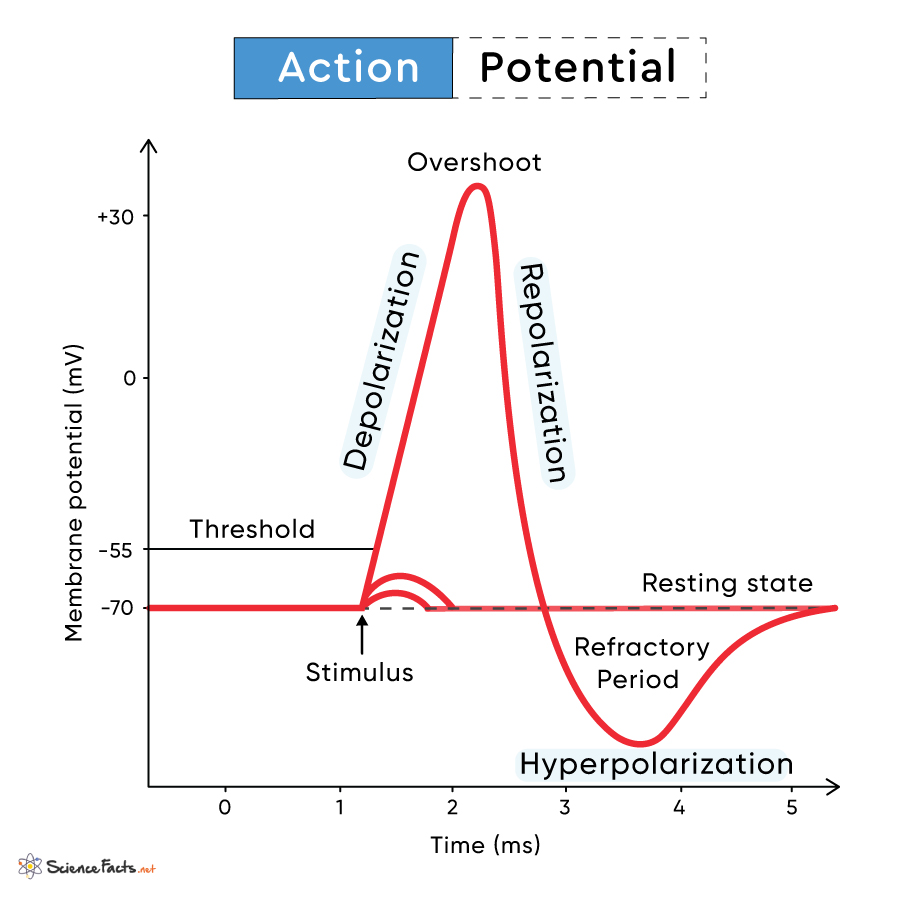
All-or-none response - a brief, all-or-none change in membrane potential
threshold potential ~ -55 mV
Depolarization - Na+ channels open
Hyperpolarization - K+ channels open
What makes neuronal membranes “excitable”?
Voltage-gated Na+ channels & voltage-gated K+ channels → open in response to a change in membrane potential (voltage)
-55 mV threshold
Depolarizing signal is required
Voltage-gated sodium channels
at rest
channel opens, Na+ moves into cell (threshold) open ~ 1 msec
inactivates - Na+ cannot move through - remains inactive for few msec (“refractory period”)
channel closes - no longer inactivated - happens when membrane returns to resting potential (“deinactivation”)
Voltage-gated potassium channels
open in response to depolarization of membrane (but with a ~1 msec delay)
slows to close
Remember: “nerve impulses” are waves of action potentials
Blood sugar on the rise: what is diabetes melitus and why is it a major public health concern?
Chemical messengers and the endocrine system
General categories of chemical messengers (short distances)
Autocrine secretion - chemical messenger affects cell that secreted it (extra local)
Paracrine secretion - chemical messenger secreted by one cell and affects nearby cells
Shh
Neurotransmitters - chemical messenger secreted by neurons at synapses
“Endocrine” secretions travel through the blood to affects distant cells
Endocrine secretion - “hormone”
secreted into blood, affects distance cells
long distance messengers
Neuroendocrine secretion - “neurohormone”
neuron secretes chemical messenger into blood
affects distant cell
Hormones and receptors
A focus on endocrine secretions: general features
gland - ductless, rich blood supply
hormone - secreted into the blood
transport - reaches every cell in the body
does not mean all cells are affected
target cell - only cells affected by hormones
3 main chemical types of hormones:
Peptide/polypeptide/”protein hormones”
made via gene expression transcription-translation
strings of amino acids
most abundant type
example: insulin, growth hormone, secretion
tend to be species specific
Amino acid derivatives/modified amino acids
Made from enzymatic modifications of a single amino acid
example: epinephrine, norepinephrine, melatonin
not species specific
enzymes made out of proteins
Steroid hormones
made by enzymatic modification of cholesterol
5 classes
example: testosterone, estrogen, progesterone
not species specific
Hormone must interact with a receptor to exert an effect
Receptors are specific
2 general classes of receptors
Intracellular - hormone-receptor complex acts as a gene transcription factor
changes in cell are slower
Membrane bound - signal transduction (signal amplification)
hormone never enters cell
Membrane receptor activation leads to rapid changes in cells
Intracellular receptors: bind hormones that can cross the membrane (lipid-soluble hormones)
Mechanism of action - how receptor works to effect change in cell
Peptides and polypeptides - cannot cross membrane
not lipid soluble
Amino acid derivatives - most cannot cross membrane
not lipid soluble
Steroids - can cross
lipid soluble
Glucose homeostasis
Glucose - if too low = hypoglycemic → not enough fuel to produce ATP
if glucose is too high = hyperglycemic → high glucose levels are toxic to neurons and blood vessels
Insulin and glucagon: 2 pancreatic hormones that are important in maintaining glucose homeostasis
human body → pancreas → islet of langerhans → alpha cell (glucagon) & beta cell (insulin)
Pancreas is an…
endocrine organ - secretes hormones
not through ducts
exocrine organ - secretes digestive enzymes
through ducts
Glucose transporters (GLUT transporters)
Membrane proteins that allow glucose to cross membrane
Facilitated diffusion - diffusion of substance across membrane with assistance of protein transporter/channel
Some are not regulated: always present in membrane
(no special signal required to insert in membrane)
GLUT 1 - most cells in the body
GLUT 2 - abundant in liver cells
GLUT 3 - abundant in CNS
Others are regulated: they require a signal to be inserted in the membrane
GLUT 4 - skeletal muscle cells, adipose (fat) cells
pool of vesicles inside of cell containing GLUT 4 transporters
insulin binds receptor
stimulates insertion of GLUT 4 transporter into membrane
GLUT 4 is insulin regulated
Insulin stimulates uptake of glucose by cells
Insulin has important actions in liver, adipose, and skeletal muscle tissue
Insulin action on liver cells
Glucose uptake occurs through GLUT 2 transporters (non-insulin regulated)
Insulin binds receptors on liver cells - signal transduction cascade stimulates glycogenesis (formation of glycogen)
Glucose is also metabolized here to produce ATP
Insulin action on skeletal muscle cells
most abundant glucose transporter: GLUT 4 (insulin-dependent)
insulin stimulates insertion of GLUT 4 into membrane
glucose → ATP
other actions of insulin in muscle cells:
glycogenesis (formation of glycogen)
amino acid uptake into muscle cells
protein synthesis
Insulin action on adipose tissue
insulin binding to receptor stimulates insertion of GLUT 4 transporters into membrane
insulin also stimulates:
formation of glycerol
uptake of fatty acids
(tri-glyceride production)
Diabetes melitus is a disorder of glucose regulation
Type 1 diabetes - individual does not secrete sufficient insulin to stay in glucose homeostasis
beta cells of pancreas attacked/destroyed by immune system
no insulin
autoimmune
Type 2 diabetes - target cells don’t respond properly to insulin
receptor issue
diabetes epidemic
origins: lifestyle factors (diet, exercise) and genetic predispositions
Type 2 diabetes: risk factors
obesity
high sugar diet
lack of exercise
metabolic syndrome
Consequences of chronic hyperglycemia
macrovascular complications (effects on arteries)
glycosylation - glucose binds to proteins in blood
atherosclerosis - thickening, hardening of arteries due to build up of plaques
Can cause: heart attack, stroke, coronary artery disease, peripheral artery disease (extremities don’t get enough blood supply)
Microvascular complications (problems with capillaries)
diabetic nephropathy (kidney disease)
diabetic retinopathy (retina disease)
damage to capillaries in kidneys - problems with filtration
vision problems due to damage to capillaries at retina
Neuropathy (problesm with neurons)
diabetic neuropathy (nerve damage)
loss of sensation
greater likelihood of injuries that may be unnoticed
Most common treatment approaches
Pharmaceuticals - drugs that attempt to mitigate certain aspects of disease
increase cellular responsiveness to insulin
increase insulin production
example: metformin, GLP-1 agonists, sulfonoureas
Lifestyle changes - diet and exercise
GLUT 4 is abudant in skeletal muscle tissue
GLUT 4 is regulated by insulin and muscular contraction
How can antarctic icefish survive without red blood cells?
What is blood useful for?
gas transport (O2, CO2) → red blood cells are good for this
fighting infections, coagulation/clotting
transporting wastes
transporting hormones
transport of heat
transport of nutrients
Important blood gases
Cellular respiration:
glucose + oxygen → carbon dioxide + water + ATP + heat
Whether you are a human or a fish, gas exchange occurs at the respiratory surface
Respiratory surface can be characterized by:
thin membrane
lots of capillaries
allows for efficient gas exchange
Gases diffusing across membranes
based on concentration gradients
Red blood cells and respiratory pigments
Hematocrit = 45
Blood can carry WAY MORE O2 than what is simply dissolved
Hemoglobin (Hb) - respiratory pigment
binds O2 reversibly
4 subunits
protein portion - “globin”
heme portion - iron - containing
each subunit can bind 1 O2
cooperative binding: when 1 O2 binds, Hb has a conformational change that increases likelihood of more O2 binding
O2 dissolves into blood plasma → 1.5%
Enters red blood cell, binds to Hb → 98.5%
(now it is taken out of solution→ not contributing to concentration)
Hb binds oxygen reversibly
Hb + O2 ⇌ HbO2 (oxyhemoglobin)
When O2 concentration is high:
→ at lung/gill capillaries
When O2 concentration is low:
← at systemic tissue (everything but lungs/gills) capillaries
The amount of O2 bound to Hb depends on how much O2 is dissolved in the blood plasma → concentration of dissolved O2 in blood plasma → partial pressure of O2 = Po2
Hemoglobin-O2 equilibrium curves: describe saturation of Hb at different Po2
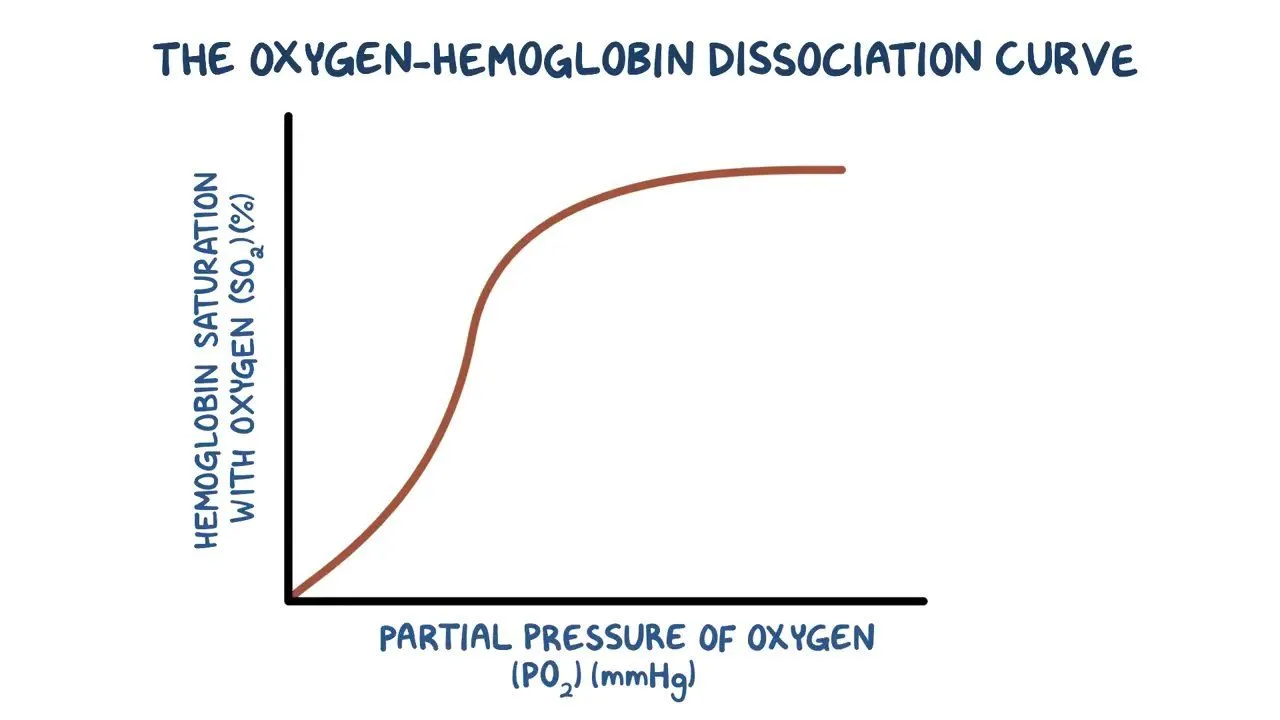
“Sigmoid curve”
when 1 O2 binds to Hb, the other 3 binding sites bind O2 more readily (comformational change)
Where in body is PO2 low? - anywhere in the body
Where in body is PO2 high? - respiratory surface and lungs
General principle: tradeoffs
Between
loading of O2 onto Hb at respiratory surface
unloading of O2 from Hb at systemic tissues
“delivery”
Hb’s affinity for O2 tells us which one is favored
Affinity: the ease with which Hb will bind O2 when it encounters O2
High affinity - readily binds O2, even when there’s not much available - favors loading
Saturated at low PO2
Low affinity - binds O2 less readily, becomes saturated only when there’s a lot of O2 available - favors delivery
saturated at high PO2
P50 is a measure of O2 affinity
P50 is the PO2 at which Hb is 50% saturated with O2
Higher affinity respiratory pigment has a lower P50 value
Myoglobin (Mb)
Single subunit
globin portion (protein)
heme unit (Fe-containing)
very high affinity for O2 (small P50)
only found in muscle cells
skeletal and cardiac muscle
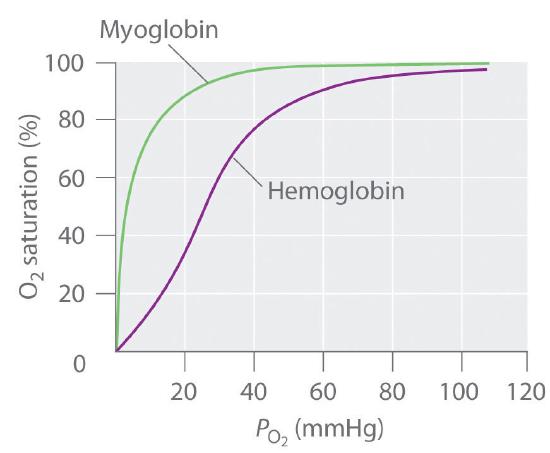
What is the function of myoglobin? - O2 “reserve” storage for muscles - holds onto O2, gives it up only when concentration drops very low
Some icefish also lack myoglobin
Closed systems: hearts
atria (plural)
ventricles
Closed systems: blood vessels
Capillaries - small and extremely thin walled
exchange occurs here
Arteries - very thick walled
Fish hearts: 2 chambers
single ventricle
single atrium
low blood pressure
only pump deoxygenated blood
Heart action:
Cardiac output - volume pumped per unit time
CO = HR x SV
3 questions to consider:
How did icefish lose the ability to produce Hb? DNA → mRNA → protein (Loss of genes themselves)
partial a-globin gene, no B-globin gene
When did loss of Hb genes occur in icefish evolution?
5.5 - 2 million years ago
happened one time in ancestor common to icefish
Synapomorphy = shared derived trait
If not advantageous, why did this condition persist?
cold H2O - higher O2 content
well aerated - higher O2 content
cold H2O lower the metabolic rate of icefish (lower O2 demand)
lack of competition
many species lacked sufficient antifreeze protein production, disappeared when ocean cooled
Hb loss = sublethal trait
only disadvantageous in the context of competition
Compared to red-blooded fishes, icefish have a low thermal tolerance
Can coconut water be used in place of IV fluids?
Body fluid compartments - intracellular fluid and extracellular fluid
Intracellular fluid (ICF) - fluid inside of cells
most of water in body is intracellular fluid
Extracellular fluid (ECF) - fluid outside of cells
Interstitial fluid: between cells
Blood plasma
Transport across membrane - active or passive
Active - uses ATP
Protein mediated
Passive - no ATP required
Protein mediated (facilitated diffusion)
Simple diffusion across membrane
Protein mediated - active or passive
Active
Primary active transport: Na+/K+ ATPas pump
Secondary active transport
Passive
Facilitated diffusion: transporters, channels, aquaporins
Aquaporins - membrane channels that allow water to move through (facilitated diffusion)
Diffusion across a semipermeable membrane establishes equillibrium
ions move along their own gradient with a permeable membrane
Solute - dissolved particles in solution
Water with move from area of lower solute concentration to a higher solute concentration
Osmosis - diffusion of water across a semipermeable membrane
depends on solute concentrations
Fluid outside → higher concentration of solute
water moves OUT
cell shrinks
Fluid outside → lower concentration of solute
water moves IN
cell swells
Fluid outside → equal concentration of solute
no NET movement
no net change
Osmolarity: concentration of solutes in solution - mOsm
Osmolarity vs. molarity
150 mM sucrose = 150 mOsm solute
150 mM NaCl = 300 mOsm NaCl
Hyperosmotic: solution has greater concentration of solutes
Hyposmotic: solution has lower concentration of solutes
Isosmotic: solution has equal concentration of solutes
Oceans: 3.5% NaCl
Freshwater: <0.5% NaCl
Estuaries: Variable NaCl
Osmoregulators vs osmoconformers
Osmoregulators - regulate internal osmolarity within a narrow range, despite difference sin environmental osmolarity
Osmoconformer - internal osmolarity matches environmental osmolarity
Freshwater fish - hyperosmotic regulator
Challenges: H2O gain, salt loss
Solutions: produce lots of dillute urine, active uptake of salts
Saltwater fish - hyposmotic regulator
Challenges: H2O loss, salt gain
Solutions: produce little urine - more concentrated than freshwater fish, active transport of salts out of body
Desication/dehydration - osmoregulator in terrestrial environment
change activity levels (reduce H2O loss via evaporation)
drink H2O (eat food with high H2O content)
metabolish H2O production
produce concentrated urine (mammals, birds, insects)
insects have waxy body coverings (reduce H2O loss from body)
reduce H2O loss in urine