Beta Oxidation of Fatty Acids (Guide)
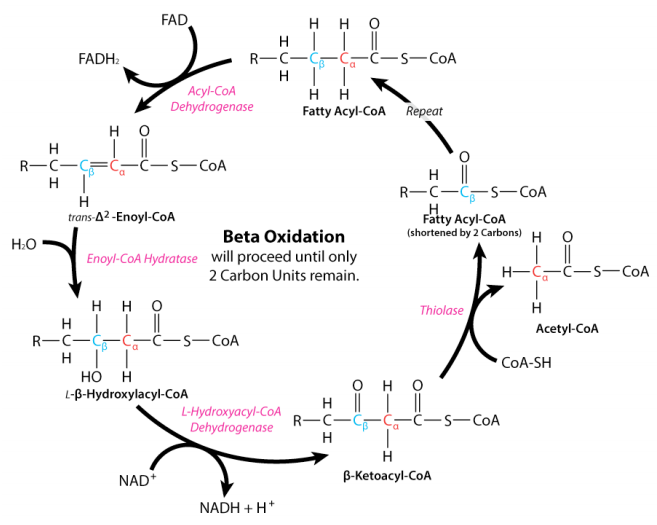
β oxidation is a catabolic process that generates acetyl-CoA and the reduced coenzymes NADH and FADH2
Each cycle involves:
Oxidation
Hydration
Reoxidation
Thiolysis
a) Acyl CoA is oxidized by a dehydrogenase (we remove 2 Hydrogens and add a double bond between the alpha and Beta carbon). Because we oxidized something, we need to reduce something else, right? Correct. FAD is reduced to FADH2.
b) Now we have a double bond in our Acyl-CoA so we need to add an H2O across it with a hydrolase. An OH gets added to the Beta carbon and an H gets added to the alpha carbon.
c) Now we have an Acyl-CoA with an OH group on the B carbon and we want to oxidize it (Beta Oxidation!) by a dehydrogenase to form a carbonyl group. In the process, NAD+ is reduced to NADH.
d) Last step- we cleave two carbons by adding a CoA-SH via thiolase to form your original Acyl-CoA (minus 2 carbons) and an Acetyl CoA.
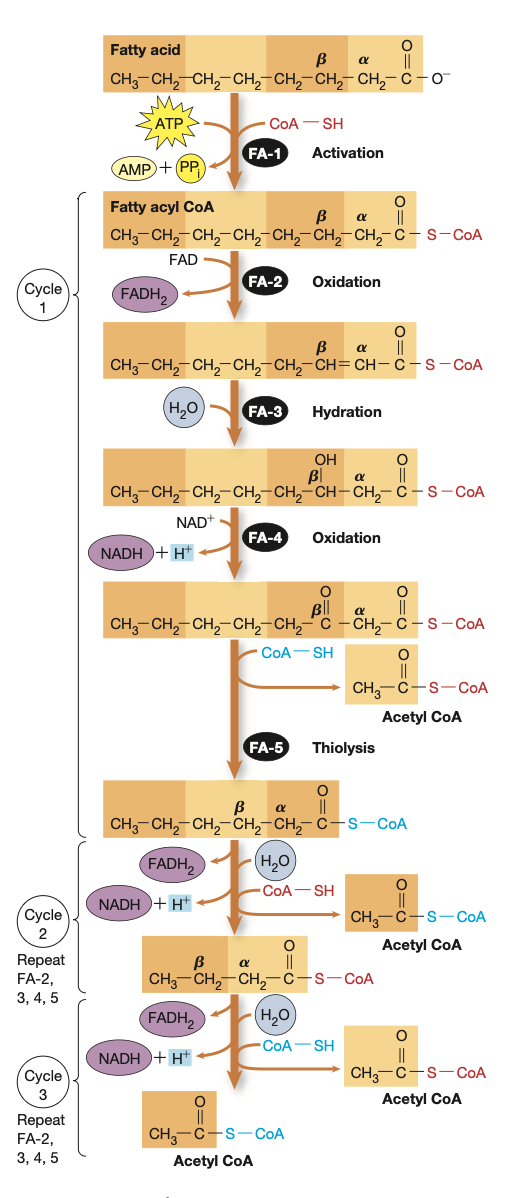
To calculate the total energy produced from Beta Oxidation, use the following equation:
(n-1) * 14 + 10 - 2
where n is the number of carbons on the saturated Fatty Acid divided by 2
This makes sense because each round of oxidation produces 1 Acetyl CoA, 1 NADH, and 1 FADH.
Acetyl CoA makes roughly 10 ATP in CAC,
NADH makes 2.5
FADH makes 1.5
For a total of 14. We subtract 1 from n because the final round of oxidation produces 2 Acetyl CoA but only 1 NADH and 1 FADH since it's the final step. We add 10 for the last Acetyl CoA and subtract 2 from the initial investment we used to activate the free fatty acid in the cytoplasm.
ex. 16-carbon palmitic acid
(16/2 - 1) * 14 + 10 - 2
= 106 ATP