AP Bio: Cellular Respiration
Intro to Metabolism
metabolism: a metabolic pathway involving enzyme-catalyzed steps
catabolism: breaking down substances
anabolism: synthesizing substances
OIL RIG: oxidation is loss, reduction is gain
redox reactions:
reduction-oxidation reactions transfer energy by adding/removing electrons.
C6H12O6 + O2 → CO2 + H2O
glucose: oxidation (glucose loses electrons and H)
O2: reduction (CO2 gains electrons and H)
biological redox reactions: electrons “fall” from molecules containing lots of hydrogen
oxygen is reduced—gain e- and H+—becoming H2O
glucose carbons are oxidized—they lose H and e-
cellular respiration
a process that generates ATP by metabolizing food using O2
turns one glucose molecule → ~36 ATP
equation: C6H12O6 + 6O2 + 6H2O → 6CO2 + 6H2O + energy (ATP)
glucose vs ATP: ATP is important because glucose releases too much energy per molecule. Too much energy all at once causes cellular overheating and results in the loss of excess heat and energy
C-H bonds in glucose hold most of the chemical energy
cellular respiration: glucose oxidizes into CO2
H+ and electrons are carried away by NAD+ and FAD
energy is transferred and held onto by ATP
ATP (adenosine triphosphate)
transfers energy released from exergonic reactions to endergonic reactions
holds onto potential energy
renewable and recyclable
hydrolysis of ATP produces energy
7.3 kcal per mole of ATP
NAD+/NADH
metabolic energy carrier
accepts one H+ and 2e- from C-H bond → transfer that energy during ETC
then transfers it to ADP, then ATP
common oxidizing agent; oxidizing agents get reduced
NAD+ is an “electron bus”
NAD+ + 2e- + H+ → NADH
FAD/FADH2
metabolic energy carrier
accepts 2H+ and 2e- from C-H bond → transfer that energy during ETC
then transfers it to ADP, then ATP
common oxidizing agent; oxidizing agents get reduced
FAD + 2e- + 2H+ → FADH2
GLYCOLYSIS
glucose → 2 pyruvic acid
in: 6-carbon glucose, 2 ADP+2P, 2NAD+
out: 2 3-carbon pyruvic acids, 2ATP, 2NADH & 2H+
location: cytoplasm
no organelles are needed
math:
“energy investment”: 2 ATPs used in 1st steps
“energy payout”: 2 ATPs generated in last steps
net production of 2 ATP
ADPs get re-phosphorylated
glucose → 2 pyruvate + 2 ATP + 2 NADH
history:
no O2 for billions of years…so glycolysis evolved
inputs (glucose/simple sugars) matched to early earth’s conditions
most widespread metabolic pathway today (almost everything undergoes this)
FERMENTATION
the step that follows glycolysis—used to clear up NADH that builds up from glycolysis
cells need a way to regenerate NAD+ (after it’s used up by glycolysis)
otherwise, glycolysis cannot continue and no more ATP can be made
fermentation: a way to regenerate NAD+ from NADH; it strips the electrons from NADH
DOES NOT PRODUCED ATP
alcohol (ethanol) fermentation:
common in fungi, yeast, and some bacteria
used to make bread, wine, beer, hard cider, old soft drinks
equation:
2 pyruvate (3C) → 2 acetaldehyde (2C) + 2 CO2 (1C)
2 acetaldehyde (2C) + 2 NADH → 2 ethanol (2C) + 2 NAD+
input: 2 pyruvate
output: 2 CO2, 2 ethanol, 2 NAD+
NAD+ is the end product goal; the thing that we mainly want from this reaction
diagram:

lactic acid fermentation:
common in bacteria, animals
used to make cheese, vinegar, sauerkraut, kimchi, pickles, sour cream, yogurt, etc.
acidity curdles milk and crates a sour taste. the high acid content limits enzymes in the pathway.
strenuous exercise → anaerobic muscle cell response
lactic acid builds up in muscle cells, causing fatigue (and then pain)
lactic acid is eventually moved from muscle cells → bloodstream → liver
liver cells connect lactic acid back to pyruvate, and then breaks it down aerobically
equation:
2 pyruvate (3C) + 2 NADH → 2 lactate (3C) + 2 NAD+
no intermediate reaction; pyruvate accepts electrons from NADH
KREBS TRANSITION AND KREBS CYCLE
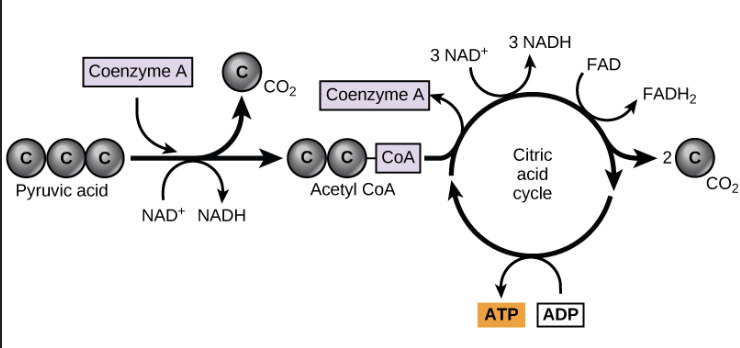
krebs transition:
moves 2 pyruvate made from glycolysis in the cytoplasm into the matrix
enters 2 acetyl-coA into the Krebs cycle
equation: 2 pyruvate → 2 Acetyl-coA + 2CO2 + 2NADH
krebs cycle:
extracts energy from Acetyl-coA
carbons are given off as CO2
makes ATP
energy stored in NAD+ and FA
it takes 2 krebs cycles to metabolize one glucose molecule (2 pyruvate)
yield per cycle: 3 NADH, 1 FADH, 1 ATP
total yield: 6 NADH, 2 FADH, 2 ATP
steps:
acetyl-coA binds to oxaloacetate → citrate
7 more steps to remove 2 carbons from acetyl-coA and generate oxaloacetate
byproducts: 6NADH, 2FADH2, 4CO2, 2ATP
diagram:
ELECTRON TRANSPORT CHAIN (ETC)
electron transport chain: a series of protein complexes and other molecules that transfer electrons and create an electrochemical gradient
after krebs cycle:
__NADH (2e, one H+ each) and __FADH2 (2e, 2H+ each) carry over their cargo to the ETC
this remaining energy in NADH and FADH2 is used to convert ADP → ATP
yield: 3 ATP per NADH, and 2 ATP per FADH2
FADH yields less because it is more electronegative and holds onto its electrons longer during the ETC
process:
ETC uses proteins in the inner mitochondrial membrane
NADH and FADH are oxidized (lose electrons) and give electrons to these proteins
passing electrons down the ETC pumps H+ ions into intermembrane space
the proton gradient provides the energy to convert ADP → ATP (chemiosmosis)
final electron acceptor: oxygen
this is the main reason for why we breathe!!
oxygen accepts the electrons from the integral proteins, freeing them up to keep cycling more electrons through
oxygen accepts the electrons and protons and use them to form water
without oxygen, the ETC can’t continue because their hands are full with electrons that they can’t let go of
H+ ions in intermembrane space flow back into the matrix through ATP synthase, which has a rotor mechanism that connects ADP back to P, creating ATP
ATP Synthase:
a channel protein for H+ ions to pass through.
the movement of H+ through the protein makes the rotor spin and phosphorylate ADP (creating ATP)
this is an ancient molecule that’s also used in photosynthesis
chemiosmosis: movement of H+ ions through ATP synthase
H+ gradient is established by the ETC
H+ easily flows back into the matrix through ATP Synthase (facilitated diffusion)
yield:
input:
10 NADH (2 from glycolysis, 2 from 2 krebs transitions, 6 from 2 krebs cycles)
2 FADH2 (2 from 2 krebs cycles)
output:
max 38 ATP
3 × (10 NADH)
yield 3 ATP per NADH
2 × (2 FADH2)
yield 2 ATP per FADH2
2 ATP from glycolysis
2 ATP from krebs cycle
EVEN MORE NOTES ON THIS:
C6H12O6 + 6O2 → 6CO2 + 6H2O + ATP
You can break cellular respiration down into two different approaches:
aerobic respiration and anaerobic respiration.
If ATP is made in the presence of oxygen, we call it aerobic respiration. If oxygen
If it isn’t present, we call it anaerobic respiration.
Introduction to Aerobic Respiration
Aerobic respiration consists of four stages containing a series of coupled reactions that establish an electrochemical gradient across membranes:
glycolysis
formation of acetyl-CoA
the Krebs (citric acid) cycle
oxidative phosphorylation (the electron transport chain + chemiosmosis)
Stage 1: Glycolysis
The first stage begins with glycolysis, the splitting of glucose
Glucose is a six-carbon molecule that is broken into two three- carbon molecules called pyruvic acid.
This breakdown of glucose also results in the net production of two molecules of ATP and two molecules of NADH.
Glucose + 2 ATP + 2NAD+ → 2 Pyruvic acid + 4 ATP + 2NADH
Glycolysis also creates two NADH, which result from the transfer of electrons to the carrier NAD+, which then becomes NADH.
NAD+ and NADH are constantly being turned into each other as electrons are being carried and then unloaded.
There are four important tidbits to remember regarding glycolysis:
occurs in the cytoplasm
net of 2 ATPs produced
2 pyruvic acids formed
2 NADH produced
Stage 2: Formation of Acetyl-CoA
Pyruvic acid is transported to the mitochondrion.
Each pyruvic acid (a three-carbon molecule) is converted to acetyl-coenzyme
A (a two-carbon molecule, usually just called acetyl-CoA) and CO2 is released.
2 Pyruvic acid + 2 Coenzyme A + 2NAD+ → 2 Acetyl-CoA + 2CO2 + 2NADH
From two 3- carbon molecules to now two 2-carbon molecules.
The extra carbons leave the cell in the form of CO2. Once again, two molecules of NADH are also produced for each glucose you started with.
This process of turning pyruvic acid into acetyl-CoA is catalyzed by an enzyme complex called the pyruvate dehydrogenase complex (PDC).
Stage 3: The Krebs Cycle
Also known as the citric acid cycle.
The Krebs cycle begins with each molecule of acetyl-CoA produced from the second stage of aerobic respiration combining with oxaloacetate, a four-carbon molecule, to form a six-carbon molecule, citric acid or citrate.
In the mitochondria, pyruvate is turned into acetyl- CoA and 1 NADH is made; double this if you are counting per glucose.
The Krebs cycle occurs in the mitochondrial matrix.
It begins with acetyl-CoA joining with oxaloacetate to make citric acid and ends with oxaloacetate, 1 ATP, 3 NADH, and 1 FADH2; double this if you are counting per glucose.
Citrate gets turned into several other things, and because the cycle begins with a four-carbon molecule, oxaloacetate, it eventually gets turned back into oxaloacetate to maintain the cycle by joining with the next acetyl-CoA coming down the pipeline.
With each turn of the cycle, three types of energy are produced:
1 ATP
3 NADH
1 FADH2
To figure out the total number of products per molecule of glucose, we simply double the number of products.
Stage 4: Oxidative Phosphorylation
Electron Transport Chain
As electrons are removed from a molecule of glucose, they carry much energy that was originally stored in their chemical bonds.
These electrons are transferred to readied hydrogen carrier molecules.
In the case of cellular respiration, these charged carriers are the coenzymes NADH and FADH2.
We now have:
2 NADH molecules from glycolysis
2 NADH from the production of acetyl-CoA
6 NADH from the Krebs cycle
2 FADH2 from the Krebs cycle
That gives us a total of 12 electron or energy carriers altogether.
These electron carriers—NADH and FADH2—“shuttle” electrons to the electron transport chain, the resulting NAD+ and FADH can be recycled to be used as carriers again, and the hydrogen atoms are split into hydrogen ions and electrons.
The high-energy electrons from NADH and FADH2 are passed down a series of protein carrier molecules that are embedded in the cristae; thus, it is called the electron transport chain.
Some of the carrier molecules in the electron transport chain are NADH dehydrogenase and cytochrome C.
Each carrier molecule hands down the electrons to the next molecule in the chain.
The electrons travel down the electron transport chain until they reach the final electron acceptor, oxygen. Oxygen combines with these electrons (and some hydrogens) to form water.
This explains the “aerobic” in aerobic respiration. If oxygen weren’t available to accept the electrons, they wouldn’t move down the chain at all, thereby shutting down the whole process of electron transport.
Chemiosmosis
The energy released from the electron transport chain is used to pump hydrogen ions across the inner mitochondrial membrane from the matrix into the inter-membrane space.
The pumping of hydrogen ions into the inter-membrane space creates a pH gradient, or proton gradient.
The hydrogen ions really want to diffuse back into the matrix. The potential energy established in this gradient is responsible for the production of ATP.
This pumping of ions and diffusion of ions to create ATP is chemiosmosis
Overall, this process is called oxidative phosphorylation because when electrons are given up it is called “oxidation” and then ADP is “phosphorylated” to make ATP.
You’re also expected to know the following two things for the AP Biology Exam:
Every NADH from glycolysis yields 1.5 ATP and all other NADH molecules yield 2.5 ATP.
Every FADH2 yields 1.5 ATP.
You will also want to make sure you remember the major steps of cell respiration, and the outcome of each steM
Photosynthesis vs. Cell Respiration
In both cases, ATP production is driven by a proton gradient, and the proton gradient is created by an electron transport chain.
In respiration, protons are pumped from the mitochondrial matrix to the intermembrane space, and they return to the matrix through an ATP synthase down their concentration gradient.
In photosynthesis, protons are pumped from the stroma into the thylakoids compartment, and they return to the stroma through an ATP synthase down their concentration gradient.
The Krebs cycle seeks to oxidize carbohydrates to CO2, while the Calvin cycle seeks to reduce CO2 to carbohydrates.
Anaerobic Respiration
When oxygen is not available, the anaerobic version of respiration occurs.
The electron transport chain stops working, and electron carriers have nowhere to drop their electrons.
The mitochondrial production of acetyl- CoA and the Krebs cycle cease too.
Glycolysis, however, can continue to run. This means that glucose can be broken down to give net two ATP. Only two instead of 30!
Glycolysis also gives two pyruvates and two NADH. The pyruvate and NADH make a deal with each other, and pyruvate helps NADH get recycled back into NAD+ and takes its electrons.
The pyruvate turns into either lactic acid (in muscles) or ethanol (in yeast).
Since these two things are toxic at high concentrations, this process, called fermentation, is done only in emergencies. Aerobic respiration is a better option
What types of organisms undergo fermentation?
Yeast cells and some bacteria make ethanol and carbon dioxide. Other bacteria produce lactic acid.
Your Muscle Cells Can Ferment
A cramp was possibly the consequence of anaerobic respiration.
When you exercise, your muscles require a lot of energy.
To get this energy, they convert enormous amounts of glucose to ATP.
As you continue to exercise, your body doesn’t get enough oxygen to keep up with the demand in your muscles. This creates an oxygen debt.
Muscles switch over to anaerobic respiration.
Pyruvic acid produced from glycolysis is converted to lactic acid.