Meiosis and Genetic Inheritance
Meiosis 🔄
Meiosis is a type of cell division that reduces the chromosome number by half, resulting in the production of gametes (sperm or egg cells).
Cells stop after Meiosis II = like a clock than a cycle
Meiosis I
Meiosis I is the first round of cell division in meiosis. It consists of the following stages:
Prophase I: The longest phase of meiosis, during which homologous chromosomes pair up and exchange genetic material through a process called crossing over.
Metaphase I: The paired chromosomes line up at the center of the cell.
Anaphase I: The paired chromosomes separate, and the homologous chromosomes move to opposite poles of the cell.
Telophase I: The chromosomes uncoil, and the nuclear envelope reforms.
Meiosis II
Meiosis II is the second round of cell division in meiosis. It consists of the following stages:
Prophase II: The chromosomes condense again, and the nuclear envelope breaks down.
Metaphase II: The chromosomes line up at the center of the cell.
Anaphase II: The sister chromatids separate, and the chromosomes move to opposite poles of the cell.
Telophase II: The chromosomes uncoil, and the nuclear envelope reforms.
Nondisjunction 🚨
Nondisjunction is the failure of homologous chromosomes to separate properly during meiosis, resulting in abnormal gametes.
Anaphase I failure: 4 abnormal gametes
Anaphase II failure: 2 abnormal gametes
Basic Genetics Definitions 📚
Gene: A piece of DNA that codes for a product, including regulatory elements.
Allele: A version of a gene.
Trait: A physical characteristic determined by a gene.
Polymorphic: A trait that comes in several forms.
Polygenic: A trait determined by several genes.
Classical Dominance 👑
"Classical dominance is a type of inheritance where one allele is completely dominant over another allele."
Homozygous dominant: An individual with two copies of the dominant allele.
Homozygous recessive: An individual with two copies of the recessive allele.
Heterozygous: An individual with one copy of each allele.
Incomplete Dominance 🤝
"Incomplete dominance is a type of inheritance where the heterozygous offspring display a blended version of the parental phenotype."
Example: Red flowers (RR) and white flowers (rr) produce pink flowers (Rr).
Codominance 🤝
"Codominance is a type of inheritance where both alleles are expressed independently, at the same time."
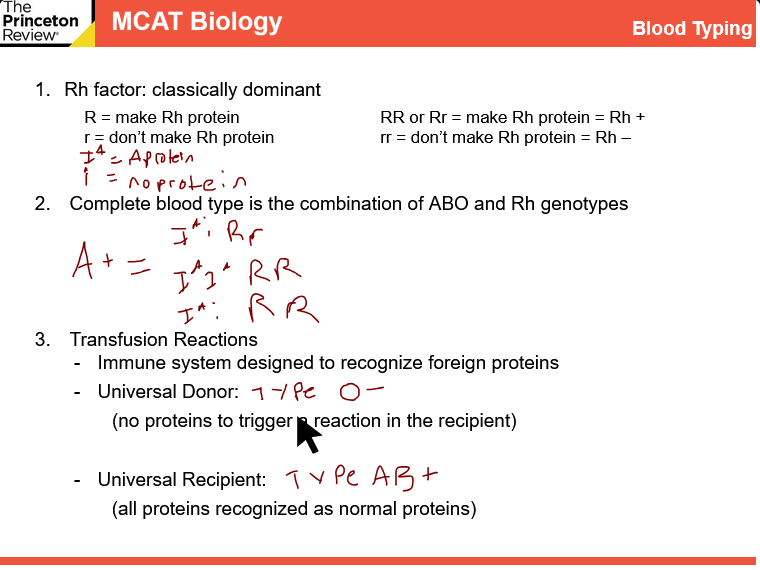
Example: Human ABO blood group gene.
GenotypePhenotype | |
IAIA | A |
IAi | A |
IBIB | B |
IBi | B |
IAIB | AB |
Epistasis 🤝
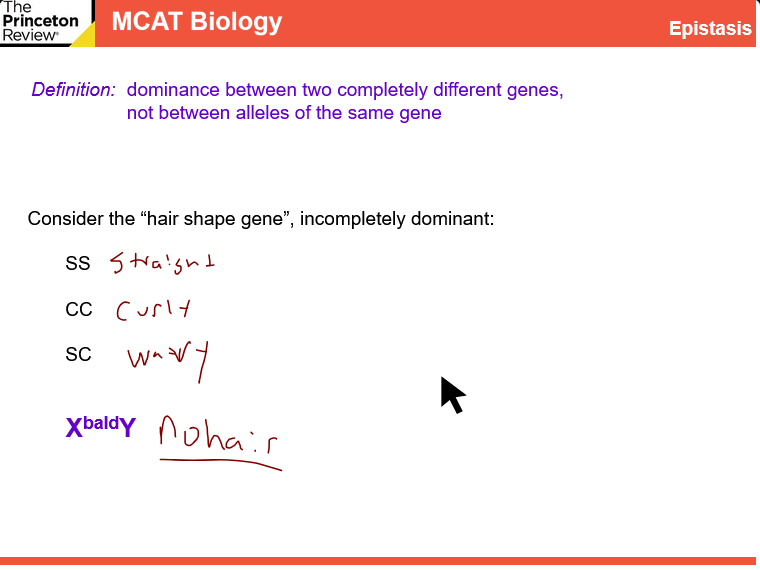
"Epistasis is a type of inheritance where one gene affects the expression of another gene."
Example: Hair shape gene and baldness gene.
Testcross 🧬
"A testcross is a cross between an unknown dominant and a homozygous recessive individual."
Example: Long-tailed mouse (unknown genotype) x short-tailed mouse (rr).
Mendel's Laws 📜
Law of Segregation: Alleles are separated during gamete formation.
Law of Independent Assortment: How one pair of alleles separates is independent of how other pairs separate.
Rules of Probability 📊
Rule of Multiplication: The probability of two events occurring together is the product of their individual probabilities.
Rule of Addition: The probability of two events occurring is the sum of their individual probabilities, minus the probability of both events occurring together.
Sample Problem 🤔
Jane has brown hair and brown eyes and is heterozygous at both locations (blond hair is recessive). Jane married Bob, who has blue eyes and who is heterozygous for hair color. What is the probability they will have a son who has brown eyes and brown hair, and who is capable of fathering blue-eyed children?
JaneBob | ||
Hair | Bb | Bb |
Eyes | Bb | bb |
Son | |
Hair | Bb |
Eyes | Bb |
Probability: 1/4## Linked Genes 🧬
Definition: Genes found close together on the same chromosome that might not sort independently (aka randomly).
Linked genes are genes that are physically close to each other on the same chromosome. Because of their proximity, they tend to be inherited together, rather than independently.
Linked Genes Sample Problem
GenerationGenotypePhenotype | ||
Grandpa Joe | ||
Grandma Jane | ||
F1 | ||
F2 |
Recombination Frequency 🔄
Recombination Frequency (RF) =
Recombination FrequencyMeaning | |
0% | Genes are completely linked |
50% | Genes are completely unlinked |
0-50% | Genes are partially linked |
Hardy-Weinberg Equilibrium 📊
Definition: Allele frequencies within a population do not change from generation to generation.
The Equations and How to Apply Them
Assuming classical dominance with only two alleles, one dominant and one recessive:
p + q = 1 (allele frequency)
pp + 2pq + qq = 1 (genotype frequency)
The 5 Conditions for which the Equations Hold True
a. No mutations
b. No natural selection
c. Random mating
d. Large population
e. No migration
How Long to Reach a New Equilibrium if the Old One is Disturbed
One generation!
Miscellaneous Stuff 🤔
Evolution by Natural Selection
Types of Selection
Speciation and Barriers to Speciation
Taxonomic Characteristics
Anatomical Terminology