(Module 48) The Internal Structure of Cities
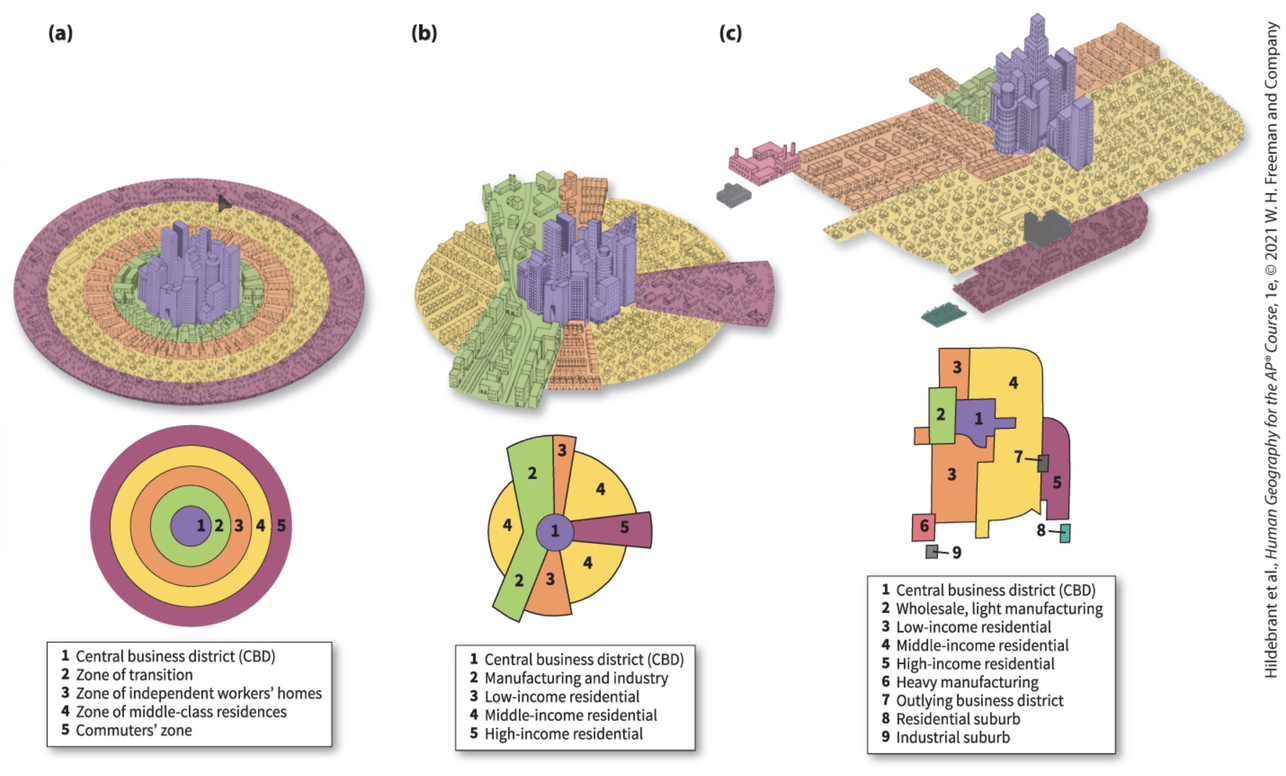
Concentric Zone Model:
Developed by EW Burgress.
Organized in 5 Rings that show different residential zones from the CBD.
Rings of the Concentric Zone Model:
Businesses in the CBD.
Zone of Transition: landlords allowing homes to deteriorate while anticipating expansion of CBD.
Better neighborhoods of working class.
Middle class families in the suburbs.
Commuter’s Zone.
At the time of development, there was little public transportation from the outer zone, most transport used to be via private car. Wealthy landowners used to live in Zone 5 but now Low Income and ‘Shanty Towns’ make up that area.
Limitations:
Assumes there are no topographical barriers.
Fails to account for complexity of modern cities and non-American city layouts.
Hoyt/Sector Model:
Developed by Homer Hoyt.
Focuses on transportation and communication as the drivers of the city’s layout.
Parts of the Hoyt Model:
CBD.
Light and manufacturing industry; close to railroads.
Low-income housing between manufacturing.
Middle-income housing.
Wealthy housing.
Hoyt vs. Concentric Zone Model:
Both models are marked by outward growth.
Higher income moves outwards, lower income moves to newly vacated areas (primarily seen in the concentric zone model).
Wealthy moves into cleaners, newer suburbs; Lower-income move into older, vacated housing closer to CBD.
Both models show expansion outward from the CBD.
Multiple Nuclei Model:
Developed by Chauncy Harris and Edward Ullman.
Residential districts are organized around many nodes rather than a singular CBD.
Combines ideas of Concentric and Hoyt model but around many nodes.
Each node has separate functions and developed independently due to ease of transportation.
Galactic Peripheral Model:
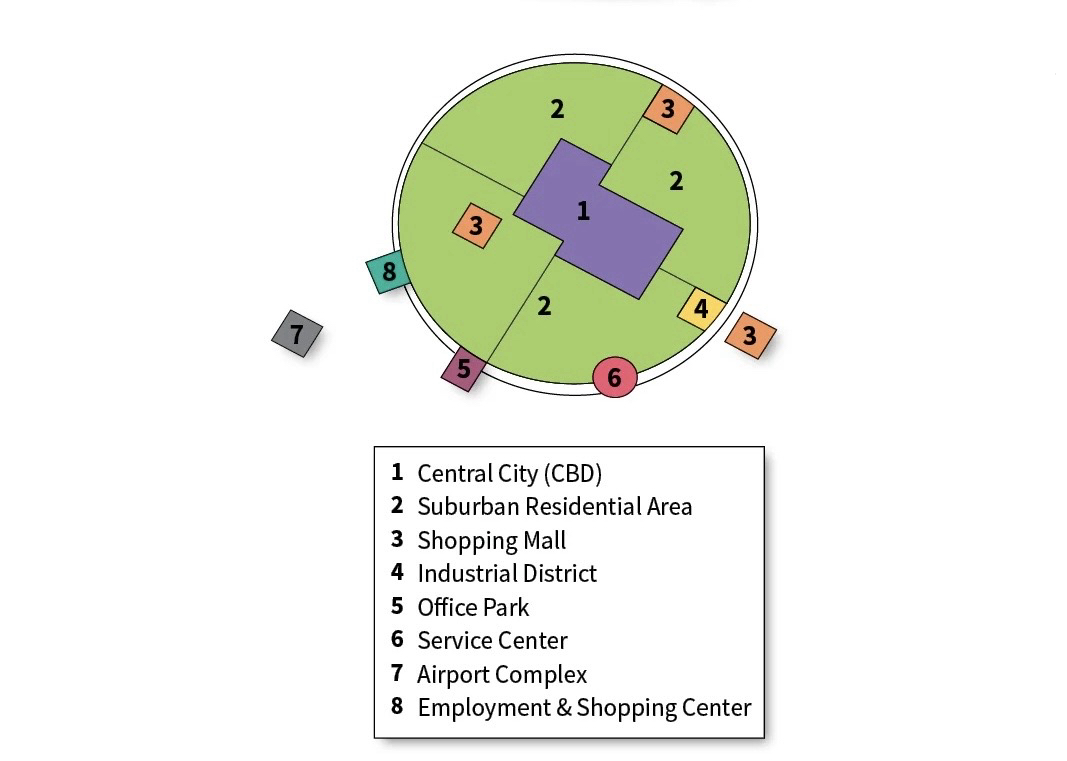
The CBD remains central but surrounded by suburbs with office parks and industries scattered by metro expressway systems.
1960s less centralized system.
CBD surrounded by urban sprawl.
Bid-Rent Theory:
High-cost residences at both near CBD and at edges.
Near the CBD; people pay high prices for short commute times, access to jobs, culture services.
Near the edges; people pay high prices for large homes/land, better privacy, better environment, schools.
Gentrification: Displacement of lower income residents by higher income residents as an area/neighborhood improves.
Ex: Low-income families forces out of government/affordable housing due to development of ‘better’ neighborhoods.
Often decreases amount of affordable housing.
Griffin Ford Model:
Latin America
Concentric and Radial Zones
2 Part CBD:
Markets & everyday goods.
Entertainment, Business, Venues.
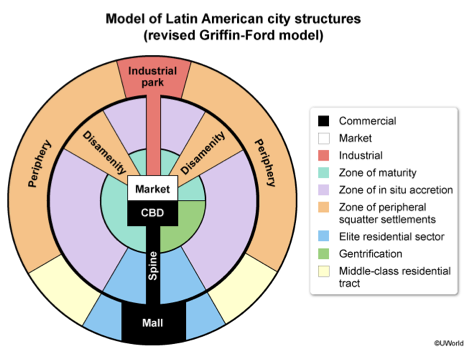
Disamenity Sector: Area where extremely low-income people live.
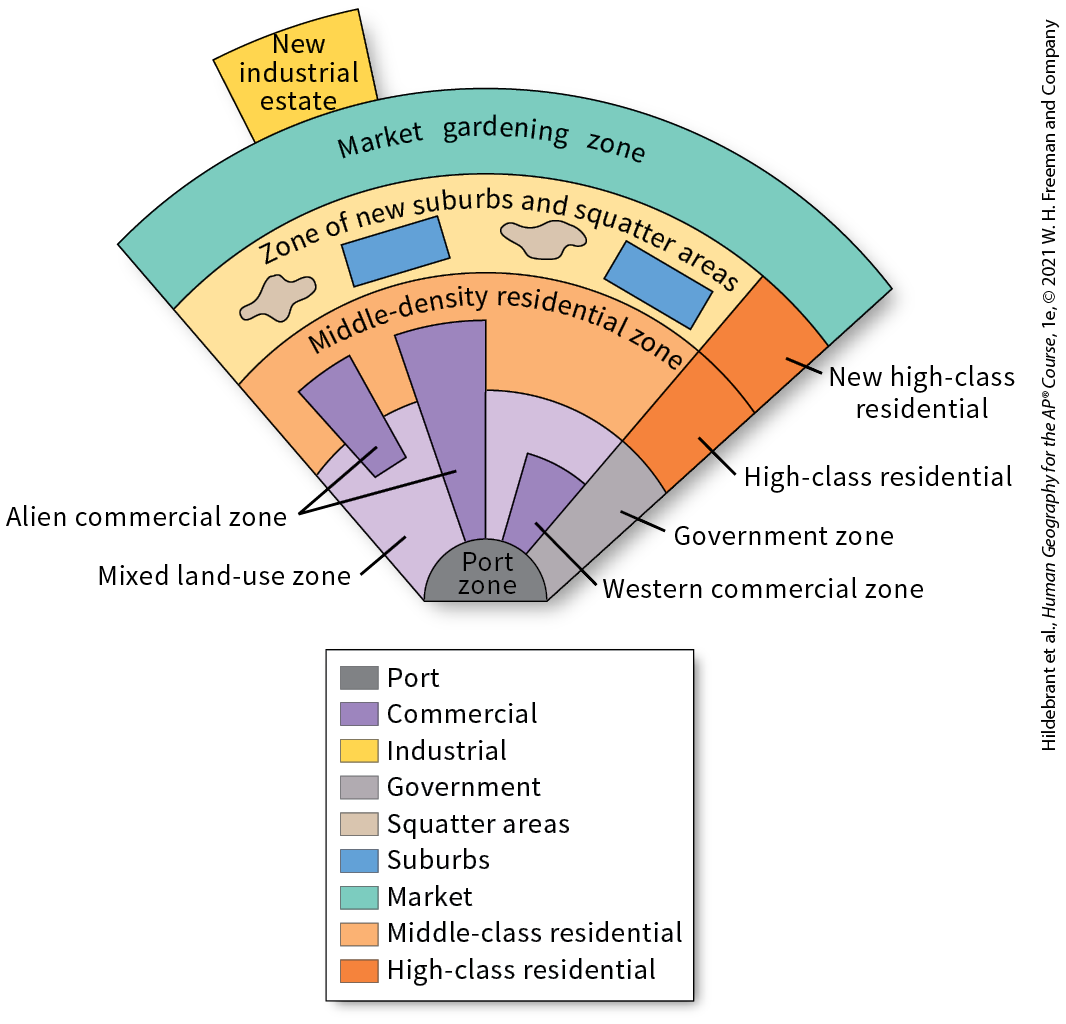
Southeast Asian City Model:
Around a port instead of CBD.
Commercial zones surrounding.
Mixed-use land; many economic activities and residential housing.
Sub-Saharan Model:
3 CBDs:
Traditional CBD: Zone of Traditional 1 Story Buildings.
Colonial CBD: Informal markets where commerce is conducted.
Mixed Neighborhoods:
Mining/Commercial Zones.
Shanty Towns due to unchecked in-migration.