Connective Tissue Notes
Connective Tissue 1 – Tissue Characteristics
Embryonic Origins of Connective Tissue
Connective tissue (CT) is derived from the mesoderm.
Ectoderm develops into the epidermis (epithelium) of the skin and nervous tissue (i.e., the nervous system).
Mesoderm forms muscle, connective tissue, and the epithelium of reproductive, cardiovascular, and renal systems.
Endoderm forms the epithelial lining of the GI and respiratory systems.
The first connective tissue formed is mesenchyme, which contains: Primitive mesenchyme cells, abundant amorphous ground substance (AGS), and few fibers (mainly reticular fibers).
Primitive mesenchyme cells give rise to CT cells and stem blood cells.
Components of Connective Tissue
Connective tissue has three main components:
Cells: Few cells are present.
Fibers: Much intercellular material in the form of fibers (collagen, elastic, and reticular fibers).
Amorphous Ground Substance (AGS): Also known as the matrix.
Different types of CT are formed by differences in:
Types of cells
Types of fibers
Ratio of fibers: cells & AGS
Cells
Structural Cells:
Synthesize (e.g., fibroblasts)
Store (e.g., adipocytes)
Immature cells: Known as “blasts” are builders that synthesize and secrete the extracellular matrix (ECM) and divide and differentiate into mature cells.
Mature cells: Known as “cytes” are caretaker cells that maintain and monitor the quality of the ECM.
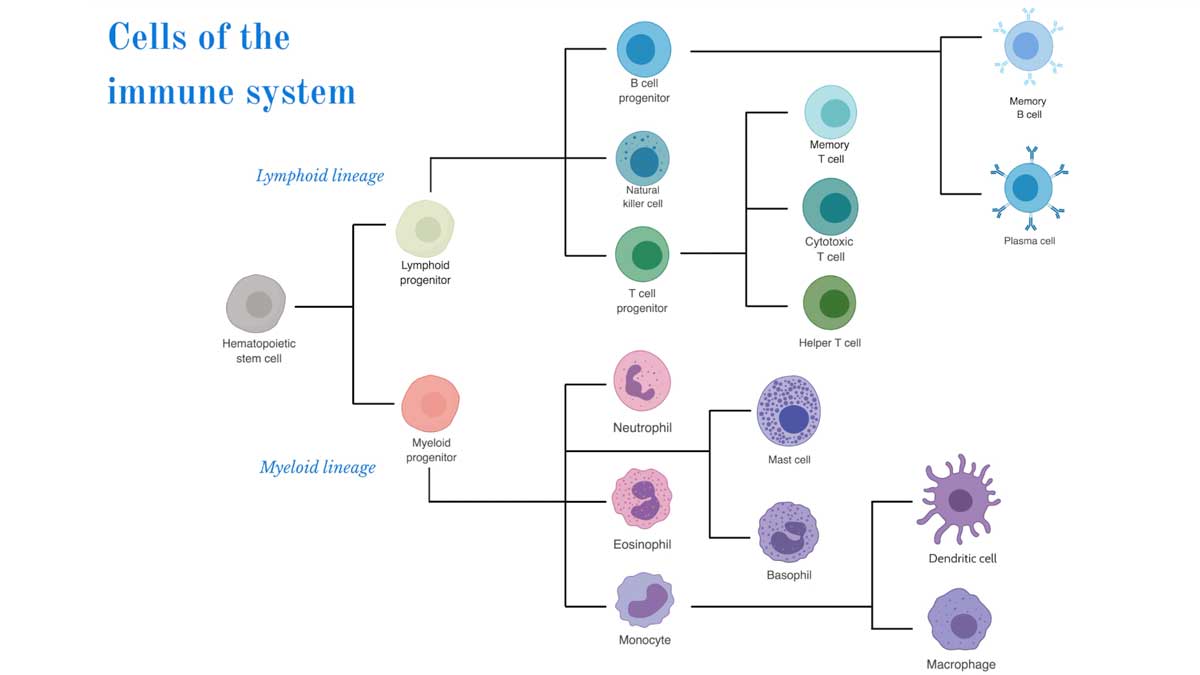
Defense Cells: Protect the body against invasion. Main types seen are macrophages, mast cells, plasma cells, and WBCs (lymphocytes, neutrophils, and eosinophils).
Amorphous Ground Substance (AGS)/Matrix
Located between cells & fibers.
Functions to provide a medium for substance exchange.
Variations in AGS/Matrix:
Fluid (Blood)
Semifluid (Cartilage)
Gelatinous (most loose & dense CTs)
Hard (Bone)
Secures CT cells & fibers within the ECM.
Fibers
Three main fiber types:
Collagen: Provides strength.
Reticular fibers: Provide a net-like framework.
Elastic fibers: Provide strength & elasticity.
Functions of Connective Tissue Components
Connects & binds tissues & organs & transmits forces – fibers (collagen).
Gives support, shape & flexibility - fibers (collagen, reticular & elastic fibers).
Provides mechanical protection – fibers (collagen).
Stores energy & acts as insulation – cells (adipocytes).
Transports nutrients/ waste products between blood & epithelium etc. - AGS.
Protects body from infections – involved in inflammation, immunity, healing – cells (macrophages, leukocytes, plasma cells, mast cells).
Basis for Classification of Connective Tissues
Proportions of cells to fibers to AGS
If the proportion of cells + AGS/matrix > the proportion of fibers, the CT is a loose CT.
If the proportion of cells + AGS/matrix < the proportion of fibers, the CT is a dense CT.
Organization/orientation of fibers
Dense Regular – fibers run parallel.
Dense Irregular – fibers run in all directions.

Functions of Connective Tissue Types
Functions are related to the components that are present in the greatest quantity.
Connects & binds other tissue types & organs - dense irregular CT.
Transmits force or provides strength in a single direction - dense regular CT, e.g., tendons, ligaments.
Gives support & shape - dense irregular CT or special CT, e.g., cartilage, bone.
Provides mechanical protection – dense irregular CT.
Stores energy & acts as insulation – loose CT.
Transports nutrients/ waste products between blood & epithelium etc. – loose CT.
Protects body from infections – involved in inflammation, immunity, healing – loose CT.
Embryonic Origins of Connective Tissue
Connective tissue (CT) is derived from the mesoderm.
Ectoderm develops into the epidermis (epithelium) of the skin and nervous tissue (i.e., the nervous system).
Mesoderm forms muscle, connective tissue, and the epithelium of reproductive, cardiovascular, and renal systems.
Endoderm forms the epithelial lining of the GI and respiratory systems.
The first connective tissue formed is mesenchyme, which contains: Primitive mesenchyme cells, abundant amorphous ground substance (AGS), and few fibers (mainly reticular fibers).
Primitive mesenchyme cells give rise to CT cells and stem blood cells.
Components of Connective Tissue
Connective tissue has three main components:
Cells: Few cells are present.
Fibers: Much intercellular material in the form of fibers (collagen, elastic, and reticular fibers).
Amorphous Ground Substance (AGS): Also known as the matrix.
Cells
Structural Cells:- Synthesize (e.g., fibroblasts)
Store (e.g., adipocytes)
Immature cells: Known as “blasts” are builders that synthesize and secrete the extracellular matrix (ECM) and divide and differentiate into mature cells.
Mature cells: Known as “cytes” are caretaker cells that maintain and monitor the quality of the ECM.
Defense Cells: Protect the body against invasion. Main types seen are macrophages, mast cells, plasma cells, and WBCs (lymphocytes, neutrophils, and eosinophils).
Amorphous Ground Substance (AGS)/Matrix
Located between cells & fibers.
Functions to provide a medium for substance exchange.
Variations in AGS/Matrix:-
Fluid (Blood)
Semifluid (Cartilage)
Gelatinous (most loose & dense CTs)
Hard (Bone)
Secures CT cells & fibers within the ECM.
Fibers
Three main fiber types:
Collagen: Provides strength.
Reticular fibers: Provide a net-like framework.
Elastic fibers: Provide strength & elasticity.
Functions of Connective Tissue Components
Connects & binds tissues & organs & transmits forces – fibers (collagen).
Gives support, shape & flexibility - fibers (collagen, reticular & elastic fibers).
Provides mechanical protection – fibers (collagen).
Stores energy & acts as insulation – cells (adipocytes).
Transports nutrients/ waste products between blood & epithelium etc. - AGS.
Protects body from infections – involved in inflammation, immunity, healing – cells (macrophages, leukocytes, plasma cells, mast cells).
Basis for Classification of Connective Tissues
Proportions of cells to fibers to AGS
If the proportion of cells + AGS/matrix > the proportion of fibers, the CT is a loose CT.
If the proportion of cells + AGS/matrix < the proportion of fibers, the CT is a dense CT.
Organization/orientation of fibers
Dense Regular – fibers run parallel.
Dense Irregular – fibers run in all directions.
Functions of Connective Tissue Types
Functions are related to the components that are present in the greatest quantity.
Connects & binds other tissue types & organs - dense irregular CT.
Transmits force or provides strength in a single direction - dense regular CT, e.g., tendons, ligaments.
Gives support & shape - dense irregular CT or special CT, e.g., cartilage, bone.
Provides mechanical protection – dense irregular CT.
Stores energy & acts as insulation – loose CT.
Transports nutrients/ waste products between blood & epithelium etc. – loose CT.
Protects body from infections – involved in inflammation, immunity, healing – loose CT.