Organic Chemistry - notes
Fractional Distillation
- Feed oil into a chamber and heat at high temperatures until it evaporates to form a gas.
- Pass this gaseous into a fractioning column which has a temperature gradient - hot at the bottom and cooler as you go up.
- Once the gaseous mixture has entered the fractioning column, it will start to rise (heat rises).
- The longer chain hydrocarbons will rise up the fractioning column quickly and condense into liquid in the cooler regions and exit the column quickly. This is because they have a higher boiling point meaning the temperature is no longer high enough to maintain their gaseous state.
- The shorter chain hydrocarbons will stay as a gas for much longer as they have a lower boiling point, meaning even as they reach the cooler regions their boiling points are low enough to maintain their gaseous state. However, when they reach a cold enough temperature they will eventually condense to form liquids and exit the column.
- These different hydrocarbons are then collected for further use e.g., long chain hydrocarbons are used to make bitumen and heavy fuel oils, and short chain hydrocarbons are used to make petrol, diesel and kerosene.
- Some short chain hydrocarbons have such low boiling points that they never condense and remain in their gaseous state for example LPG gas which is made of mostly butane and propane.
- Your shorter chain hydrocarbons at the top of the column will produce the best fuels as they are the most flammable, however the longer chain hydrocarbons at the bottom will no be extremely useful so they are either used for something else or broken down into smaller chain hydrocarbons by cracking.
Catalytic Cracking
- Heat long chain hydrocarbons and vaporise them (turn them into gas).
- Prepare hot catalytic aluminium oxide powder as our catalyst.
- Pass vapour over aluminium oxide powder and they hydrocarbon should break into - forming two shorter chain hydrocarbons.
Steam Cracking
- Heat long chain hydrocarbons and vaporise them (turn them into gas)
- Mix the vapour with steam and heat them at very high temperatures.
- This will cause the long hydrocarbons to split in two, leaving you with two shorter chain hydrocarbons.
Addition Polymers
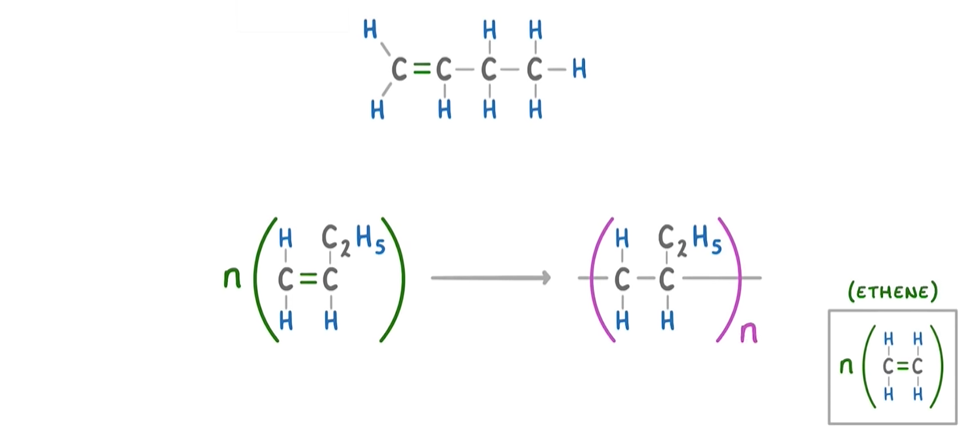
- To name polymer you place “poly” in front of the name.
- E.g., the example above is called poly(butene)