Leadership and Management Nursing
Definition of Leadership
Leadership is the process by which an individual influences others to achieve common goals. It involves guiding, directing, and motivating others to complete tasks and fulfill objectives, often within an organizational context.
Characteristics of Leaders
Visionary Thinking: Leaders have a clear vision of the future and are able to communicate this vision to others.
Integrity: They demonstrate honesty, ethical behavior, and trustworthiness.
Empathy: Leaders understand and share the feelings of others, fostering strong relationships.
Decisiveness: Effective leaders make timely decisions, even in uncertain conditions.
Resilience: They remain steadfast and adaptive in the face of challenges and setbacks.
Inspirational Motivation: Leaders inspire and motivate others through their passion and commitment.
Communication Skills: They communicate effectively, ensuring that team members understand goals, expectations, and feedback.
Leadership Skills
Emotional Intelligence: The ability to recognize, understand, and manage one's own emotions and the emotions of others.
Conflict Resolution: Skillfully managing and resolving conflicts to maintain a productive work environment.
Strategic Thinking: The ability to plan for the future, set goals, and identify the steps needed to achieve them.
Team Building: Creating and maintaining cohesive teams that work well together.
Delegation: The ability to assign tasks to others based on their skills and expertise, empowering them to take ownership.
Time Management: Effectively prioritizing and managing time to meet deadlines and achieve goals.
Leadership Theories
i. Trait Theories
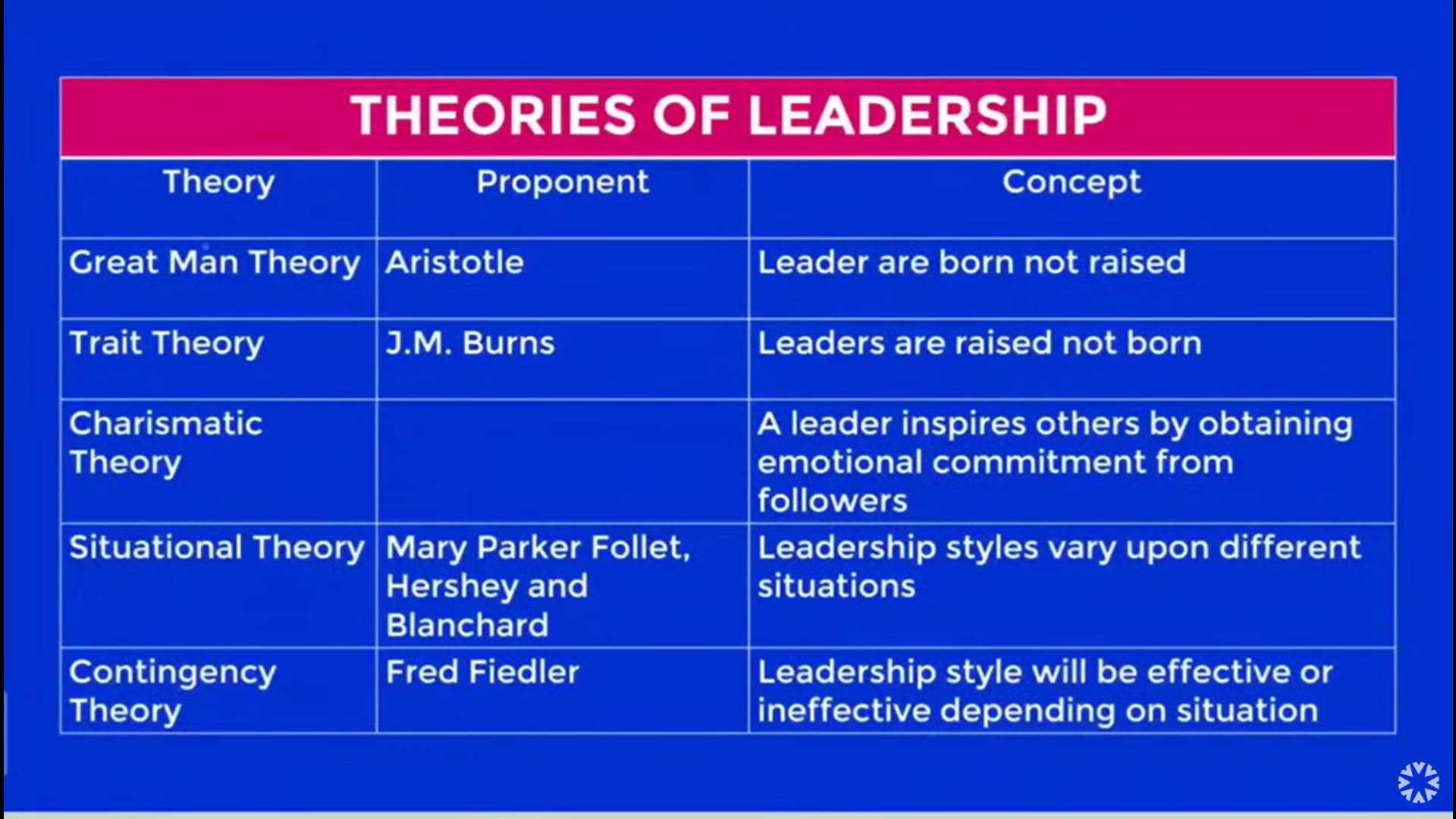
Trait theories suggest that leaders are born with certain inherent traits that make them effective. People are "natural born leaders."
ii. Behavioral Theories
Behavioral theories focus on the actions and behaviors of leaders rather than their traits. According to these theories, leadership can be learned and developed through the observation of successful leaders' behaviors.
Situational and Contingency Leadership Theories: These theories propose that the effectiveness of leadership depends on the situation. The most effective leaders adapt their style based on the context and the needs of their followers.
Interactional Leadership: Interactional leadership emphasizes the dynamic interaction between the leader and followers, considering how their personalities, behaviors, and situations influence each other.
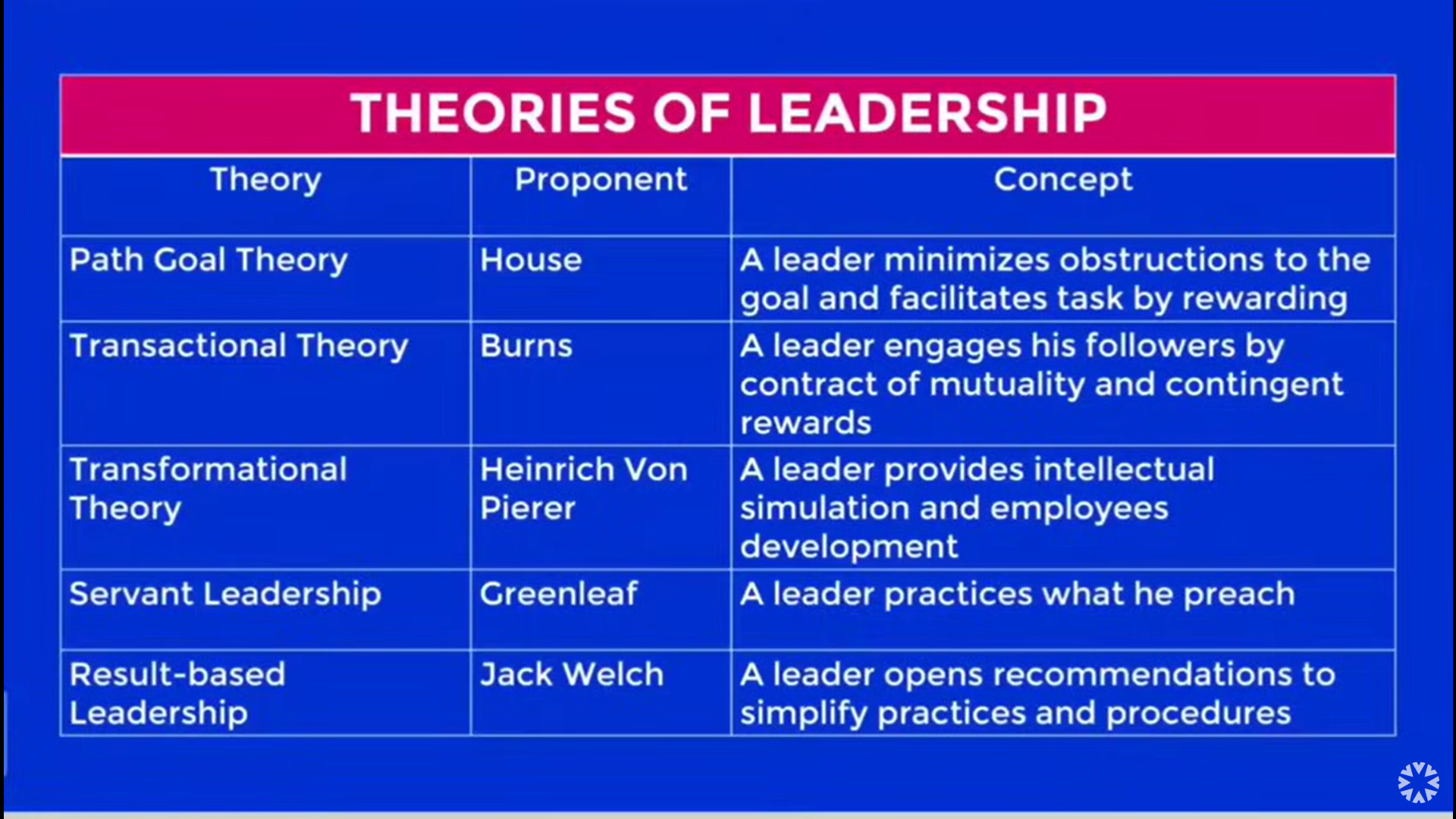
Transactional Leadership: Transactional leaders focus on exchanges between the leader and followers, such as rewards for achieving targets. This style is effective in maintaining the status quo and achieving short-term goals.
Transformational Leadership: Transformational leaders inspire and motivate followers to exceed their own self-interests for the good of the organization. They are change agents who foster innovation and creativity.
iii. Contemporary Theories
Servant Leadership: Servant leadership focuses on serving others and placing the needs of followers above the leader's own needs. This approach fosters a supportive and inclusive environment.
Quantum Leadership: Quantum leadership draws on principles from quantum theory to emphasize flexibility, adaptability, and collaboration in a rapidly changing and complex environment.
Relational Leadership: Relational leadership centers on the importance of relationships in the leadership process, focusing on building trust, respect, and collaboration among team members.
Shared Leadership: Shared leadership involves distributing leadership responsibilities among team members, promoting a more collaborative and democratic approach to decision-making.
Definition of Management
Management in nursing is the process of planning, organizing, leading, and controlling resources, including human resources, to achieve specific goals in the healthcare setting. It involves coordinating efforts, making strategic decisions, and ensuring that the nursing staff provides high quality care while maintaining efficiency and effectiveness in the healthcare environment.
Key Aspects of Nursing Management: (POLC)
Planning: Developing strategies and setting objectives for nursing teams and patient care.
Organizing: Structuring the nursing staff and resources to achieve the planned goals.
Leading: Motivating and guiding the nursing team to deliver optimal care.
Controlling: Monitoring performance and implementing corrective actions to ensure goals are met.
Controlling consists of five steps: (1) set standards, (2) measure performance, (3) compare performance to standards, (4) determine the reasons for deviations and then (5) take corrective action as needed.
Role of Managers
Nurse managers play a critical role in the healthcare system. Their responsibilities include:
Leadership and Supervision:
Providing guidance and direction to nursing staff.
Facilitating professional development and mentoring.
Ensuring effective communication and team collaboration.
Resource Management:
Allocating and managing resources, including staff, equipment, and supplies.
Budgeting and financial management to ensure cost-effective care.
Quality and Performance Improvement:
Monitoring and improving patient care quality.
Implementing best practices and evidence-based care protocols.
Addressing and resolving performance issues.
Policy and Compliance:
Ensuring adherence to healthcare regulations and standards.
Developing and enforcing policies and procedures.
Conflict Resolution:
Managing conflicts among staff members and between staff and patients.
Facilitating a positive work environment
Developing Future Managers
Succession Planning refers to the systematic process of transferring leadership responsibilities to another employee to ensure the seamless continuity of an organization's operations. Today, this concept has acquired importance in various industries, including healthcare, with a specific focus on nursing.
Five D’s of Succession Planning
Death
Disability
Divorce
Disagreement
Distress
Developing future managers in nursing involves several key strategies:
1. Education and Training:
Providing formal education in management and leadership through advanced degrees or certifications.
Offering workshops and training programs focused on management skills.
2. Mentorship and Coaching:
Pairing aspiring managers with experienced mentors.
Offering coaching to develop leadership competencies.
3. Professional Development:
Encouraging participation in professional organizations and conferences.
Supporting continuous learning and specialization in areas of interest.
4. Experience and Exposure:
Providing opportunities for shadowing and hands-on experience in managerial roles.
Allowing involvement in decision-making processes and leadership tasks.
5. Feedback and Evaluation:
Regularly assessing performance and providing constructive feedback.
Setting development goals and evaluating progress.
Management Theories
Understanding various management theories can enhance nursing management practices. Here are some foundational theories:
1. Classical Management Theories: Managerial>Broad>Specific
(DADWSRCsOESIE)
HENRI FAYOL (Administrative Management): Emphasizes the importance of managerial functions and principles, such as planning, organizing, commanding/leading, coordinating, and controlling. [Managerial approach]
Principles according to the Father of Modern Management Theory:
Division of labor/work - (single leading function) delegation of tasks
Authority and responsibility
Discipline - a mean obedience, respect for authority, and observance of established rules.
Unity of command - (report to only one supervisor) an individual employee should receive orders from only one superior at a time.
Unity of direction - (have one goal) having one goal or one objective for the team to pursue
Subordination of Individual Interest - This indicates a company should work unitedly towards the interest of a company rather than personal interest.
Remuneration - monetary or nonmonetary
Centralization - the authority responsible for the decision-making process should be neutral. With use of decentralized communication, flows from all direction.
Scalar chain - is the formal line of authority that moves from highest to lowest rank in a straight line. Must know who to communicate.
Order - the right person should be placed at the right job and the right thing should be placed at the right place. “Right person, Right place”
Material Order for Physical Resources
Social Order for Human Resources.
Equity - All employees should be treated equally and respectfully.
Stability of Tenure of Personnel - An employee delivers the best if they feel secure in their job. (e.g. 80% max personnel in private)
Initiative - The management should support and encourage the employees to take initiatives in an organization
Esprit de corps - managers should create and foster among their employees the morale, common spirit, sense of identification, feeling of pride, loyalty, devotion, honor, solidarity, unity, and cohesiveness with respect to their organization or organizational department.
MAX WEBER (Bureaucracy Management): A “legal-rational“ approach that advocates for a structured hierarchy and clear rules to ensure organizational efficiency and accountability. [Broad approach]
FREDERICK TARLOY (Scientific Management): Remember to use machinery in the hospital. Focuses on improving efficiency through scientific analysis of work tasks and standardization. He popularized time and motion studies. [Specific approach]
2. Human Relations Theories:
ELTON MAYO (Hawthorne Effect): Highlights the impact of social factors and employee morale on productivity and performance.
The Hawthorne studies began in 1927 where Mayo tried changing the environment and realized that improving lighting increases productivity. When turning the lights off, the production increased even more. These people were aware that they are being studied and the attention made them feel important which resulted in a better output. The Hawthorne effect proved social interactions and recognition improve productivity than by mere environmental conditions.
DOUGLAS MCGREGOR (Theory X and Theory Y): Differentiates between managerial assumptions of employees' motivations.
Theory X manager thinks everyone is lazy so then being more authoritarian
Theory Y manager is being more participative, allows members in happy decision making.
3. Contingency Theories:
PAUL HERSEY AND KEN BLANCHARD (Situational Leadership): Suggests that leadership styles should be adapted based on the situation and the readiness of the team.
ROBERT HOUSE (Path-Goal Theory): Focuses on how leaders can help followers achieve goals by providing the necessary support and guidance.
4. Transformational and Transactional Leadership:
Transformational Leadership: Encourages innovation and change by inspiring and motivating staff to exceed their own self-interests for the sake of the organization.
Transactional Leadership: Focuses on routine and established procedures, with an emphasis on performance-based rewards and punishments.
5. Systems Theory: (Metaphor of living biological organism)
BERTALANFFY AND MILLER (Systems Theory): Views the organization as an interconnected system of parts, where changes in one part affect the whole system. It emphasizes the importance of understanding and managing these interactions.
Open - Applies input>process>output
Holism - viewed as a whole and not pieces
Interdependence
Made up of subsystems
Feedbacks
Entropy/Balance
Extra notes
A. Leadership Styles
Authoritative - directive, only leader decides, “boss”, not ideal in every day but ideal in emergencies. Other terms: Dictatorial/Bureaucratic/Traditional
Democratic - everyone has the right but with slow decision making process. Other term: Participative
Laissez fare - leader is “lazy“ and lets the team decide
Charismatic - possesses inspirational quality that makes followers get attracted to him and regard him with reverence.
Transactional - actions are based on transactions, perhaps rewards & punishment. “if you, then I”
B. Management Styles
Country club management - characterized by a high concern for people and a low concern for production
Team management - characterized by a high concern for people and also a high concern for production
IDEAL:
Transformational - teamwork and shared decision making, the leader is strong. “Let’s change the environment where every team member feels valued and empowered to contribute to patient care.”
C. Conflict Management
Types of conflict
Intrapersonal - Man vs himself
Interpersonal - conflict between two people or groups (ER vs ICU)
Stages of conflict
Latent stage - Conflict is present but not yet apparent.
Perceived stage - Conflict is recognized, but not yet acted upon.
Felt stage - Emotional responses (anxiety) to the conflict become apparent.
Manifest stage - The conflict is openly expressed, leading to confrontation or resolution.
Aftermath stage - The effects of the conflict are felt, with potential for resolution or further issues.
Conflict management strategies
Avoidance - avoiding conflict
Accommodating - one party gives in and allows other party to win
Compromising - lose lose situation. Both parties are not satisfied
Competing - one wins and one loses
Smoothing - compliments other side but not gonna resolve conflict
Withdrawing
Forcing
IDEAL:
Collaborating - mutual problem-solving approach where both parties work together to find a common goal
D. Delegation
Five rights of delegation
Task - focuses on task that may be delegated. e.g. Paramedics can do things outside the hospital and ER works inside the hospital. The scope of their tasks differentiate with each other.
Circumstance - situational based, e.g. if patient is cyanotic and diaphoretic, registered nurse is the only person to do it, no delegation of that task in that circumstance
Person - e.g. oral meds must be administered by a registered nurse, but it can be given to the right person like Licensed Practical Nurse (LPN)
Direction - Leadership must provide clear guidance on the delegation of tasks to ensure patient safety and effective care delivery. e.g. clearly explaining how you need the task to be completed to the LPN
Supervision - the RN is responsible for evaluating the outcome of the task. “was it done or not done?”
Delegating between personnel
Unlicensed (CNA)
Patient personal care e.g. bathing, dressing, grooming, feeding (except under swallowing precautions) and assisting with mobility and activities of daily living.
CPR (if trained)
Fall prevention
Ambulation
Routine vital signs
Charting I&O
Licensed (LPN or LVN)
Medications
Enteral feeding
Invasive items like catheter, ET tube and enema
Wound care management
IV therapy administration depending on state laws
Only RNs can EAT
Evaluate, Assess, and Teach
Vision & Mission
A vision statement describes an organization's desired future state or aspirational long-term goal, essentially a dream of what it wants to achieve.
A mission statement, in contrast, explains the organization's present purpose, defining its core business, objectives, and how it plans to achieve its vision.
A goal is the main aim of the company.
Sample board questions
When dealing with tribal groups, what is the most critical skill a leader must possess? A: Proper communication skills
You can properly influence others through? A: Health teaching
What is the leadership style with freedom, without supervision and allows everyone to do what they want? A: Laissez faire
What leadership focuses on vision and growth? A: Transformational
What leadership is employee focused and relationship oriented? A: Servant
What leadership is flexible and can modify style based on needs? A: Situational leadership
Assessment of this is a reliable tool for predicting a manager’s potential. A: Personality traits
What reflects with “leaders are born and not made?” A: Great Man Theory
Which of the following styles best fits a situation when the followers are self-directed, experts, and are matured individuals? A: Laissez faire
What does not characterize a transactional leader? A: Vision
External forces are those changes that are part of an organization’s general and business environment. Low morale of staff which only affects the unit is an example of? A: Internal factor
What has a high concern for services and high concern for staff? A: Team management
Which of the following is true about functional nursing? A: focused on tasks and activities and not on the holistic care of the patients.
When the functional method is used, the _____ and sociological needs of the patients are neglected; the patients are regarded as ‘tasks to be done’ A: Psychological
What Is the First Rule of Management? A: Delegation (division of work or responsibilities)
TOPRANK NOTES
Leadership: Key word is “Influence”
May or may not have official appointment
As long as the followers are willing to follow
Empathetic manner
Risk taking and explore new ideas
Goal setting
Management: Key word is “Organize”
Must be appointed
Have the power to enforce decision
Relate to others according to rules
Carry out rules and regulations
Orderly, controlled equitable structure
Goal is to control the organization: Manpower and resources
Must have decision making and communicating skills
Levels of Management
Top - Chief or Director
Middle - Supervisor
Low - Head nurse/Team leaders
First - Staff nurse
Scheduling
Centralized - Schedule created by one person (usually chief nurse)
Decentralized - Schedule (per department) created by head nurse
Rotating work shift
RA 5901 promotes 40 hour work week law for gov and private hospital. If a nurse is working in a hospital with population of 1 million and the bed capacity is more than 100, they will work 40 hours per week (5 days). If the bed capacity has less than 100, they will work 48 hours per week (6 days).
AM - 45% of RNs
PM - 37% of RNs
Nocturnal - 18% of RNs
Cyclical Schedule - repeated every 4 to 6 weeks
Flex time - adjusted time in and time out
Unproductive time
Term used when planning to leave for vacation or using sick leave
50%-60%
of company operational cost must go to salary and benefits of the employees
Vertical Organizational Chart
Matagal ang process ng communication
Horizontal Organizational Chart
Madaling magawa ang communication
Horizontal communication ex. end of shift communication
Note
Unity of direction cannot be found in the organizational structure
Staffing
Requirement - enlisting of personnel
Selection - evaluating and choosing
Indoctrination - induction or including you in the payroll
Training and development
Transfer and separation
Documents for staff nurse position
Certificate of previous employment
Membership to an accredited professional organization
Professional Identification card
NOT: Related Learning Experience
RA 10912
CPD law
Planning
Strategic Planning - long term goal
Operational Planning - day to day maintenance
Philosophy
Values and beliefs of organization. The “sense of purpose.”
Organizational Charts
Vertical
Horizontal (e.g. staff to staff)
Principles
Communication
Unity of Command
Span of control
Specialization
Communication Process
Idealization
Encoding
Transmission
Receiving
Decoding
Feedback
Nursing Care Delivery System
Case Method
Pros - total patient care
Cons - different nurse, shift, days
No consistency and non structured environment
Not for autistic and alzheimer’s patients
Functional System
Pros - efficiency
Cons - Nurses do managerial work and aides to patient care
Tasks are divided
Cost effective care
Team Nursing
Pros - Team effort
Frees patient care coordinator to manage the unit
Use of Nursing Care Plan (NCP) as form of communication
Cons - Time needed to coordinate delegate work
Nurses are divided into groups
Primary Nursing
Pros - RNs give total patient care
Primary nurse has 24 hour responsibility
Accountability
Cons - Confinement nurses talent is limited to the patient
From admission to discharge
Types of Power
Reward power
Punishment or coercive power
Information power
Legitimate power - given by virtue of position
Expert power - more than 5 years of experience
Referent power - “idol”
Delegation
Sharing of responsibility
Not “transfer” of responsibility
You are still accountable even if you delegate
Supervision
Evaluation/Reevaluation is a continuous process and must be private between members
Structured: with checklist
Unstructured: without checklist
Quality Assurance
Process of establishing standard of excellence of intervention and ensuring that each patient receives the expected level of care
Framework of quality assurance
Structure - personnel, supplies, etc.
Process - what and how services are delivered
Outcome - results expected
Benchmarking
Process of comparing performance of company against the standards of the best performing organization
TQM
Also known as CQI or continuous quality improvement
Total quality management is a tool for improvement
Focus in customers needs not the management
Mission
Describes what the organization will provide
Philosophy
Sense of purpose