4. Finite/Non-finite
Finite verbs
can stand on their own as main verb
have tense
have person
can be singular/plural
Non-finite verbs
cannot be main verb
no tense/person/number
→ Gerunds, Participles and Infinitives
Finite clause contains
finite verb
subject that agrees with verb
can be main or subordinate clause in sentence
Non-finite clause
non-finite verb as main verb
may (often does not)contain subject
only subordinate clause
3 types of subordinate clauses, all 3 can be finite/non-finite
adjectival clauses modify noun
adverbial clauses modify verbs/other clauses
noun clauses act like nouns
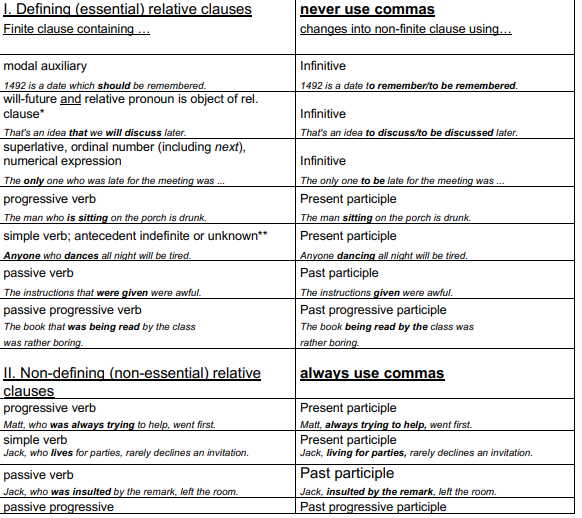
Adjectival clauses
finite adjectival clauses: relative clauses
non-finite constructions: abbreviations, often used by native speakers
Adverbial clauses
Of time
→ after, as, as soon as, before, by the time, every time, now (that). once, since, the moment (that), until, when, whenever, while
Comma only if subordinate clause first
→ Non-finite clause: Participle -ing form (if sequence needs to be clear having + part)
Of reason
→ as, beacuse, inasmuch as, insofar as, in that, (just) in case, seeing that, since
Non-finite clause: Participle -ing form
of result
→ in such a way as to, in such a way that, or else, so (...) as to, so (that), so/such… that
(no comma before in such a way, so as to, comma before or else, sp that, such that)
Non finite clause: so + adjective + as to + verb
of purpose
→ for fear that, in order that, in order to, lest, so as to, so that
Non-finite clause: to-infinitive, in order to, so as to
of concession
→ although, even if, even though, no matter, though, whatever, whenever, wherever, while, adj./adv./verb + as
Non-finite clause: Despite/in spite of + gerund
Being generally avoided in non-finite cluases, but 3 instances when used
meaning because
after preposition
to transform passive progressive
Noun clauses
Types:
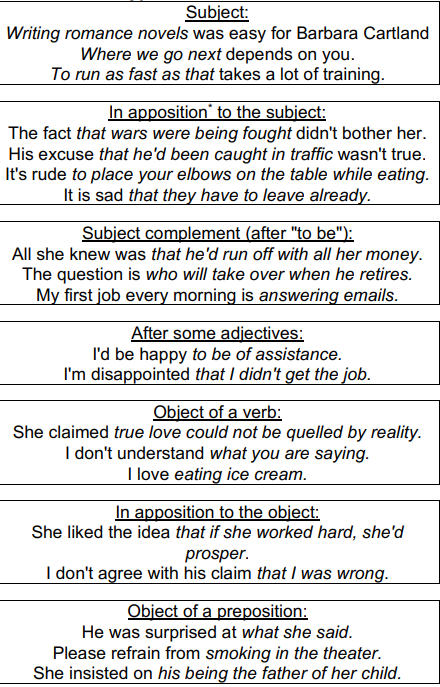
Noun clause transformation to non-finite
General rules:
no commas
infinitives clauses containing will/would/should
other finite verbs: gerund adding preposition if necessary
Special cases
noun clauses in apposition beginning with it is/was → move noun clause to beginning to replace “it”
delete phrase “the fact that”
constructions with “to be” two ways
appropriate preposition + gerund
to-infinitive
certain verbs (think, feel, believe, imagine, understand, …) followed by clause containing “be”/”have” → non-finite construction: noun + to be/have
Difference Adjectival Clause/Noun clause
adjectival clause describes noun
noun clause same thing as noun
which instead of that only possible in adjectival clauses