Economics C.2 - The Economics Concepts of Scarcity and Choice A
The concepts of scarcity, choice and opportunity cost
‘Scarcity and Opportunity Cost (You Will Love Economics)’ YT
Economics – the study of how finite resources are allocated to satisfy wants and needs
Scarcity – the fundamental economic problem of having seemingly unlimited human wants and needs in a world of limited resources
The term ‘scare resource’ refers to the limited supply of factors of production and the unlimited demand for them, that is to say the quantity of goods and services people like to have exceeds the amount which the economy’s resources are capable of producing.
Opportunity cost – the best alternative foregone when a choice is made
Choices that involve an opportunity cost applies to governments, firms, and individuals alike.
The role of incentives in motivating behaviour
Incentive – something that motivates an individual or firm to behave in a certain way
Regulation – a law, rule or order that must be followed. A violation of the regulation results in a punishment
Governments prefer to use incentives to influence consumer and producer behaviour. Enforcing punishments for breaches of regulations results in a drain on scarce resources.
Specialisation
Specialisation of labour/division of labour – the seperation of a work process into a number of tasks, with each task carried out by a seperate worker or group of workers
Adam Smith is the economist associated with the concept of the specialisation of labour. In An Inquiry into the Nature and Causes of the Wealth of Nations, gives the example of a pin factory. He suggested that of each worker were to specialise in just one task, each individual worker would be more productive and efficient in their assigned task.
Advantages of specialisation | Disadvantages of specialisation |
Workers become more efficient, meaning that each unit can be produced at a lower cost per unit. Additionally, no time is wasted is wasted due to workers switching between tasks. | For a worker, specialising in one task all day can become repetitive and boring. Staff morale and motivation can fall, which can lead to workers becoming less productive. |
Workers are more productive as they get better, faster and more efficient at their assigned task. Total ouput is higher, as are profits. | Allows for little chance of career progression as no new skills are being developed. |
Training costs for the employers are lower as the individual workers only need to be able to carry out a narrow range of tasks. | Workers may struggle to find alternative employment in the future due to a narrow range of skills. |
Demand, supply and markets
Law of Demand – the inverse(negative) relationship between price and quantity demanded
Law of Supply – the positive relationship between price and quantity supplied
Market – a place where buyers and sellers come together, and where the interaction of demand and supply occurs to determine a price
Cost-benefit analysis
Cost-benefit analysis – an evaluation of all the costs and benefits of various options in order to make the most optimal decision
Financial costs – the monetary expenditures and sacrifices required to implement a decision
External costs – indirect, unintended expenses or negative impacts imposed on third parties who are not directly involved in the trasaction or project
External benefits – the indirect, positive effects of a project, policy or business decision on third parties who are not directly involved in the transaction
Future projected costs and benefits – the estimated expenses and expected returns of a proposed project, decision, or investment over a specific future timeframe
Net cost – the costs outweigh the benefits, therefore generally the project does not proceed
Net benefit – the benfits outweigh the costs, therefore generally the project is more likely to proceed
Microeconomics vs macroeconomics
Microeconomics – analyses the behaviour/decisions of indiviuals and firms
Macroeconomics – studies the behaviour/decisions of governments and countries, i.e. it looks at the economy as a whole
Production possibility frontier
Production possibility frontier – an economic model used to show the capacity of the economy or firm to produce goods and services with the scarce resouces that are available
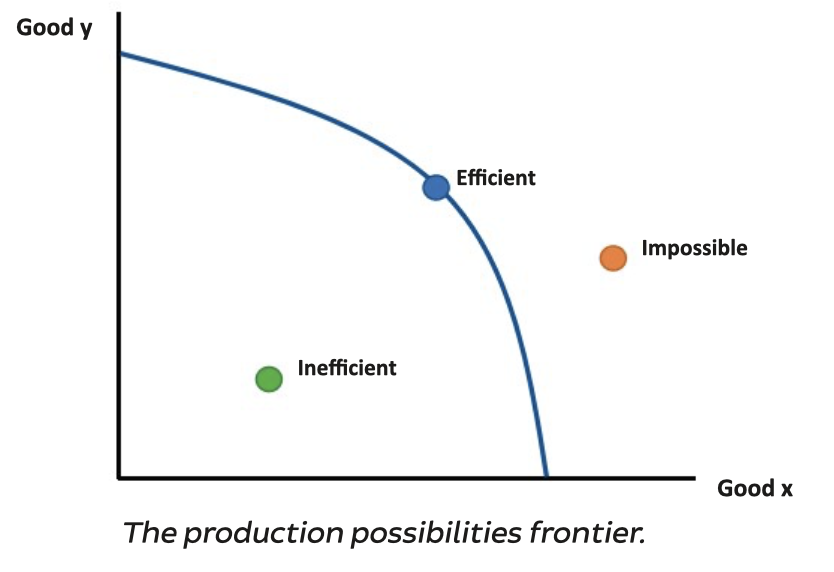
It is assumed two goods can be produced: one on the x-axis and one on the y-axis. The curve itself is a series of points that are joined to form a curve. These points represent combinations of both goods that could potentially be produced with the scarce resources available assuming these are fully and efficiently used. A movement along the curve indicates that an opportunity cost is incurred.
Any point that is inside/to the left can be produced, however resources are being underutilised and not used efficiently. Any point to the right of the curve cannot be produced as the economy/firm does not have the capacity.
The curve can shift to the left if there is a disruption to the supply of resources. The curve can shift to the right if the resource supply increases.