In Lab
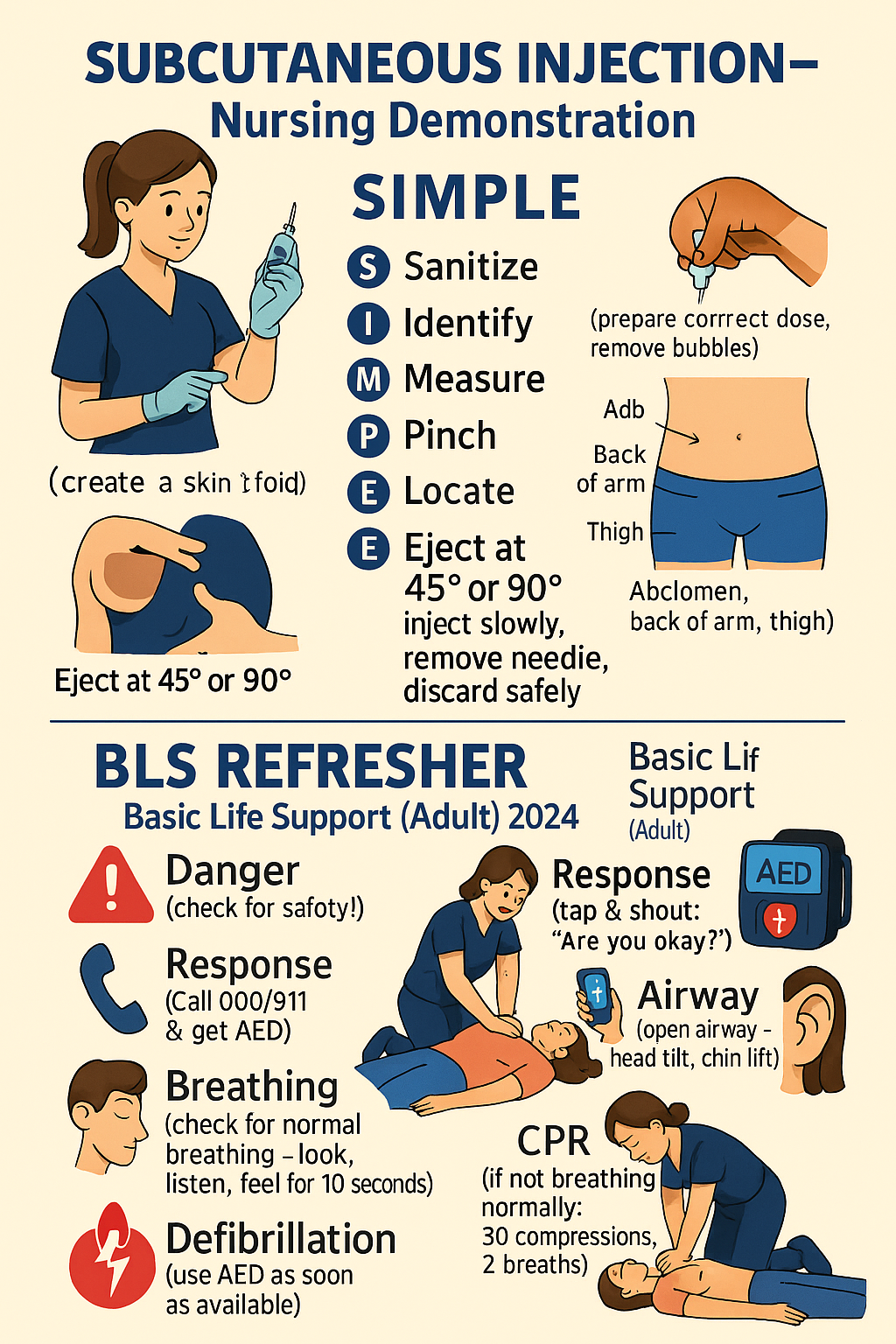
💉 Subcutaneous (SC) Injection – Nursing Demonstration
Mnemonic: "SIMPLE"
S - Sanitize (hand hygiene + gloves)
I - Identify (patient, medication, dose, site)
M - Measure (prepare correct dose, remove bubbles)
P - Pinch the skin (create a skin fold)
L - Locate site (abdomen, back of arm, thigh)
E - Eject at 45° or 90°, inject slowly, remove needle, discard safely
Subcutaneous Injection Quick Steps:
Hand hygiene and check 6 Rights of medication.
Choose injection site (rotate to prevent tissue damage).
Clean site with alcohol swab (let dry).
Pinch 2.5 cm of skin (especially for thinner patients).
Insert the needle:
45° angle if thin skin
90° angle if more fatty tissue
Inject medication slowly.
Withdraw needle quickly and safely.
Apply light pressure with cotton ball (no massaging!).
Discard needle in sharps container immediately.
🩺 BLS Refresher – Basic Life Support (Adult) 2024
Mnemonic: "DRS ABCD" (especially in Australia and many global BLS protocols)
D – Danger (check for safety!)
R – Response (tap & shout: "Are you okay?")
S – Send for help (Call 000/911 & get AED)
A – Airway (open airway – head tilt, chin lift)
B – Breathing (check for normal breathing – look, listen, feel for 10 seconds)
C – CPR (if not breathing normally: 30 compressions, 2 breaths)
D – Defibrillation (use AED as soon as available)
CPR Quick Rules:
Step | Action | Notes |
|---|---|---|
Chest compressions | 100–120 per minute | Depth: at least 5 cm but not more than 6 cm |
Airway | Open properly | Head tilt-chin lift |
Breathing | Give 2 rescue breaths | Ensure visible chest rise |
Defibrillation | Use AED ASAP | Follow voice prompts |
Mnemonic to remember compression rate:
🧠 "Stayin' Alive" by the Bee Gees – (100–120 beats/min = perfect rhythm!)
🎯 Quick Visual for Both Topics:
Subcutaneous Injection | BLS Steps |
|---|---|
Sanitize, Identify, Pinch, Inject at 45–90°, Dispose Safely | Danger, Response, Send for help, Airway, Breathing, CPR, Defibrillate Identify the emergency situation, initiate the appropriate response, and monitor the patient for any changes in their condition. |